The Wrong Copy of a Roman Ruin
The Forum was painted. Nobody told Thomas Jefferson.
I enter the Roman Forum through the Arch of Constantine, white gravel crunching under my shoes as I descend into the ancient world.
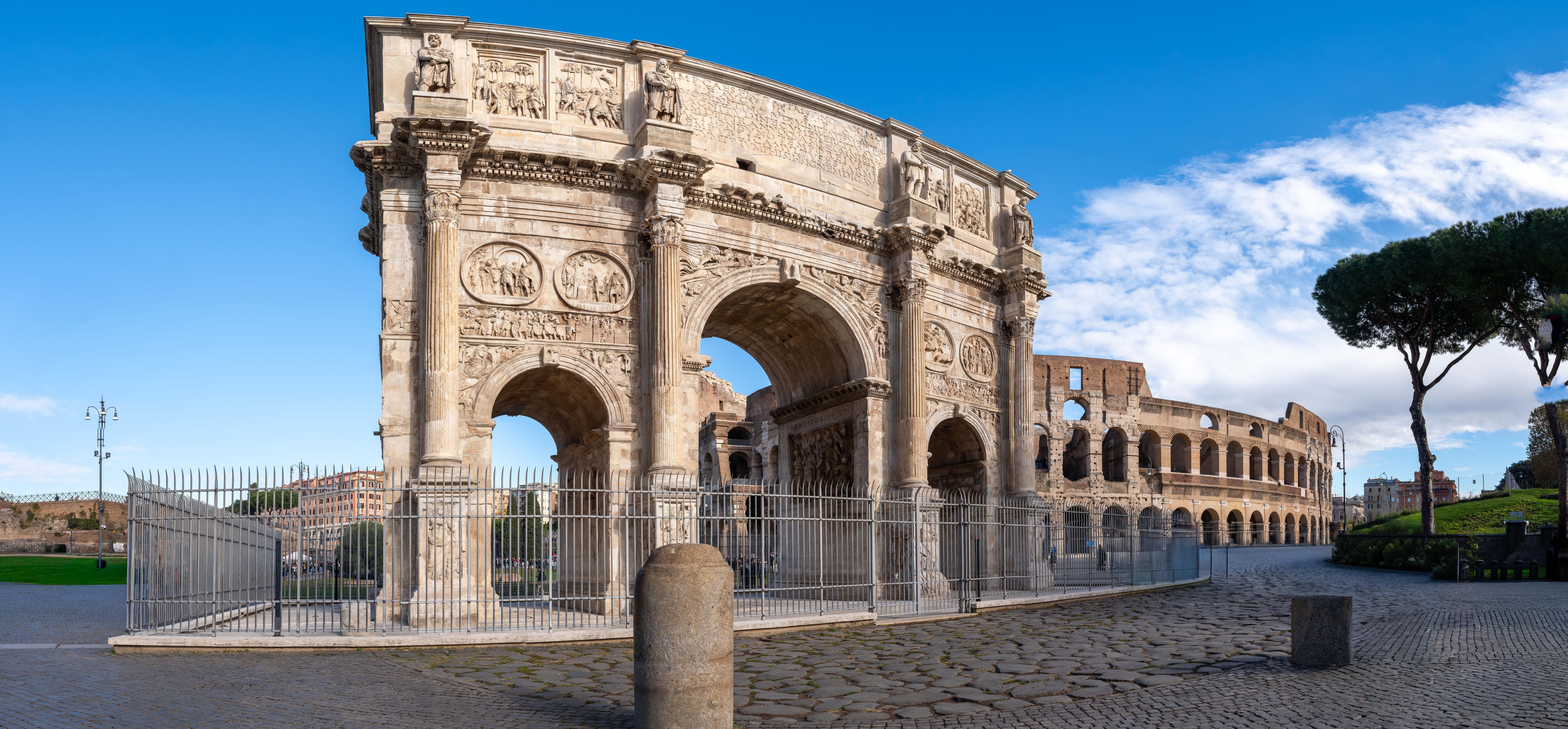
The ruins - well below modern street level - stretch before me, magnificent white and gray marble, glowing in the sinking afternoon sun. Tourists drift past. I stop.
A woman passes on my right and leaves behind a trace of Italian perfume, something floral and warm.
I think about what this place smelled like two thousand years ago.

Not perfume. Garum — fermented fish sauce poured over nearly everything, sharp and briny and inescapable. Roasting meats. Lentils simmering in clay pots. Frankincense drifting from the temple doors. And underneath all of it, the smell of horses and cattle and the manure ground into the stones by thousands of feet and cart wheels every day.
It was not a quiet or delicate place. Men were executed within sight of these temples. The Tarpeian Rock sits just above where I’m standing now — criminals were thrown from it onto the stones below.
I look up at the ruins, and the question comes to me the same way it always does here.
Why do we think these buildings were white?
The answer is that we were wrong for a long time, and in some ways we still are.
What we know now is that the Roman Forum was not a place of white and gray stone. The temples and public buildings were painted. Reds. Blues. Greens. Yellows. Color was everywhere, applied deliberately, meant to be seen from across a crowded square.
Then the centuries performed their relentless work.
Sunlight bleaches pigment slowly and without mercy. Rain pulls it off in layers, season after season, decade after decade. The binders — wax, egg tempera, the organic materials that held color to stone — broke down and washed away long before anyone thought to look for them. What remained was the marble underneath. Hard, pale, indifferent to time. The bones of the buildings survived. The skin didn’t.
By the time Renaissance artists and scholars began studying these ruins in the 14th and 15th centuries, the color was almost entirely gone. What they saw was white marble. And here’s the part that’s hard to believe: they didn’t think the color had disappeared. They thought the white marble was the point.
The brilliant Greeks and Romans, whose achievements in philosophy and politics they revered, had surely chosen to leave their marble bare — pure form, pure intellect, no need for decoration. Painting sculpture was something less refined minds did. Medieval minds.
The white marble wasn’t a stripped ruin. It was, they decided, a statement of genius.
So Michelangelo carved in unpainted white marble. Renaissance architects built in unpainted white stone. And the aesthetic they established — monochrome and severe — became the definition of the classical ideal for centuries to come.
Making some of the original colors had been anything but austere.
Blue didn’t exist in nature in a form you could just apply to a wall. Roman craftsmen made it by heating sand, crushed copper, limestone, and soda in high-temperature kilns — pushing the furnace to nearly a thousand degrees, feeding wood and charcoal into the fire, and standing close enough to feel the heat scald their skin.
What came out was hard and brittle. They broke it apart with hammers and ground it down by hand until it became a fine powder. Egyptian blue. It stained workers’ hands for days afterward.
If you saw blue on a building in Rome, someone had worked hard for it. It meant wealth. It meant intention.
Today, we can actually see what’s left of that intention, even when the eye can’t. Ultraviolet light and multispectral imaging — technologies that detect light far beyond what we can see — can detect traces of pigment still clinging to marble surfaces after two thousand years. Microscopic flecks of Egyptian blue. Traces of red ochre. The color is mostly gone, but it left fingerprints.
The Renaissance had none of that. What they had were beautiful white ruins, and a theory to explain them.
Here’s where it gets interesting.
Thomas Jefferson visited France in the 1780s as American minister and saw the ruins of the classical world with his own eyes. He was obsessed with architecture — self-taught, working from the Italian architect Palladio’s books.
When he stood before the Maison Carrée, a well-preserved Roman temple in the south of France, he knew exactly what he wanted to do with it. He used it as the model for the Virginia State Capitol.
Later, as Secretary of State, he worked on the design of Washington, D.C., itself, pushing for a capital that projected the weight of antiquity. He sketched a design for the U.S. Capitol based on the Roman Pantheon.
What he saw when he looked at those ruins was what everyone saw — white stone, gray columns, clean marble lines. Magnificent and permanent.
Nobody in the 1780s knew the buildings had been painted.
The style spread fast. By the mid-1800s, Greek and Roman Revival architecture was everywhere in America — courthouses, banks, state capitols, plantation houses.
Builders were putting up white columns everywhere from Philadelphia to Tennessee. It became so closely associated with the young country that people called it the National Style.
All of it was built from the same source material: bleached ruins that a previous century had decided were pristine on purpose.
So here’s the irony I keep turning over as I stand in the Forum.
Washington, D.C., looks like ancient Rome. The Lincoln Memorial looks like a Greek temple. The Supreme Court looks like the Parthenon.
But ancient Rome didn’t look like ancient Rome. Not the version we copied.
America built a copy of a ruin, and the ruin was already missing half of what made it real. And the people who handed it to us thought the missing half was never there to begin with.
I walk further into the Forum past tourists with strollers.
Somewhere nearby, a child is eating gelato, and the smell of it — something with strawberry, sweet and cold — drifts past me for a second, and then it’s gone.
I look back up at the white-and-gray marble glowing in the afternoon sun.
It’s a beautiful sight. And somewhere in the last two thousand years, between the rain and the sun and the Renaissance and Thomas Jefferson, a string of entirely reasonable decisions added up to something that was never quite real. Artists copied what they saw. Architects copied the artists. A new nation copied the architects, and nobody along the way thought to question what had been lost.
The Forum looks exactly the way it’s supposed to look.
It just never looked this way before.
Explore more details of history that few know. We cover them weekly. Subscribe today for free.


Ancient world had more colors, therefore was more beautiful