

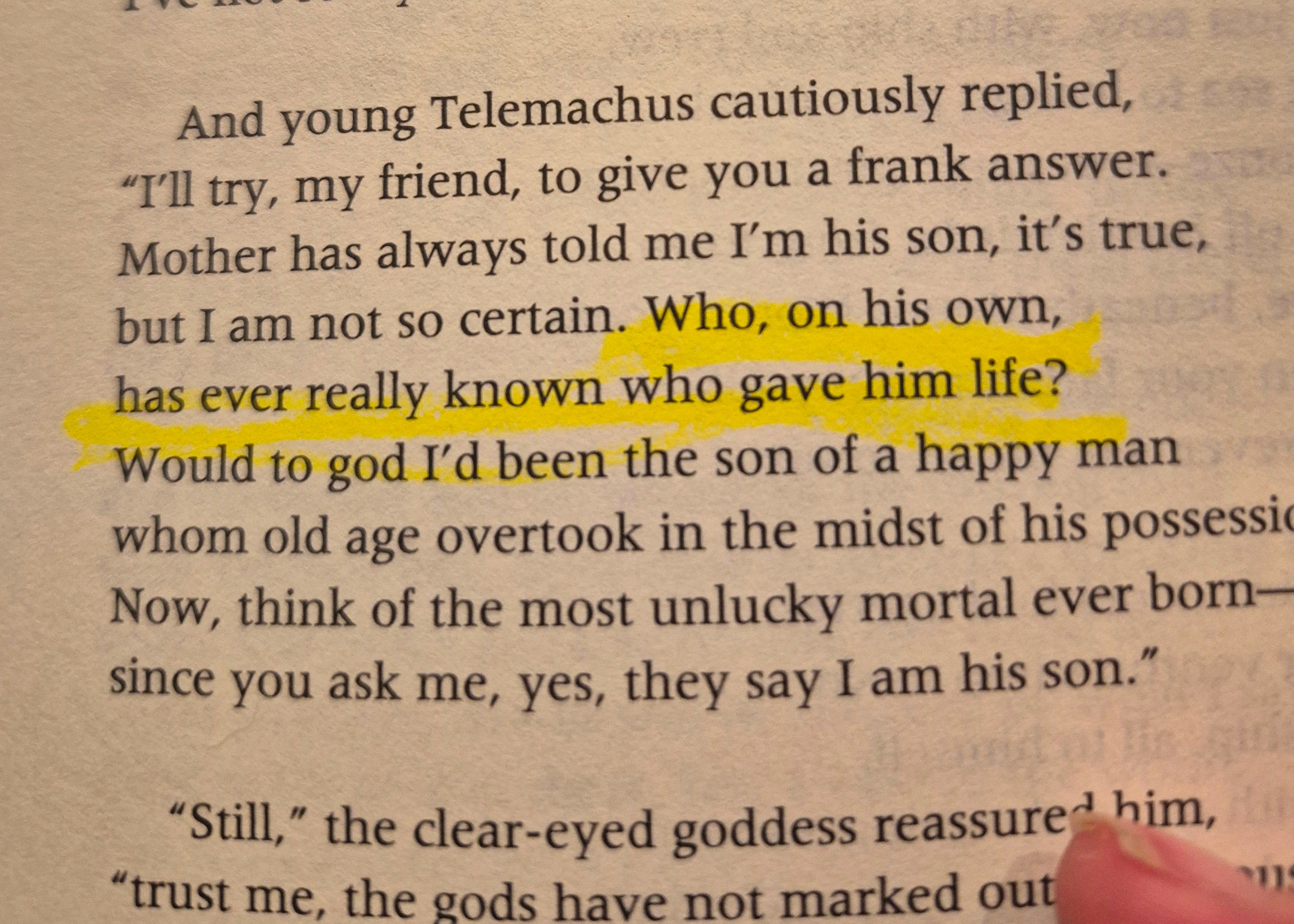
Telemachus doesn't know if his father is really his father. This isn't a metaphor. His answer in Book 1 of The Odyssey reads
“Who, on his own, has ever really known who gave him life?”
Homer, in Robert Fagles’s translation, wrote that line about 2,800 years ago. It’s still perhaps the most honest thing a kid can say about a parent.
A Roman father held a power that made the question irrelevant. The law gave him the final word on who counted as his child.
Modern fathers take DNA tests. Roman fathers made legal decisions.

Ten years ago, I bought my dad, Joe, a sign for the garage at our cottage in Canada. It still hangs there. “Dad’s Workshop. Dad can always fix it.”
Today is his birthday week and Father’s Day in the same breath, which happens most years, and I’ll call him from another state like I do every year. The sign says something the call can’t. My dad fixes and builds things. The boat motor, the dock, cabinets, whatever broke this summer. That’s the whole tribute.
Dad can always fix it.
In ancient Rome, patria potestas extended far beyond boat motors.
The Father Who Decided If You Lived
Patria potestas meant a Roman father held legal authority over his children for as long as he was alive, no matter how old they got. A forty-year-old son with his own house and his own career still belonged, in the eyes of Roman law, to his father. No birthday ended it. Death did.
A Roman son could become a senator, command legions, and grow old waiting for his father to stop being his father.
The power started at birth. A Roman father could look at a newborn and decide whether the household kept it. Jurists called this ius vitae necisque, the right of life and death. Roman sources credit fathers with exercising it.
It went further. A father could sell his children. Roman law eventually limited this, oddly, by capping it: sell the same child into slavery three times, and the bond finally broke. Until then, his children’s earnings belonged to him. His children’s marriages required his approval. His children’s punishments were his to set.
Roman adulthood arrived when your father died.
We talk about helicopter parenting like it’s a modern affliction. Rome had a father who legally owned the kid, the kid’s paycheck, and the kid’s marriage license.
The helicopter parent eventually lands. Patria potestas never did.
The Father Who Sent You Away
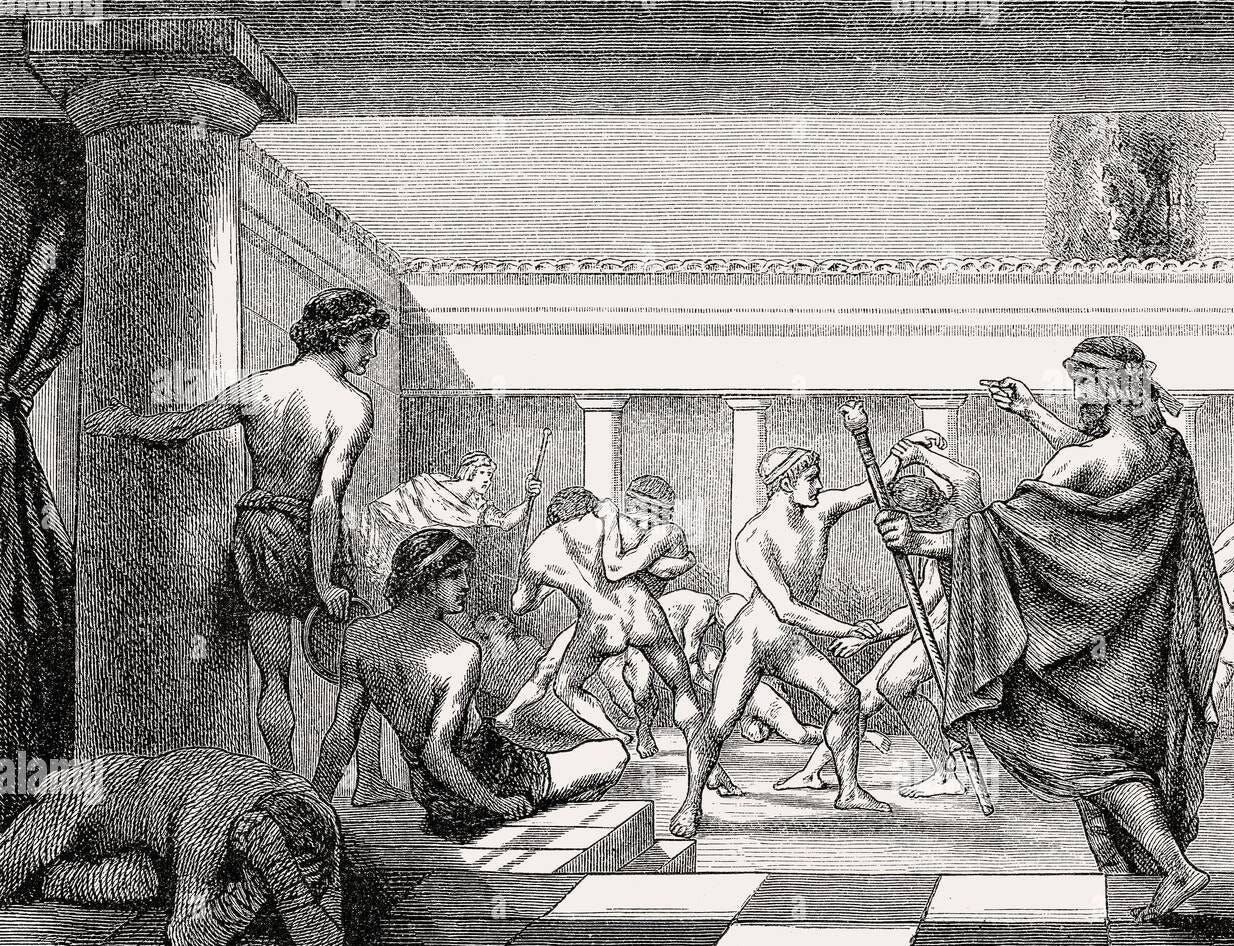
Athens ran a different model. It was distance instead of ownership.
A wealthy Athenian father rarely raised his own son day to day. He paid a paidagogos, a household slave, to walk the boy to and from school. He hired a grammatistes to teach letters and a paidotribes to teach wrestling.
Homer got recited at home, not as a bedtime story but as moral instruction, because a Greek father’s real curriculum was what kind of citizen his son would become in public.
The city raised the man, and the father chose the teachers.
Sparta pushed the same idea to its logical extreme. At seven, a Spartan boy left his father’s house for the agoge, the state’s training program, where he learned to march, fight, and steal food to survive on deliberately thin rations. The state finished what the father started.
Sparta treated sons as future soldiers long before they became future men.
An Athenian father shaped his son mostly through what he expected, not what he did with his hands. A Spartan father handed his son to the state and trusted the result.
Neither one built a single cabinet.
History remembers the laws. Most sons remember who showed up.
What the Sign Says
Rome gave fathers absolute legal power and called it normal. Athens gave fathers distance and called it discipline. Somewhere in the last two thousand years, fatherhood lost its legal teeth and grew a new set of expectations nobody voted on.
Nobody expects a father to own his children anymore. They expect him to answer when the phone rings.
My dad never had patria potestas over me. He never sent me to a paidagogos or an agoge. What he had was a workshop and the conviction that whatever broke, he could fix.
The Romans would have called that a small thing. Most children don’t.
That’s a smaller claim than the Roman one. It’s also the one that’s still true. A father who can’t sell you into slavery still finds a way to be the most reliable person you know.
Telemachus opened the whole epic by admitting he couldn't be sure. Nobody who has stood in front of that garage has ever had to wonder about mine.
The sign is still nailed up outside that garage in Canada. Ten years of Ontario winters, and it hasn’t moved.
The Roman father could decide whether a child belonged to him.
The rest of us spend a lifetime proving that we do.
History shows every generation thought it was over. It never is. Also discussing the use of AI as a history writer. Followed by The Culturist — #2 in History.
Paterfamilias had the right of life or death over any member of his family in Republican Rome.
The contrast is great. Rome gave fathers power by law. Today, a father’s strength is often shown in quieter ways: answering the call, showing up, and being there when something breaks.