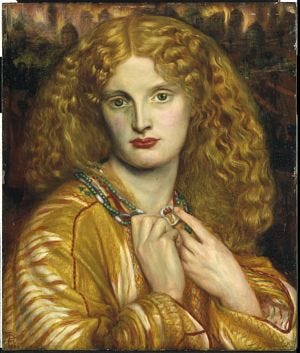
Aristotle Had Opinions About Skin Color. The Helen of Troy Debate Ignores Them
The casting debate escaped the internet. The history behind it is stranger than the argument.
Grabbed bananas and spinach on Monday night. Two women were arguing in the produce section about Helen of Troy.
Helen. Not the upcoming movie.
Whether Helen should be Black. Whether it even mattered.
Once people in my grocery store start arguing about Bronze Age Greece beside the avocados, the story has broken containment.
Christopher Nolan’s Odyssey trailer had already crossed 28 million views by then. YouTube jammed with angry thumbnails and red circles around Lupita Nyong’o’s face. One tweet about the controversy pulled 4.6 million views in a single day.

Culture Explorer, one of the sharpest history writers on X, said it well:
“Modern Hollywood treats inheritance like raw material for contemporary moral messaging. Then people who object get mocked for caring about the inheritance itself.”
He’s right. But Aristotle wrote something about skin color that neither side is reckoning with, and it complicates both arguments.
Hollywood earned some of the backlash.
Studios spent almost a decade making the same casting move in the same direction. The brain needs about three repetitions to recognize a pattern. After fifteen, it stops feeling like artistic freedom. It feels like policy.
Being told you’re imagining it is what turned annoyance into anger.
At the same time, Helen of Troy turns out to be a strange hill to die on.
Because Helen wasn’t real.
Helen Wasn’t Real. Her World Was.
Homer calls her “white-armed.” Sappho describes her hair as xanthe, that pale golden shade the Greeks associated with beauty and status. In Bronze Age Greece, pale skin mattered because it meant a woman lived indoors, away from fields and heat. Soft hands and covered skin meant a life without sunburn and work.
But Homer constantly gives the same description to Hera and other noble women. These were oral-poetry formulas, repeated by memory across generations, moving from singer to singer long before they touched parchment.
They weren’t eyewitness descriptions.
The archaeology from Helen’s world is more concrete than the poetry. A 2017 Nature study looked at DNA from Minoan and Mycenaean remains tied to Bronze Age Greece and Anatolia, the world the Trojan War stories came from. Most ancestry traced back to Anatolian farmers, with additional ancestry from the Caucasus and Iran. Dark hair and olive skin probably dominated.
The bones and the poems point roughly in the same direction.
Helen wasn’t real, but the world that invented her was.
Memnon Got Immortality. He Still Wasn’t Greek.
The Greeks knew Black Africans well. Attic vase painters documented them in black-figure and red-figure pottery from roughly 550 to 400 BCE — African boxers at Greek games, soldiers in battle, faces on drinking vessels. The Boston Museum of Fine Arts has several.
Herodotus describes Ethiopian soldiers fighting in Xerxes’ Persian army during the invasion of Greece in 480 BCE, the same campaign as Thermopylae. Greeks fought beside and against them at Plataea.
Memnon, king of Ethiopia, arrives at Troy after Hector dies. He nearly matches Achilles in battle before finally falling. Hesiod calls him king of the black Ethiopians. Later stories say the gods granted him immortality.
The Greeks could admire outsiders without pretending they were the same people.
Memnon’s whole role depends on where he comes from.
The Trojans and Greeks share one world. Memnon rides in from another. That geography is built directly into the story. Helen is Spartan, at the center of the Greek world. Memnon appears at its edge, arriving from somewhere the Greeks considered the edge of the known world.
His Africanness is the entire point of the character.
Aristotle wrote something that almost never appears in this debate. Very dark people were supposedly cowardly. Very pale people were cowardly too. Women and northern Europeans got grouped together there. Courage sat somewhere in the middle.
Conveniently Greek.
The Greeks didn’t ignore skin color. They ranked it, built a philosophy around it, and placed themselves at the ideal.
Greeks noticed difference constantly. They just organized it around different things than we do.
Civilizations Don’t Preserve Stories Casually
Some people say it’s myth. Relax.
Civilizations don’t spend three thousand years preserving stories they feel relaxed about.
Virgil built the Aeneid directly on Homer. Dante placed Homer among the great poets in the Inferno.
Then Joyce turned Ulysses into a line-by-line response to the Odyssey while sitting in Zurich cafes, pages stacked beside cold coffee cups. Cigarette smoke drifted toward the ceiling
Some medieval monk spent bitter winter nights copying Homer onto stretched animal skin by candlelight while snow piled against stone walls outside. He preserved it for people he could never imagine.
Eight hundred years later, somebody would scream about casting decisions through a cracked iPhone screen while DoorDash headlights rolled up outside.
The chain somehow never broke.
The Greeks didn’t treat these stories like disposable entertainment. They treated them as ancestral memory, woven into their understanding of where they came from. Changing details carried meaning.
Culture Explorer got this right. Once you start mocking people for caring about the inheritance, you’ve already decided the inheritance doesn’t matter much.
If the ancient poem is only raw material for a modern blockbuster, why call it The Odyssey at all?
Money.
The Street Runs One Way
Since around 2017, the same casting pattern has repeated often enough that audiences started noticing the direction of traffic.
Bridgerton turned Queen Charlotte into a Black queen built around disputed theories of distant ancestry. Netflix cast a Black actress as Cleopatra, triggering backlash from Egypt itself because the Ptolemaic dynasty remained aggressively Macedonian-Greek for three centuries. Troy: Fall of a City cast Black actors as Achilles and Zeus, drew poor ratings, and got canceled. Jodie Turner-Smith played Anne Boleyn despite five centuries of surviving portraits showing exactly what Anne looked like.
Nobody is remaking Shaka Zulu as Scandinavian.

The street runs one way. It’s okay to notice.
A 2023 Ipsos survey found that half of Americans felt diverse characters were being added mainly to satisfy representation goals rather than help the story. White respondents agreed most strongly. Hispanic respondents came in just under 50%.
That’s not a fringe opinion. That’s half the United States.
The Angrier the Internet Got, the Greener the Spreadsheet Looked
Hollywood noticed all this before most audiences did.
Somewhere in Los Angeles, executives watched engagement numbers climb across wall-mounted screens while catered sushi dried out beside untouched bottles of Perrier.
The internet thought it was fighting over history. Hollywood thought it was opening weekend.
From roughly 2017 through 2023, diversity messaging looked profitable. Prestige media rewarded it. Investors rewarded it. Then the political winds shifted, and the math shifted with them.
By 2025, white actors held more than three-quarters of all major roles in theatrical films. Two years to reverse a decade of stated commitment.
Hollywood’s convictions last exactly as long as the profit margin does.
Every outrage cycle became free advertising with studio lighting and better analytics.
Everyone yelling online is still buying tickets. The studios know it.
Both sides are doing unpaid work for Hollywood.
The Story Outlived the Argument
People are reacting to something older and harder to name than casting decisions.
Three thousand years ago, somebody told a story about a woman whose face launched a thousand ships. It survived collapsing kingdoms and burned libraries. It crossed from oral poetry onto parchment, then into printed books and glowing phone screens in dark bedrooms at two in the morning.
Now it feeds an internet war in 2026.
The people fighting over Helen’s complexion shout past each other because they’re using different maps. One side imagines the ancient world as basically colorblind and infinitely interchangeable. The other treats these stories like sealed ethnic property that modern people aren’t allowed to touch.
Neither map would make sense to an actual Greek
The Greeks themselves told us how they thought about this. They placed themselves at the center of a human spectrum they invented and arranged everyone else around them in order of distance from the ideal.
I don’t know what those two women in the grocery store concluded. The argument was still going when I left.
Probably settled nothing.
The press releases will be gone by next month. The think pieces will follow shortly after.
Helen will still be standing there, same as she always has been, waiting for the next person to argue about her.
Did you learn anything new? Let me know in the comments.
I write about history, tradition, beauty, and the things that shouldn't change. The past is stranger, funnier, and more like us than you think.


The Greeks already had a Black hero in the Trojan War. Memnon, king of Ethiopia, shows up after Hector dies and nearly takes down Achilles. He's foreign and that's the whole point of him, which is why nobody casts him. He only works if he stays an outsider, and that's no use to either side of this fight.
Fantastic essay, Joseph!
I'm sure I'll be waiting until I die for a remake of Tarzan where they cast a black man to play him.