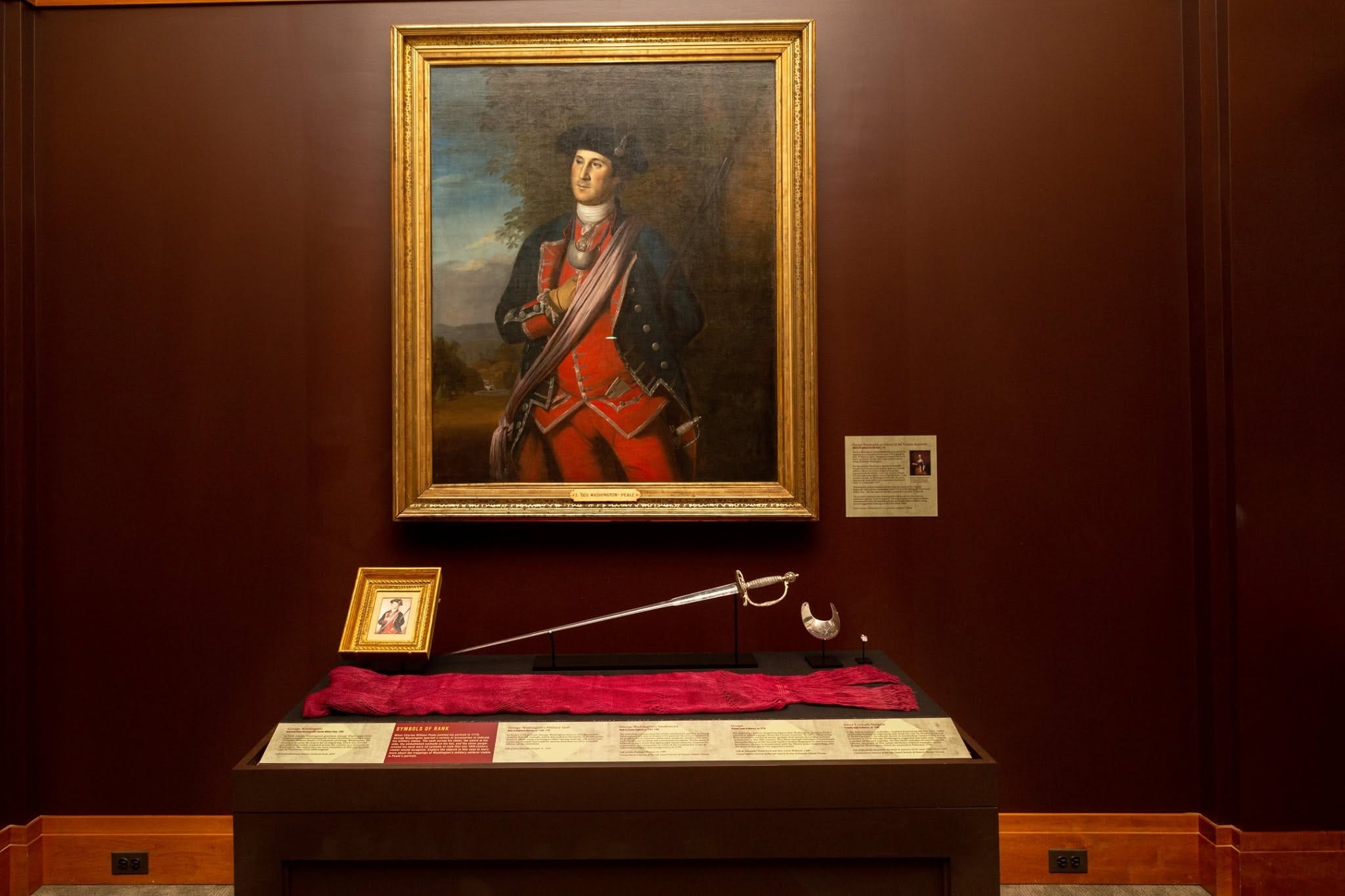
A portrait of the young colonial officer, displayed alongside a sword and medal, more artifact than mystery to the museum that houses it.
"Life can only be understood backward, but it must be lived forwards."
Kierkegaard wrote that in 1843, nearly a century after a drifting, uneducated 22-year-old Virginian signed the only surrender of his military career.
That man was George Washington. The museum-plaque version of his life skips straight from Surveyor »»» General »»» President. As if his life were locked in from the start.
It wasn’t: his early years were a string of embarrassments, and what made him great later was what he did the morning after each failure.
The Washington years nobody taught you about just became a $19 million weekend.
“Young Washington” opened over the Fourth of July weekend, the second-best live-action debut in Angel Studios’ history. Director Jon Erwin already announced a sequel, “1776,” before the studio had even finished counting the weekend’s ticket sales.
For a man about to headline a franchise, the public record on him is thin.
The cherry tree story, the one about the hatchet and “I cannot tell a lie,” was invented in 1806 by a preacher named Mason Locke Weems. It’s still most of what survives in public memory of the man Hollywood just bet on.
The Family Connection That Wasn’t Enough
Washington’s father died when George was eleven. His older half-brothers got shipped to school in England. George got a local tutor and some arithmetic. He wasn’t headed anywhere in particular until a wealthy neighbor invited him along on a monthlong surveying trip through the Shenandoah when he was sixteen.
A year later, that same family’s connections got him an official license and a county surveyor’s post at seventeen, no exam required, unheard of for his age.
He had little money and no college. What he had was one connection, and a connection only opens a door. Once he was standing in the room, nobody handed him anything else. Over the next few years, he ran roughly 200 surveys throughout the Ohio Valley, building a reputation for accuracy so good that landowners started requesting him by name.
You’ve probably had a version of that break too, the one that got you somewhere you hadn’t quite earned yet. Nobody remembers how you got in the room. They remember what you did once you were standing in it.
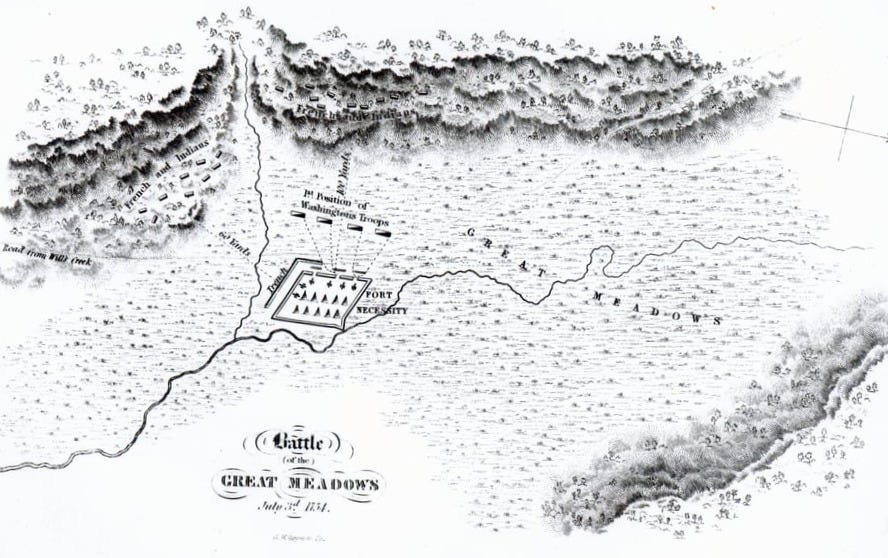
A period map of the Battle of Great Meadows, showing Fort Necessity at the center of the low, open ground Washington chose to defend
“A Charming Field for an Encounter”
In 1754, at twenty-two, Washington ambushed a French scouting party, killed its commander, and helped light the fuse on the Seven Years’ War. Days later he wrote his brother that hearing bullets whistle past him was oddly charming.
In the same letter, he said he wasn’t worried about an attack from 500 men, and called the ground at Great Meadows “a charming field for an encounter.” Then, closer to 700 French and native troops surrounded him there.
First victories have a way of producing second mistakes born of overconfidence.
Washington dug into a low, exposed meadow against better advice. Rain flooded his trenches, his powder was ruined, and he surrendered, the only formal surrender of his career, before he turned twenty-three.
The terms, written in French, admitted his earlier ambush amounted to assassination, something he hadn’t grasped until he’d already signed it.
Past Passport is reader-supported. Three pieces a week on the history behind the moment, because history never repeats itself. Man always does.
Only 17 cents per day.
The Only Surrender of His Career
Washington answered that mistake instead of running from it. He rebuilt the Virginia Regiment into a disciplined force, studied why his tactics had failed in woodland fighting, and carried that muddy meadow into every decision thereafter.
Twenty years later, the same man who’d once called gunfire charming moved with caution bordering on paranoia, because he already knew what overconfidence cost him.
You’ve probably had your own version of that meadow, the youthful screwup that finally made you pay attention.
I had one in Ukraine long ago, involving paying the mafia to smuggle me over the Russian border. But that’s another story.
That gap between the woodland young man who found bullets charming and the seasoned general who didn’t is an education, and none of it happened in a classroom. Failure was the curriculum, and it’s available right now to anyone broke, unqualified, and in over their head.
Four Bullet Holes and Not a Scratch
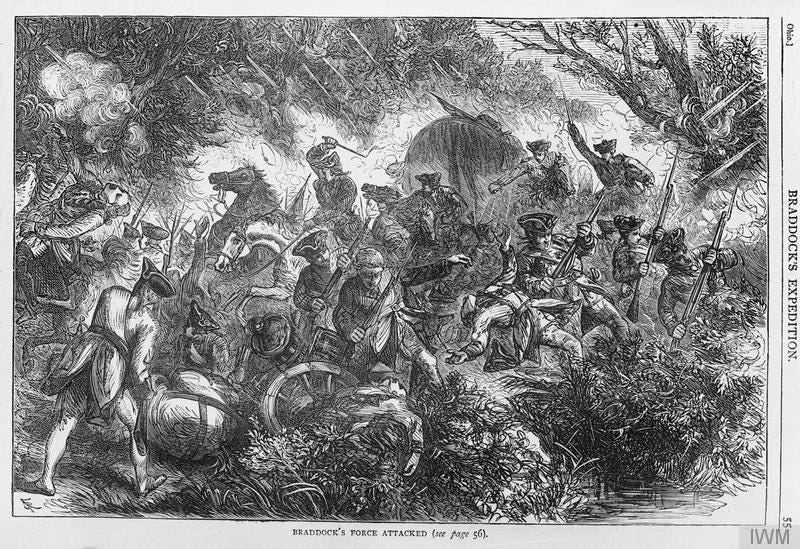
A year later, Washington rode his mare into a worse disaster. As an aide to General Braddock in July 1755, he watched the army march in tight European formation into a French and Native ambush.
An engraving of Braddock's defeat on the Monongahela, July 9, 1755. Braddock died of his wounds four days later; Washington helped organize the retreat
Nearly two-thirds of the British force was killed or wounded in three hours, and every mounted officer went down except him. Two horses were shot out from under him, and he rode through the slaughter delivering orders because, with Braddock down, he was one of the few officers left who could.
Nine days later, after word spread that he’d died, Washington wrote his brother to set the record straight. Four bullets had gone through his coat and two horses had been shot under him, and he’d walked away without a scratch while men fell on every side.
A Native chief who’d fired at him more than a dozen times that day and missed every shot reportedly decided, years later, that something larger than luck was protecting him.
Whether Providence spared him or luck did, Washington left that battlefield a different man than the one who entered it.
A year earlier, this was a man who’d called gunfire charming and signed a surrender he hadn’t fully read. Now he was the last officer standing in a massacre, running toward the wreckage instead of away from it.
The Plaque Remembers the Victories. Character Was Built Elsewhere.
George Washington went on to lead a revolution, preside over a constitutional convention, and step down from power when he could have kept it, deliberately modeling himself on Cincinnatus, the Roman general who did the same and returned to his farm.
A connection he didn’t earn got him in the room, but everything after that came from his own decisions: a surveyor’s eye built through unglamorous work, and a humiliating surrender that taught him more than any tutor could have.
His face ended up on the dollar bill. Twenty-two years earlier, his name was on a French document confessing to an assassination he hadn’t realized he’d committed.
The movie theaters are showing you the muddy meadow and the four bullet holes.
What they can’t show you is the only part that mattered: the man walking away had no idea he was becoming George Washington.
If this is the kind of history you didn't get in school, subscribe. Three pieces a week, only $5 per month, always chasing the parts the plaque leaves out.
The Paragraph I Stopped Pasting Into AI
I used to paste in a full paragraph explaining who I am, how Past Passport works, and what “good” looks like for this kind of piece, every single session. That’s the paragraph you type ten times before you realize it’s no longer a prompt. It’s a skill.
Claude has a feature for exactly this. In Settings, under Skills, you can save that paragraph once and give it a name. From then on, Claude checks it automatically instead of you having to explain yourself from scratch.


The early failures make the later restraint make more sense. He learned the cost of pride the hard way.