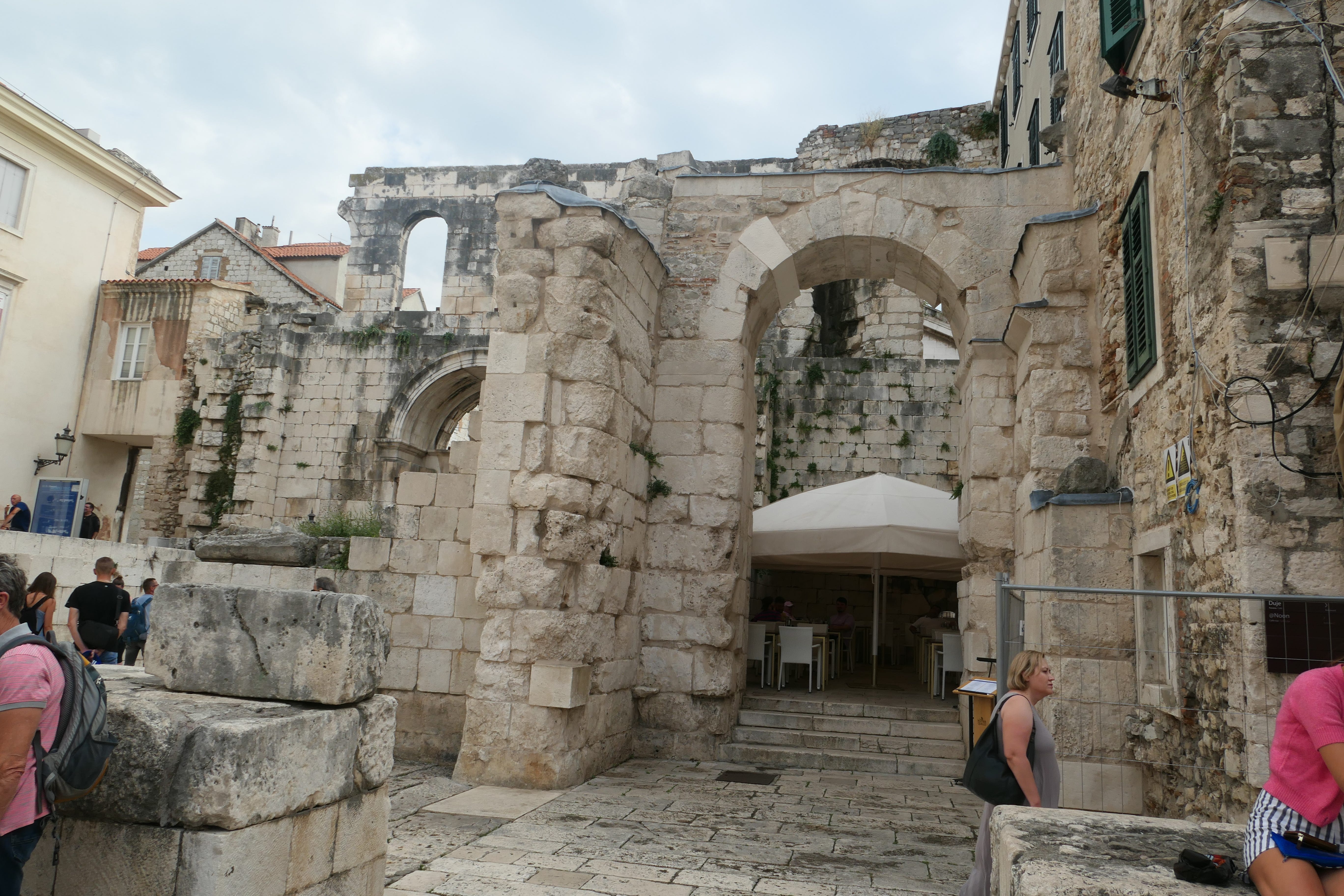
Diocletian’s ‘retirement villa’: a Roman fortress that never retired, now full of cafés and shortcuts instead of soldiers
You don’t enter Diocletian’s Palace the way you enter a ruin, because it never became one. It has stayed lived‑in for centuries.
One moment you’re in open light, the Adriatic flaring off the water and white stone, heat pressing up from the brick pavement. Then the narrow street tightens, the air cools, and the light thins into pale strips that slide down the walls.
Stone closes in on both sides — pitted, rough, sun‑warmed limestone you can drag your fingers across. You feel tiny chips and old tool marks.
A Roman Emperor’s Retirement - Built Like an Empire
Diocletian did not build this palace to rest. He built it to control the end of his life the same way he controlled the empire.
After decades of instability — brutal civil wars, collapsing currency, emperors rising and falling in quick succession — he stepped down voluntarily and came here to construct a walled compound the size of a small city.
The outer walls still feel defensive when you get close to them: thick limestone courses stacked in clean, steady lines, their edges softened by centuries but their mass unmistakable. The gates cut through them with orecise geometry, aligned to the compasss like decisions snapped to a grid.
If this kind of “under the floorboards” history is your thing, Past Passport is reader‑supported—become a subscriber so I can keep following these tunnels.
This was not a villa. It was engineered like a military installation: towers set where they could see furthest; streets and courtyards organized as if someone had drawn them with a straightedge on wet sand. Even now, when you walk, you feel nudged — turned, narrowed, released into open space — by a plan laid down seventeen hundred years ago. Even in retirement, he imposed order on everything around him.
The plan in miniature—tight walls, straight axes, he accounted for everything.
Diocletian dragged the empire back from the brink. He split power between four co‑emperors to stop the endless civil wars, overhauled the bureaucracy and the army, and tried to tame runaway inflation with new taxes, new coins, and even maximum‑price laws. For a while, borders held, the army was paid, and the chaos of the third‑century crisis finally eased.
His reforms held the empire together, but they came with weight: more bureaucracy, more rules, more stone around everything. You can feel that weight in the palace itself—thick walls, tight gates, movement channeled into narrow paths instead of open choice.
The Ground That Remembers Every Footstep
Walk deeper and the ground tells the story before anything else does. The cracked stone beneath your feet dips slightly in the center, worn into shallow channels where countless steps have passed.
The surface is slick in places, polished to a soft sheen by hundreds of years of contact: Roman boots striking hard, cart wheels rattling, sandals scraping, medieval traders shuffling, modern sneakers sliding on the same faint slope.
Look up and around, and you see how much was poured into the original palace frame. After the empire, people didn’t ring the palace with a new town — they moved directly inside it. They built homes and workshops in leftover courtyards, wedged walls into Roman arcades, stacked living rooms above old service passages.
In some narrow, shaded lanes, you can stretch out your arms and touch stone from a dozen different centuries at once: a Roman block at your left palm, a later medieval wall at your right, a modern drainpipe cutting between them.
The palace did not fall into ruin and silence after Rome. People who came later absorbed and repurposed it.
A Roman mosaic floor, patched and walked on for centuries instead of sealed behind glass.
Down to the Underworld: Sewers and Ghost Rooms
The basement corridors stretch out in long, vaulted lines, the ceiling low enough in places that the air feels close to your face. The temperature drops and humidity rises as you step lower. It’s cool, damp, smelling faintly of stone dust and old moisture. Footsteps land heavier here, each one sending a dull echo up into the curves of the vaults before it dies.
These chambers were never meant to impress anyone. They were built to carry waste. Everything above—living quarters, kitchens, imperial halls — drained into this system and flowed outward toward the sea. The layout is not random.
The plan of these underground rooms matches, almost exactly, the floor plan of the vanished imperial apartments that once rested above them, like a stone negative. Walking through these dim corridors is like moving through the ghost‑shape of Diocletian’s private world, stripped of decoration and flipped upside down.
For centuries after the empire faded, locals continued using these spaces for the same purpose. Sewage descended through hundreds of holes resident cut above.
Ceiling scars from the upstairs toilets: sewage once dropped straight through these holes into the palace underworld.
They also stored goods down here, dumped rubbish and debris, let mud and trash pile up until some vaults were choked with fill.
Ironically, that neglect —treating the cellars as a dump and storage pit — sealed their surfaces away from weather and vandalism. The most intact Roman architecture in the complex is the part the city tried hardest to forget.
From Sewer to Wedding Hall
Now those same corridors host weddings. Lights are strung across stone arches, small warm bulbs casting soft halos on the rough vaults. Tables are set where waste once moved in darkness. Voices rise in laughter where water and sewage used to rush; heels click on floors once littered with refuse. Music curls around the arches, bouncing just enough to feel thick in the air.
Same stone, different flow: once sewage, now cocktails and wedding speeches.
People stand in formal clothes, raising glasses beneath ceilings designed not to impress them, but to support an emperor’s rooms overhead. The smell is gone, the function transformed, but the structure remains exactly what it always was: a system built to support life above. The meaning has been altered, but Dioclecian’s design endures.
The Emperor Who Chose Cabbages
Then there is the detail that feels almost out of place. After building this fortress and stabilizing an empire, Diocletian left it behind. He moved inland, away from the sea and the stone and the echoing courtyards, and grew cabbages.
From above, Diocletian’s ‘palace’ looks less like a ruin and more like a packed neighborhood
Imagine the shift in texture: from hard limestone underfoot to soil that gives a little when you press your heel into it. Dioclecian receded from the smell of salt and cool masonry to the dense, green scent of plants and earth after rain. That was the life the emperor chose.
When later rulers asked him to return to power, he refused, saying that if they could see what he had grown with his own hands, they would not ask again. After decades of ruling millions from a place built to stage his presence, he chose black soil, routine, and something he could control directly, with fingers instead of decrees.
What Dioclecian Palace Proved
Dioclecian’s reforms held the empire together, but they came with a burden: more bureaucracy, more rules, more stone around everything. You can feel that weight in the palace itself — thick walls, tight gates, movement channeled into narrow alleys.
Yet the building outlived his system because it could be reused. People turned gates into doorways, barracks into apartments, sewers into wedding halls. The empire he tried to stabilize broke and reformed; his retirement fortress quietly became a city. And then a tourist destination today.
You step out through the gate into modern Split — noise, exhaust, sea salt, open light—and it finally is clear The man is gone. His controls are gone. The structure remained, and other people found ways to live inside it.
Get more hidden‑history stories in your inbox each week.