

Paris or Rome for a winter vacation? It was the second-longest-running argument in our marriage.
Two months later, as I paced through Notre-Dame, I checked my watch; the place felt about 1,200 years too young for a Rome guy.
Turns out she was right, though not for the reasons she thought.
Under the cathedral square lies a crypt of Roman Paris going back to the first century A.D., and across the square, under a hospital, was something older.
This week, France’s Ministry of Culture announced that archaeologists may have found Lutetia, the Celtic town Caesar’s army came to take.
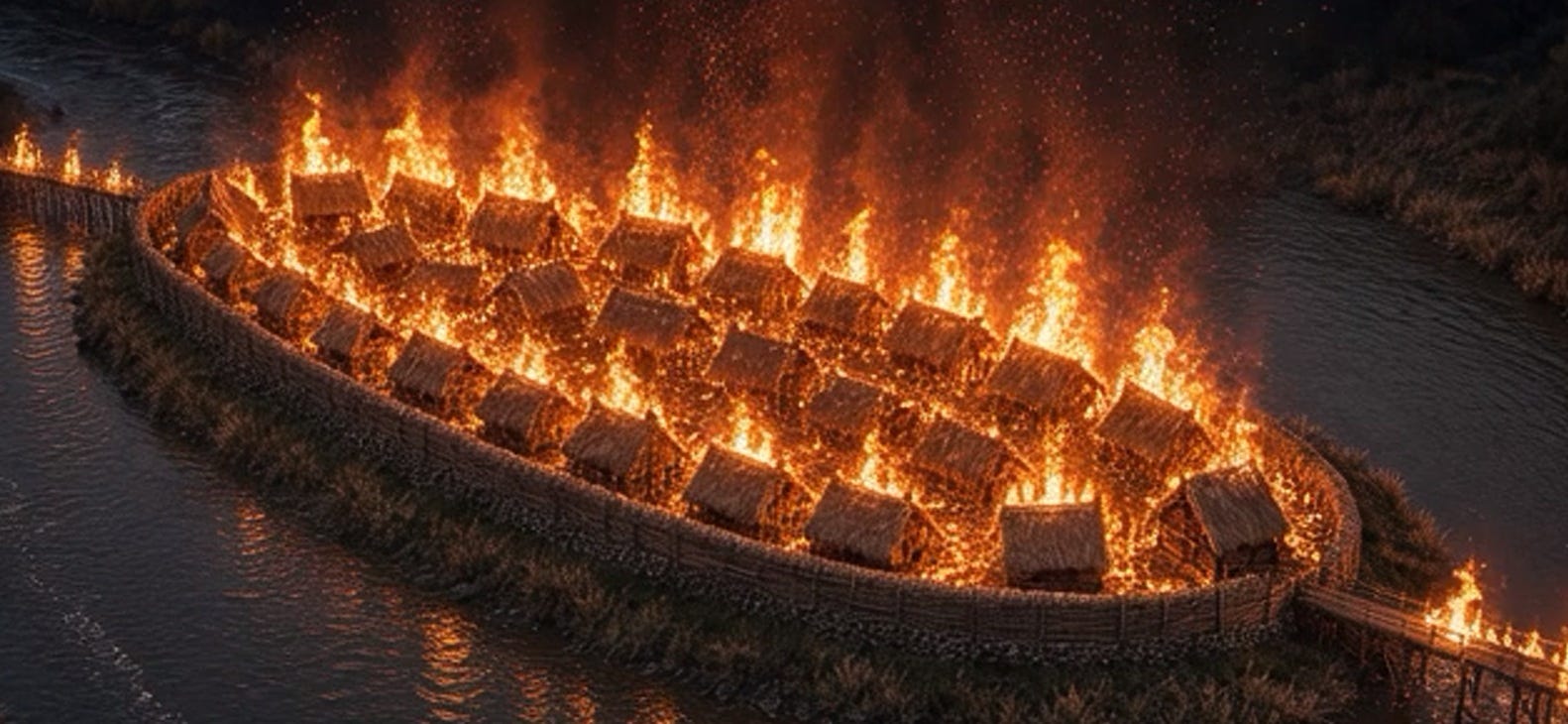
In the hospital’s courtyard, they uncovered 65 feet of its wall, the stones blackened by fire and the beams burned to charcoal.
Caesar wrote that Lutetia stood on an island in the Seine, and that when Rome closed in, the Gauls burned it and cut the bridges. Historians read that with one eyebrow raised for 2,000 years.
“The enemy... ordered Lutetia to be burned and the bridges of that town to be cut down.”
Julius Caesar, The Gallic War, Book VII, 52 B.C.
The wall is on that island, the same one Notre-Dame stands on, and it burned.
So on this one, Caesar was telling the truth. How Lutetia ended up in flames is a cracking story.
Much better than anything he polished up about himself for posterity.
Try Past Passport free for 7 days. Paid subscribers get:
3 weekly history essays. Easy reading. No dull dissertations.
3 weekly quick summaries of how we use AI to create every essay.
1 extra monthly newsletter, rotating between a full AI breakdown for writers and video and a Stoic philosophy article.
Open DM sessions on the month’s top article.
1-week free trial, then just $5 per month.
Caesar hired himself as his press agent
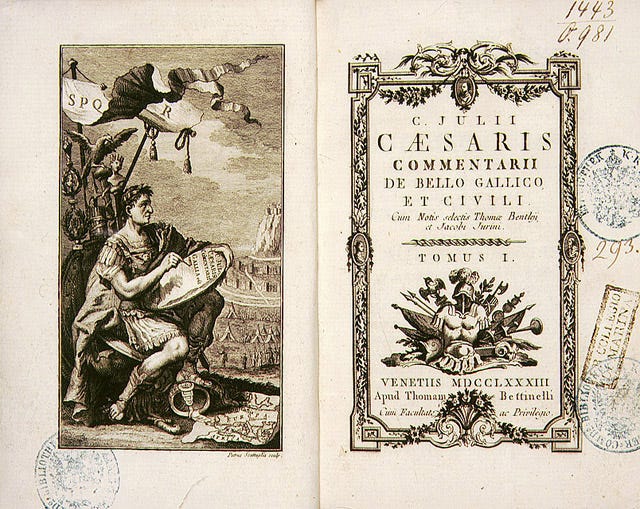
Caesar was the best general of his age and a hell of a PR man. For most of the Gallic War, he’s our only witness. Nobody else’s account survives to check him against.
He wrote The Gallic War himself, in the third person, and sent it home to the Roman voters paying for his campaigns.
The third person was smart thinking. “Caesar” crosses rivers and wins battles, and you almost forget the man writing it is the same man being praised.
Historians have been checking him ever since, and he doesn’t always pass. In 55 B.C., he claimed two German tribes numbered 430,000 and that he wiped them out without losing a man.
He’d attacked while their envoys were in his camp for peace talks, and back in Rome, Cato the Younger suggested handing Caesar over to the Germans to make amends.
At Gergovia, the one battle he lost in person, Caesar blamed his soldiers. Even his own officer, Asinius Pollio, said Caesar’s memory had a way of burnishing his record.
In his Brutus, Cicero praised the books as plain and unadorned, like a statue with the clothes taken off. That plainness is what makes them so persuasive. Caesar reads like a man with nothing to hide.
That’s why the recently uncovered charred wall is significant.
The burning of Lutetia earns Caesar nothing. He wasn’t there, and the Gauls torched the town before his army could take it. A PR man gains nothing from a story like that, so there’s no reason to invent it.
He wrote it down in Gallic Wars for one reason: it happened.
If you’ve ever wondered how much of Caesar to believe, start there. The parts where he had nothing to gain by lying are the parts most worth trusting. Carbon dating puts the wall’s timber between 200 and 10 B.C., and the team is still testing, but a dig in Paris has now backed up one of those parts.
Here’s how it happened.
Caesar was two hundred miles away
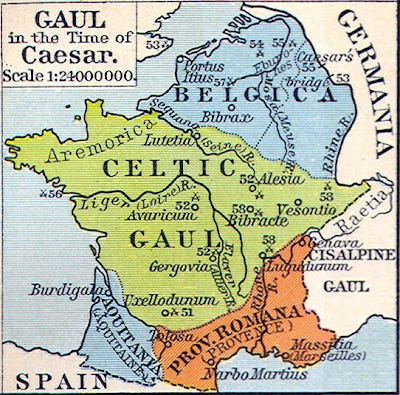
Spring, 52 B.C. All of Gaul rose behind a young Arvernian chief named Vercingetorix.
Caesar marched six legions south to besiege him at Gergovia. The other four went north with his best lieutenant, Titus Labienus, who had orders to crush the tribes along the Seine.
Labienus dropped his baggage at Agedincum, modern Sens, and marched downriver toward Lutetia. The Gauls gave their army to Camulogenus, an old Aulerci chief. Caesar says he was worn out with age but won the command anyway, because nobody in Gaul knew war better.
Camulogenus camped behind a marsh draining into the Seine and dared the Romans to try crossing it. Labienus gave it a shot. His men laid wicker hurdles in the mud and packed earth on top to build a causeway, and the marsh swallowed every bit.
So Labienus did an end-around. He marched back upriver in the dark to Metiosedum, modern Melun, seized about fifty boats and crossed the Seine. Then he came down the far bank toward Lutetia, from the side nobody was guarding.
The Parisii, the tribe that would one day give Paris its name, saw him coming.
They couldn’t hold the island, and they refused to hand a walled town in the middle of the river to a Roman army. So, the Parisii set fire to Lutetia and cut its bridges.
The fire bought them one night in the rain
Burning Lutetia didn’t save the Parisii. It did strand Labienus.
Then the bad news arrived.
Caesar had failed at Gergovia, and the Aedui, Rome’s oldest allies in Gaul, had joined the revolt. Labienus had four legions on the wrong side of the Seine with a Gallic army in front of him. His baggage was fifty miles back at Sens. He had to cross the river without fighting in the water.
He crossed at night.
Five cohorts marched upstream, making as much noise as they could, dragging small boats behind them. The rest of the army boarded the Melun boats in silence and slipped four miles downstream. A storm rolled in and drowned out the oars, and the Gallic sentries missed the whole crossing.
