Cicero Called It a River of Gold. Then It Vanished.
How Aristotle's best work disappeared, and how the rest survived by accident.
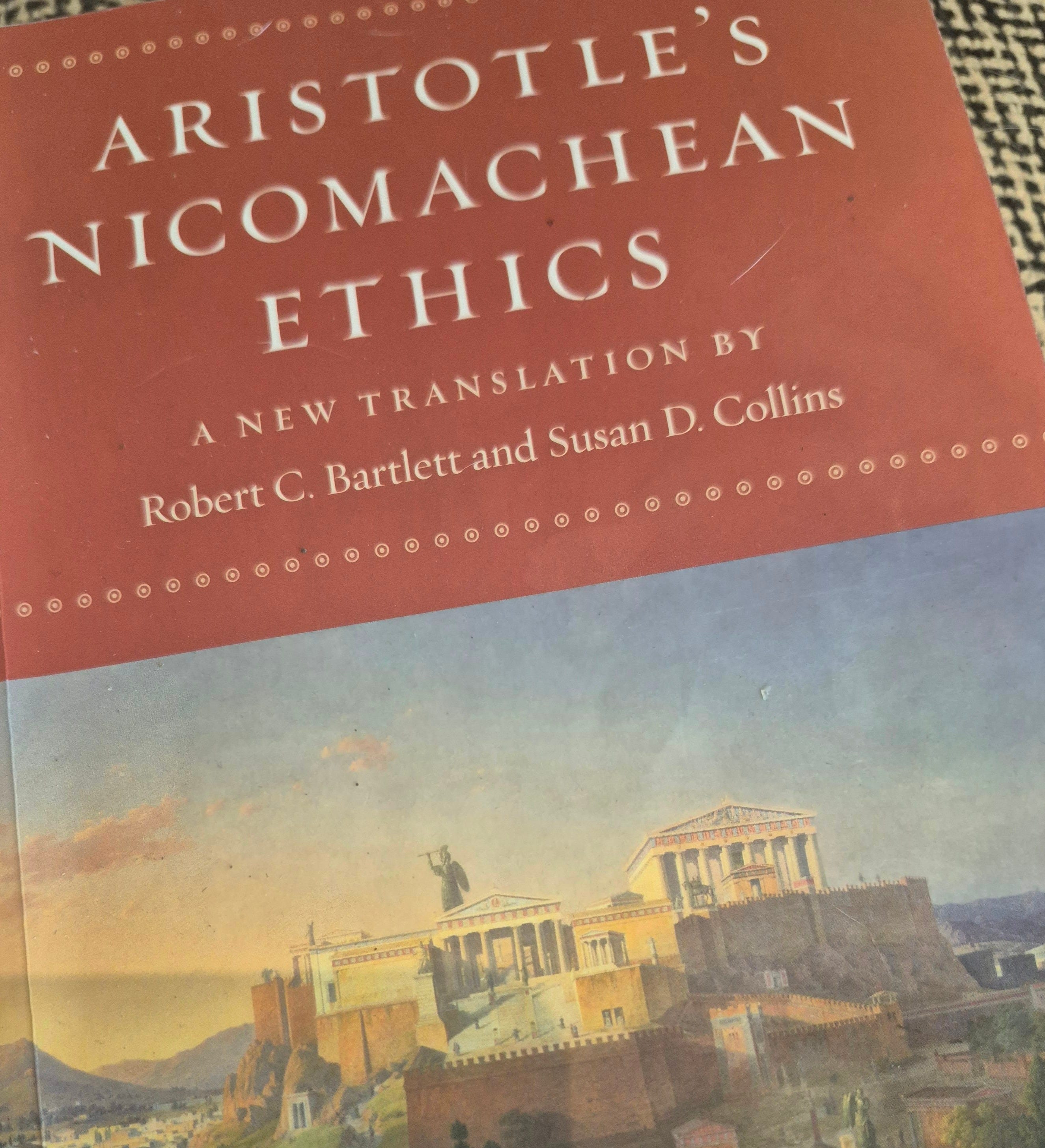
I found a copy of the Nicomachean Ethics in a used bookstore last month. The Athenaeum Book Club starts reading it next week. I wanted to get a feel before the readings begin.
The book in my hands came close to not existing at all, like most of Aristotle’s works. Not because of fire or war or deliberate destruction. Because of a cellar in a provincial Turkish town and a chain of accidents so improbable it reads like fiction.
The Aristotle who shaped the modern world survives mostly by accident.
“If Plato’s prose was silver, Aristotle’s was a flowing river of gold.”
Ancient sources list over 150 works by Aristotle. Roughly a third survive today. What we’re missing isn’t the rough drafts. It’s the finished work.
The works that made Aristotle famous in his own lifetime were his public-facing dialogues, elegant and polished, written for a general educated audience.
Cicero, whose Latin prose remains the standard against which all others are measured, called Aristotle’s writing a river of gold. Those works are gone. Not damaged. Not fragmentary. Gone. We have titles and occasional quotes preserved by later writers. That’s all.
The missing titles are depressing to read. The Protrepticus, an exhortation to philosophy. On the Poets. On Philosophy. Works ancient critics ranked alongside Plato’s finest. Gone for good.
What Survived and the Irony
What we have are his esoteric works, which the Greeks called acroamatic, meaning intended to be heard. Lecture notes, research materials, and teaching aids for advanced students at the Lyceum. There was no classroom in the modern sense. The Lyceum was a public gymnasium on the eastern edge of Athens, built on grounds sacred to Apollo, where young men had trained and exercised for generations before Aristotle arrived.
He lectured while walking, hands clasped behind his back, moving through covered colonnades called the peripatos, surrounded by pomegranate trees and wild herbs. Students followed and wrote down what they heard.
That’s where the name came from: peripatetic, meaning “walking.” While Alexander the Great was conquering Asia, his former teacher was pacing a lush garden in Athens, talking about ethics, politics, and the nature of things, and someone nearby was scribbling notes.

Some of what we read today may not even be Aristotle’s own words. The text is dense, sometimes repetitive, and occasionally incomplete. A professor’s working notes, not a finished book.
The Nicomachean Ethics. The Politics. The Physics. The Metaphysics. The Poetics, incomplete. These texts shaped Western civilization for two millennia. None were meant to leave the garden.
Cicero’s river of gold has run dry. History erased the polished masterpieces and preserved the lecture notes.
The Damp Cellar
After Aristotle died in 322 BC, his manuscripts passed to his successor Theophrastus. When Theophrastus died, he left them to the student Neleus of Scepsis. Neleus took the manuscripts from Athens back to his hometown, a backwater town in what is now northwest Turkey. It lies a few miles from where the Trojan War was fought.
Ancient sources disagree on what happened next. The most dramatic account, reported by Strabo and based on the testimony of a witness who was actually in Athens when it was sacked, says Neleus’s heirs heard that the kings of Pergamum were searching for books to build their rival library.
Fearing confiscation, they hid the Aristotle manuscripts in an underground trench. There they sat for 200 years, damaged by moisture and moths, in a provincial town nobody cared about while the Hellenistic world flourished around them. Alexandria was building the greatest library in history. Rome was rising. Aristotle’s precious manuscripts were in a hole in the ground.

The Rescue Chain
Around the 1st century BC, book collector Apellicon of Teos tracked them down and bought them for a large sum. The manuscripts were badly damaged. Apellicon attempted to restore them, filling in the gaps himself, but he was a book lover rather than a philosopher. His guesswork introduced errors that scholars are still untangling today.
According to Plutarch, when Sulla’s Roman soldiers ransacked Athens house by house in 86 BC, they found Apellicon hiding in his own library. They killed him and reported the find to Sulla, who ordered the entire collection shipped to Rome.

The same sack that destroyed much of the Lyceum, the colonnades where Aristotle had walked and lectured, accidentally rescued the manuscripts.
A Roman general destroyed Aristotle’s school and accidentally rescued Aristotle himself.
In Rome, a grammarian named Tyrannio, acquainted with Cicero, accessed the manuscripts and began organizing them. He passed copies to Andronicus of Rhodes, the eleventh head of the Peripatetic school that Aristotle himself had founded. Andronicus spent years sifting through the damaged, error-filled texts. The edition he produced around 58 BC forms the basis of every text of Aristotle we read today.
Our Luck
Aristotle had died 260 years earlier, in exile, having fled Athens to avoid an impiety charge after Alexander’s death made his Macedonian connections a liability. He reportedly said he would not allow Athens to sin against philosophy twice. He died in Chalcis, on the island of Euboea, in 322 BC.
Think about how many times this almost went the other way.
Neleus’s heirs had to fear the kings of Pergamum enough to hide the manuscripts rather than sell them, but not so frightened that they destroyed them. Apellicon had to be obsessive enough about books to track them down in a town nobody visited.
Sulla had to pillage Athens, which he did for reasons unrelated to philosophy. The manuscripts had to survive the journey to Rome, damaged and full of errors. Apellicon tried to fix them. Tyrannio had to gain access. Andronicus had to finish the work.
If any single link in that chain snaps, we lose it all. Not just the polished dialogues, which are already gone. Everything. The Ethics. The Politics. The Poetics. The notes taken in a garden in Athens two and a half millennia ago that accidentally became the foundation of Western thought.
What history preserves comes down to luck.

The Athenaeum Book Club Starts Next Week
The road from Aristotle’s garden to a June 2026 reading runs through war, mold, moths, and luck.
The miracle isn’t that Aristotle wrote these books. The miracle is that you can still buy one for eight dollars in a used bookstore.
The Athenaeum Book Club will study the Nicomachean Ethics starting June 9 at noon ET. Don’t miss it.
How AI Assisted My Research
The research for this piece came from an AI conversation that started with a simple question: how did we come to have Aristotle’s surviving works at all? Twenty minutes later, I had Neleus, the cellar in Scepsis, Apellicon, Sulla, Tyrannio, and Andronicus. A story that took classicists centuries to piece together surfaced in an afternoon.
Five years ago, I would have spent days across dozens of websites and probably missed half of it. The editorial judgment about what mattered, what fit, what to cut, was still mine. The research was faster and deeper than anything I could have done alone.
History shows that every generation thinks it’s all over. It never is. I write about history, optimism for the future, and how AI can assist writers with their work.
Hat tip to the Athenaeum Book Club, whose reading list for next week gave me the idea.


