

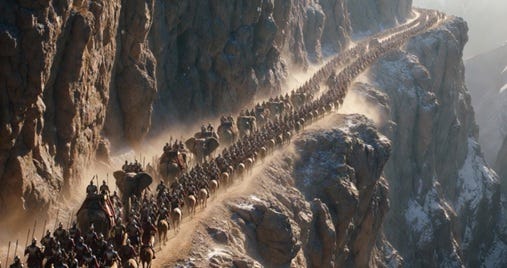
How the hell did elephants get into the Alps?
The logistics are mind-boggling.
Hannibal looked at the tallest, most brutal mountain range in Europe and decided, in 218 BC, I’m marching 37 African elephants in snow at nearly 10,000 feet.
Nobody knows why. But we can guess.
Polybius and Livy, the two ancient historians who wrote the most detailed accounts of the campaign, never record Hannibal explaining himself.
The leading theory: shock and terror. Elephants panicked horses and soldiers who’d never seen one, and there’s compelling evidence for that from his later battles in Italy.
Some historians think it was also about appearances, a way to impress tribes in northern Italy who’d never seen anything like it before. Pick a side. One of them has giant animals.
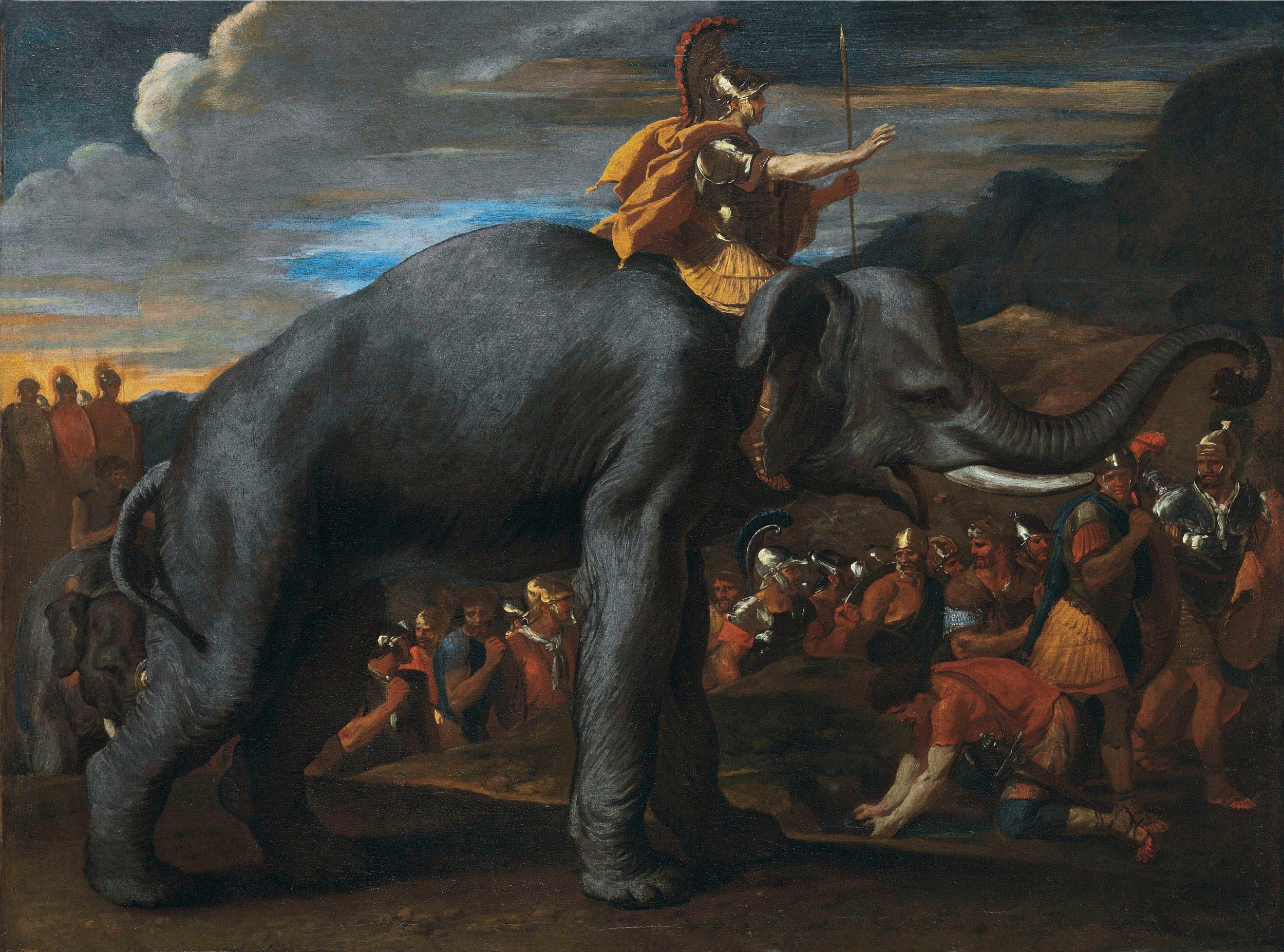
Hannibal never wrote his reasoning down, and neither did anyone who asked him.
Researchers from Oxford and Germany don’t know why either.
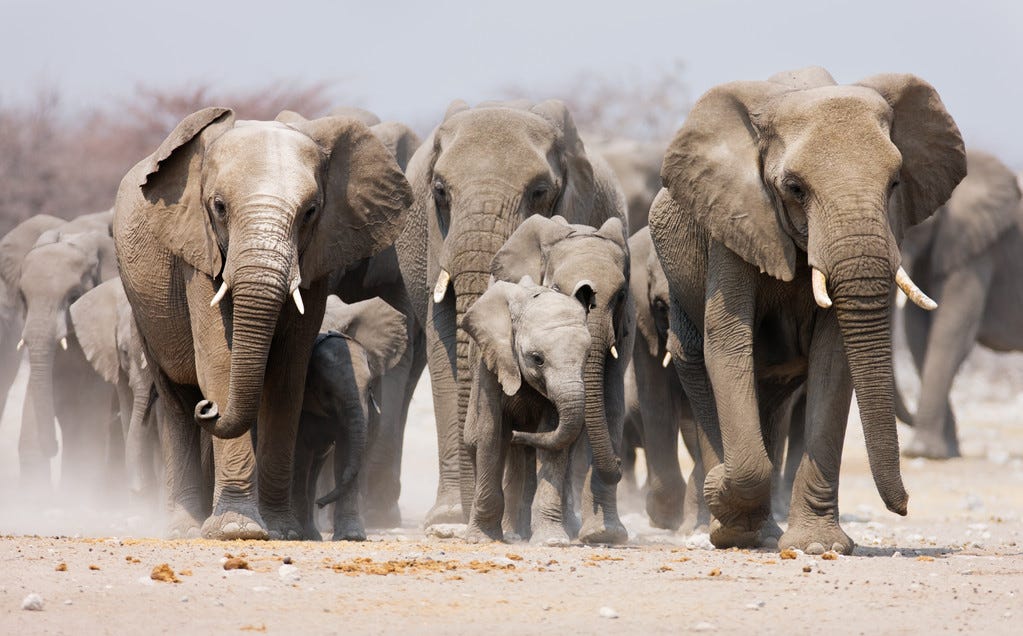
But they discovered which mountain pass he used by studying elephants that are alive right now, in Kenya.
The Answer Hid in Kenya
218 BC.
Nobody knew for 2,200 years which pass got Hannibal's army over the Alps, the opening move of the Second Punic War and his one shot at Rome.
Three real candidates, argued over by classicists for generations.
The Col de Montgenèvre: the easiest and lowest, roughly 6,100 feet.
The Col du Clapier: 8,127 feet.
The Col de la Traversette: brutal, nearly 9,700 feet, one of the highest usable passes in the entire range.
In July 2026, a team from the University of Oxford and two German research institutions published an answer in the Proceedings of the National Academy of Sciences.
Their method was to borrow the math used to track living elephants today.
Researchers used a model called ENERSCAPE, originally built to track how modern African elephants move across real terrain.
It calculates exactly how much energy a body that size burns on a given slope, at a given elevation, in a given kind of snow.
They ran Hannibal’s entire army through it, men, horses, and all 37 elephants, across every candidate pass.
The Traversette route won.
Not because it was gentler. Because it was shorter, and shorter, even at nearly 9,700 feet, cost less energy overall than a longer, lower path.
The food calculations alone are staggering. Feeding the men through the crossing required an estimated 232 tons of grain, hauled up a mountain by hand, alongside soldiers who could barely feed themselves.
The elephants needed five to six hours of feeding a day just to survive….animals the size of a small truck, scraping vegetation out of the snow.
The Mountains Killed Half His Men
Hannibal marched out of Carthago Nova, the Carthaginian capital in Spain, army in tow: 38,000 infantry, 8,000 cavalry, 37 elephants.
They were forest elephants from North Africa, smaller and darker than the ones you’re picturing. Wool cloaks over bronze-studded leather, most of his men Iberian and Gallic mercenaries who’d never seen snow in their lives.
Hannibal marched out of Carthago Nova, the Carthaginian capital in Spain, army in tow: 38,000 infantry, 8,000 cavalry, 37 elephants. His target was Rome itself.
They were forest elephants from North Africa, smaller and darker than the ones you’re picturing. Wool cloaks over bronze-studded leather, most of his men Iberian and Gallic mercenaries who’d never seen snow in their lives.
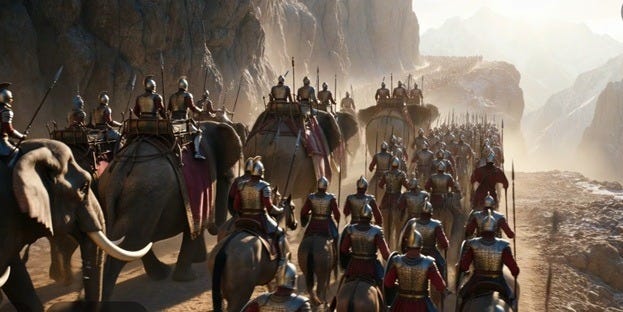
Rome controlled the sea. A direct crossing by ship was out.
So Hannibal chose the only other way in: over the Alps, and straight down into Roman territory from the north, where nobody expected an army to come from.
Which route he actually took stayed unsettled for two thousand years... until the answer turned up walking around Kenya today.
Ancient sources don’t agree on how long the crossing took; Polybius says 15 days, other traditions say more like 19.
By day nine, according to Polybius, the army had reached the highest point of the route, exhausted and ready to quit.
Hannibal rode to the front, stopped the column, and pointed down into Italy, and declared:
“Henceforward all will be easy going,” he told them. “No more hills to climb.”
He was wrong.
Livy records four straight days where the pack animals had nothing to eat, the ground buried under old snow that had never fully melted from the previous winter.
Men chewed whatever grain rations they had left, cold and half-frozen, sleeping wherever the path was wide enough to lie down.
Local mountain tribes weren’t helpful.
They rolled boulders down onto the column from above, picking off stragglers on the narrowest stretches. One wrong step meant a soldier, a horse, or an elephant went straight off the edge.
By the time Hannibal reached the other side, he stood in the upper Po Valley, in the territory of the Insubres, one of the Gallic tribes he was counting on to help him fight Rome.
Nearly half his army, gone, to cold, to disease, to boulders rolled down from above, to falls off cliffs that never gave anyone a second chance. The mountains took them, not the Romans.
The Elephants Were Fine. The Men Weren’t.
Picture the crossing, and you probably think about the elephants. Stumbling, terrified, dying in the snow. That’s the image every painting and film has sold you for centuries.
Not what happened.
Researchers estimate the elephants lost only about 4% of their body fat reserves making the crossing. Horses lost 11%. The soldiers, the ones everyone assumes fared best, lost 19%, nearly a fifth of their body fat, in fifteen days.
These aren’t measurements. They’re modeled estimates, built from data on living African elephants and extrapolated backward across 2,200 years and an extinct subspecies. The best guess anyone’s had yet, not a fact carved in stone.
The men took the real damage. Cold, starving, sleeping on exposed rock with nothing but wool and leather between them and the frost.
Nearly half of Hannibal’s human army never made it to the other side. Most of his elephants did.
What Survived the Alps Didn’t Survive Winter
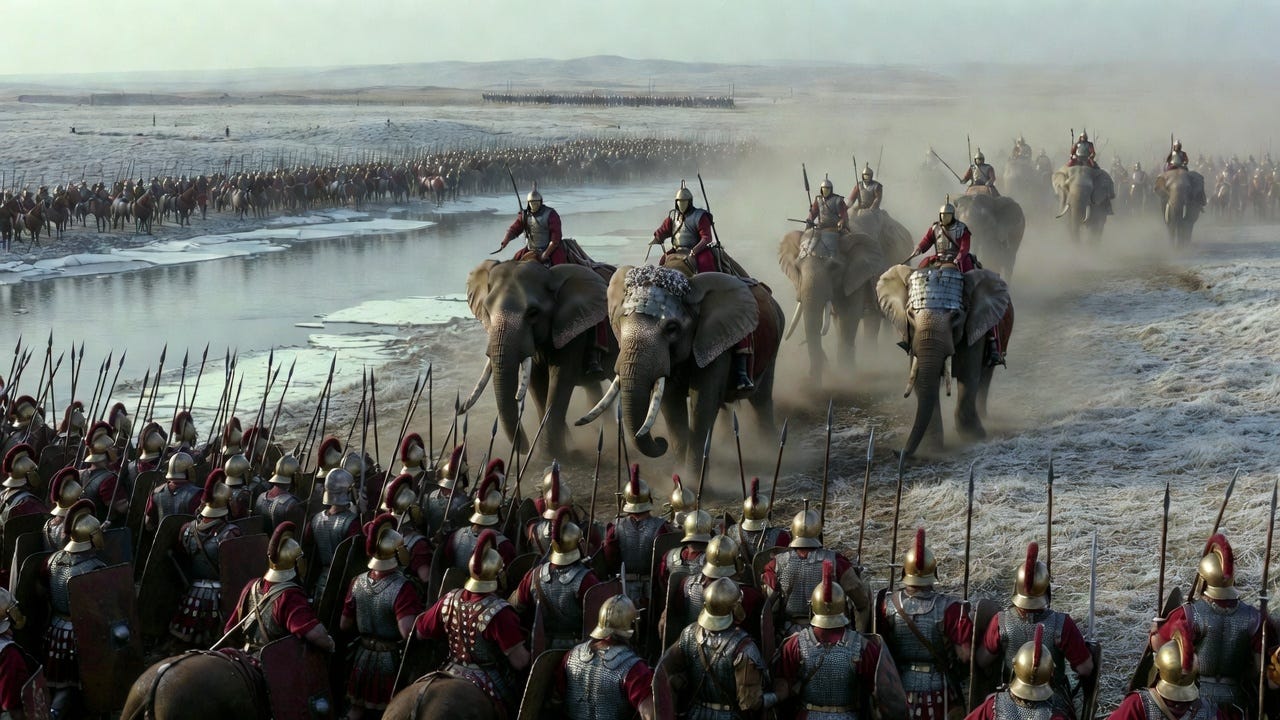
Two months after the crossing, in December 218 BC, Hannibal fought his first battle on Italian soil, at the Trebia River.
He still had his elephants.
At Trebia, the sight of them shattered the Roman line before it ever fully formed. Hannibal won decisively.
It was the winter that followed, not the battle, that finally killed them. By spring, all but one had died, frozen out by a cold snap nobody saw coming.
The single survivor, an Indian elephant named Surus, later carried Hannibal himself across the swamps of Etruria on the way to his next battle.
Hannibal Survived the Alps. He Didn’t Survive Scipio.
Nobody at Trebia knew what they were looking at. Rome had never fought an army with elephants on Italian soil.
It showed.
Hannibal built on that shock at Lake Trasimene the following June, then kept fighting in Italy for over a decade.
By the time Rome finally cornered him, he was back in North Africa, defending Carthage itself, at Zama.
He had 80 fresh elephants. Rome had a young general who’d studied every mistake made against him the first time.
Zama is where Hannibal finally lost. Not to a mountain. Not to the cold. To Roman general Scipio, who did his homework on Cannae.
This is the first of a new weekly series: real battles, real research, rebuilt with AI video and actual sources behind every claim. If you want more of this, upgrade to paid, one battle a week, one Stoic piece a week, always fact-checked.
All for 17 cents per day.
Making AI Sound Like Me, Part II
I continue to draft with Claude. I still struggle with getting it to sound like a real human, me.
I have long voice prompts meant to mimic me. They don’t work great.
As I write more history articles, I’m settling into my natural style, well-grounded in history with a casual, punchy voice built for easy reading.
My next plan is to feed Claude several of my latest essays and tell it to copy how I write. I’ll let you know how it turns out. If it works, it might save me at least an hour of editing.
Every fact in this article was checked against actual sources before it went out, not left as whatever the first draft assumed.
How did he get the elephants to Spain in the first place?
The wildest part is that the elephants may have handled the crossing better than the men. That completely flips the picture most of us have of Hannibal in the Alps.