I Watched Three Eclipses From My Backyard. The Last One Scared Me.
A 2025 brain study confirmed what historians figured out 2,000 years ago.
Editor's note: I've added a short section at the bottom on how I used AI to write this piece, including why voice-to-text is worth trying. Skip it if that's not your thing.
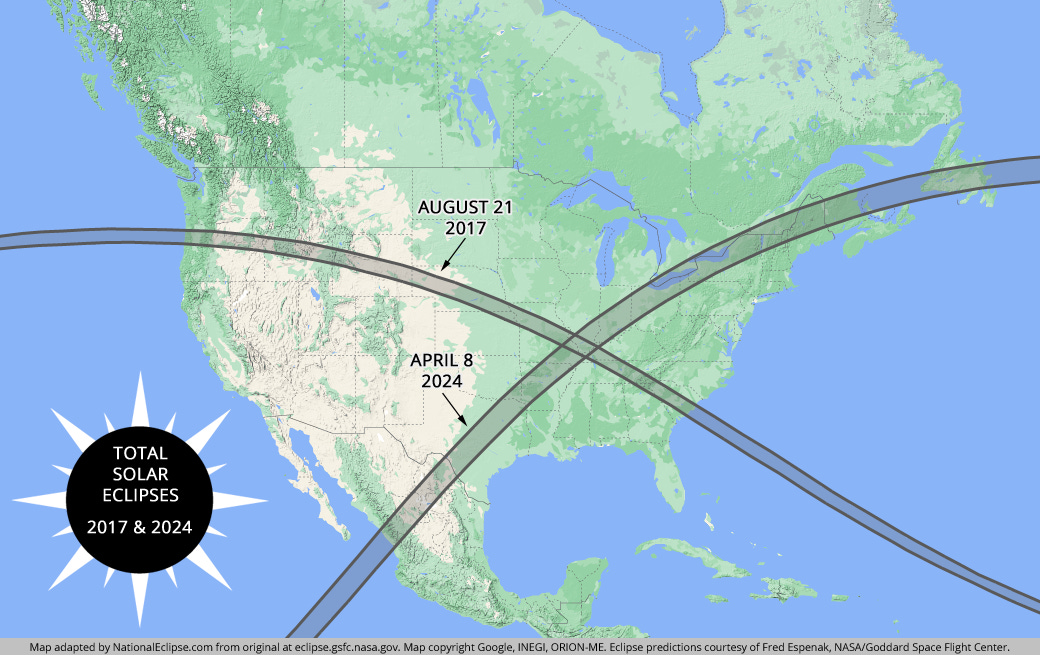
August 21, 2017. Standing in my San Antonio backyard at 1:09 PM, sweat soaking through my shirt. I point my 9.5-inch Schmidt-Cassegrain telescope at the sun. No looking through the eyepiece — the scope projects the image onto a piece of cardboard in my hand to view the partial eclipse. A small bite taken out of the sun, sharp-edged and strange, as sweat trickles from my face.
I found out that day that an annular eclipse was coming in six years, and a total solar eclipse a year after that. I made a mental note: don’t miss those.
The annular came October 14, 2023. The total came April 8, 2024. I walked through the same door, using the same gear. Set up at the same patch of grass.
I’m fifty and those seven years passed in a blink. It felt like a week.
That scared me.
Why Your Brain Does This
In September 2025, researchers from Cambridge published a study in Communications Biology that finally put a name to the feeling. They scanned the brains of 577 people, ages 18 to 88, while each person watched the same 8-minute Alfred Hitchcock clip.
Older brains shifted between neural activity states less often. Fewer distinct mental snapshots logged in the same stretch of clock time. The years don’t disappear. They just leave fewer fingerprints behind.
The brain isn’t broken. It’s filing efficiently. I walked out the same way and set up the same equipment in the same area. Nothing new to record. The 2017 memory and the 2023 memory are almost identical in my mind. The brain compressed them into one.
Paul Janet was teaching philosophy at the Sorbonne in Paris in 1877 when he first wrote about why time feels faster as we age. One of his doctoral students was the young Henri Bergson, who would later win the Nobel Prize for his work on time.
A year at age 5 is 20 percent of everything you’ve ever lived. At 50, it’s 2 percent. The older you get, the smaller each year becomes as a share of your total experience.
The calendar doesn’t lie. It just stops feeling accurate.
Men in 49 AD Felt It, Too
Seneca was in his early 50s, navigating Nero’s court in Rome, when he wrote On the Shortness of Life in 49 AD. His complaint wasn’t that life was brief. It was routine that made it disappear. “We are not given a short life,” he wrote, “we make it short.” Time didn’t crawl for Seneca. It glided past while everyone was too busy to notice.
Michel de Montaigne climbed the stairs of his tower library on his French estate most mornings in the 1580s, sat down among a few hundred books, and wrote about getting old. The view from the window hadn’t changed in years. The routine was the same, too.
He wrote that time had started folding into itself in a way it hadn’t when he was young. He wasn’t lamenting it. He was reporting it, the way you’d describe the weather.
William James had been walking the same streets of Cambridge for decades when he published Principles of Psychology in 1890. Same Harvard Yard, same Irving Street house. He wrote that by middle age, the years “telescope” together because novelty has run out. A man deep in routine, James wrote, looks back at a decade and finds almost nothing there.
Three men. Nineteen hundred years between them. All had the same feeling I did as I held the cardboard in my sweaty hand.

I watched the 2024 eclipse from my garage. Clouds had moved in, and the rain looked close, so the telescope stayed inside. I stood at the garage door and waited.
The sky went dark under the clouds. The streetlights flickered on. The birds started chirping, the way they do at dusk, startled by a darkness that wasn’t supposed to arrive for another six hours. It stayed dark for about two and a half minutes.
Then it lightened again. Faster than I expected.
Seven years had passed since the cardboard, the backyard, and the partial bite taken out of the sun. Seneca noticed it in Nero’s Rome. Montaigne noticed it climbing the stairs to his tower library. Scientists at Cambridge measured it in 2025 while people watched the same Hitchcock film inside an MRI scanner.
In 2017, the next eclipse felt impossibly far away.
In 2024, it felt like I had never put the telescope away.
Eclipses used to terrify entire civilizations. The older I get, the more terrifying the part is how fast the next one arrives.
Has the last decade felt like a year to you? Tell me in the comments.
An optimist writing about how history shows every generation thinks it’s over. It never is. Subscribe today for more just like this.
Why I Use Voice-To-Text With AI
Most of this piece started as voice-to-text using Wispr Flow. I talked through the eclipse memory, the backyard details, the garage scene, all of it dictated while the idea was fresh. That raw material went to Claude, who organized the rough draft. Then I took it from there.
I like Wispr Flow because it’s accurate. It also edits out my “ers” and “uhs”. Big help.
I resisted voice-to-text for years. I’m used to the physical action of typing, and it took a while to trust that talking could replace it. About a month ago, I discovered how much faster the early draft phase goes when I dictate into Wispr Flow and let Claude organize the raw material. The rough draft gets done faster. Then I spend most of my time where it belongs, improving, not starting.
What AI can’t do is supply the memory and judgment. The 1:09 PM detail, the cardboard, the birds chirping at 1:32 in the afternoon, those came from me. The research on Seneca, Montaigne, James, and the Cambridge study came from a mix of my own digging and AI assistance.
If you’ve been staring at a blank page, try talking at it instead.


I think the crazy coronavirus panic had a lot to do with "losing" some of those years. It was the same B.S. over and over for more than 2 years. Mostly lost time, but I did start a Substack. Still here 4 years later.
Yeah, that was part of it! Crazy times.