In 500 BC, a Greek Atheist Chopped Up His God and Cooked Dinner Over It
The ancient Greeks were already denying God.
This tweet about a guardian angel saving a life was viewed 1.5 million times last week.
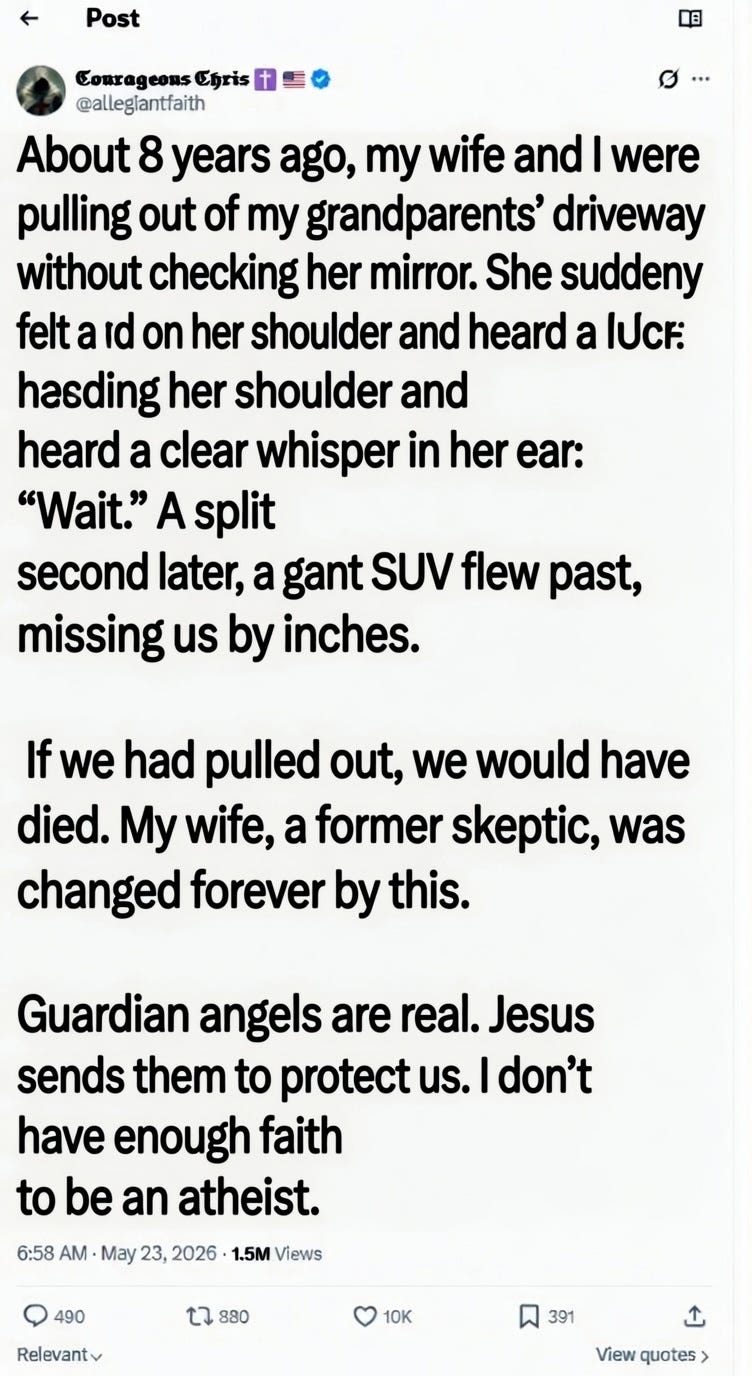
Hundreds shared their own stories about guardian angels. The hand of God showing up in ordinary moments.
I was one of them. My daughter’s roommate from Virginia Military Institute was killed in a bicycle accident in 2015. Her last words to her father as she left home the last time were:
‘I will go wherever God goes.’
Her parents found all of her belongings packed in boxes in her room after she died. She was about to leave for Parris Island and the Marine Corps. Her boxes were stacked in rows, taped up, labeled, and ready for the trip she never made.
Some years divide your life into before and after. I’d believed in God my whole life. That year, it became something more real than that.
Which got me thinking about the people who go the other direction. And how long they’ve been doing it.
"There is nothing new under the sun." — Ecclesiastes 1:9
Gallup released data in April 2026 that surprised many people. Young men ages 18 to 29 now say religion is “very important” at a higher rate than young women — 42% versus 29%. Two years earlier, that number for young men was 28%.
The Christian share of U.S. adults is around 62%, roughly where it’s been since 2019. The religiously unaffiliated — atheists, agnostics, the “nothing in particular” crowd — haven’t moved off 29% in years.
People have been announcing the death of God for centuries. God keeps outliving the obituary.
A certain argument keeps circulating online: science has replaced God. People centuries ago didn't have it, so of course they believed. We know better now. Belief is what you have before the proof shows up.
The Greeks would like a word.
Atheism in 500 BC

In the fifth century BCE, a Greek poet named Diagoras of Melos got himself exiled from Athens. He’d mocked the Eleusinian Mysteries, the most sacred initiation rites in the Greek world.
The story that followed him through 2,500 years was recorded by ancient writers who wanted to discredit him. He found a wooden statue of Heracles, chopped it up for firewood, and cooked his lentils over it.
That’s not a 2026 atheist podcast. That’s ancient Athens at its cultural peak. The same city that built the Parthenon, produced Sophocles, and invented democracy.
Athens produced the Parthenon and atheists at the same time
Theodorus of Cyrene, around 340 BC, went further than most. He denied the gods existed and argued that morality itself was just a set of rules invented by fools. Ancient writers knew him as ho atheos, or the atheist.
Protagoras, writing around 450 BC, gave us ‘man is the measure of all things’ and said he had no way of knowing whether gods existed. In a society where public religion was civic duty, that statement was nearly as dangerous as burning a statue.
Cambridge classicist Tim Whitmarsh makes a critical point: polytheistic societies such as Greece and Rome were more tolerant of disbelief than many of the monotheistic cultures that followed. When your system has many gods and room for flexibility, one more skeptic isn’t a threat. The harder crackdown on doubt came later.
Skepticism didn’t hide in the ancient world. It argued in public, with worn sandals scraping marble and smoke from sacrifice fires drifting over the crowd.
Atheism moved through the Enlightenment, picked up philosophical weight from Nietzsche and Marx in the 19th century, and arrived in the 20th century as something you could build institutions around. The New Atheism wave of the 2000s, Dawkins and Hitchens, made it loud and a little smug. Then that wave quieted too.
Athens built the Parthenon and produced atheists at the same time.
The arguing over faith and doubt never stopped.
A 24-year-old packs her belongings into boxes, writes her name on them in black marker, and doesn’t come home. Her last words to her father were: I will go wherever God goes.
Some people hear a story like that and feel God touch them. Some don’t.
Both responses go back further than most of us realize: all the way to a poet in ancient Athens cooking dinner over a god he didn’t believe in.
Athens had atheists before the Gospel of Matthew was written.
Ecclesiastes 1:9 says there's nothing new under the sun.
Not the whisper that started it, not the argument I had with myself afterward.
I write about history to show how every generation thinks it's over — and why it never is. Also, figuring out AI as a non-technical creator. Subscribe today.
A note on AI and research
Grok is good at historical research. Many believe it’s better than ChatGPT or Claude. It surfaces names, dates, and details fast. For a piece like this, it saved me a few hours of digging.
The problem is that it gives you too much. I made that mistake this week on a piece about Russia. The research was solid, I got enthusiastic, and too much of it ended up in the article. It wandered.
AI is miraculous for research. A treasture trove of information in seconds. But it’s up to you to judge what stays and goes. The reader doesn’t need everything you found. Give them enough to follow you, leave them some room to think. When you over-explain, you’ve killed the piece trying to help it.
This one I wrote today, I kept tighter. One idea, best details, everything else cut.
And verify what matters before it goes in. AI makes things up. The Diagoras story checked out. Not everything does.
PP


it is amazing though how history likes to rhyme. It is almost like we, as in our modern selves, just like it for the stories, but not for the lessons of fault our ancestors can teach us. As humans, we are resilient and adaptive. If only we remember that we were then maybe we could push further, rather than continue dwelling in a regressive mindset whilst simultaneously rooting ourselves in technological progression.
Good article! I like the way you were upfront at the end by admitting you use LLMs like Grok as research tools. AI chatbots are great mechanisms to use (if done right) in helping us shape our thoughts more profoundly. We still have to do the work though, the AI is only there as a "virtual assistant"... say a better version of Clippy.
I do the same with my pieces. I am a bit different. I'm not a fan of using chatbots entirely for research. But I do use it as a tool to help me draft my reflections. I will often spend a couple hours formulating through draft after draft of my own words in tools like Grok, Chatgpt or Copilot then ask it to help me articulate those words into a better form, so it doesn't sound like a 12 year old wrote it haha. Believe me, if I wrote my stuff without editing help, it would like a 12 year old.
I agree that the polarities like Greece and Rome never intended to care what you wish to believe on a religious or non-religious sense. Heck, Rome at its heighth never cared if you wish to worship many gods, one God or no gods. I mean, they tolerated the Jews. Their beef with early Christendom wasn't that we believed in one God and it was the "condemned criminal" Jesus. it was politically motivated that Christians weren't giving their allegiance to the State through the imperial cult of Caesar, and that we proclaimed one Lord, in Jesus the Nazarene as son of God. That wasn't religious indifference for the Romans; that was political sedition.