What the Rebel Yell Actually Sounded Like
The Rebel Yell wasn't a yee-haw. We have recordings.
Stonewall Jackson survived two years of the bloodiest war in American history. He was killed by his own men.
May 1863, Virginia wilderness. A group of nervous Confederate soldiers heard movement in the trees after dark and opened fire. Jackson took three bullets. He died eight days later. This week marks the anniversary of that battle — Chancellorsville — arguably Robert E. Lee’s greatest victory, won while outnumbered nearly two to one.
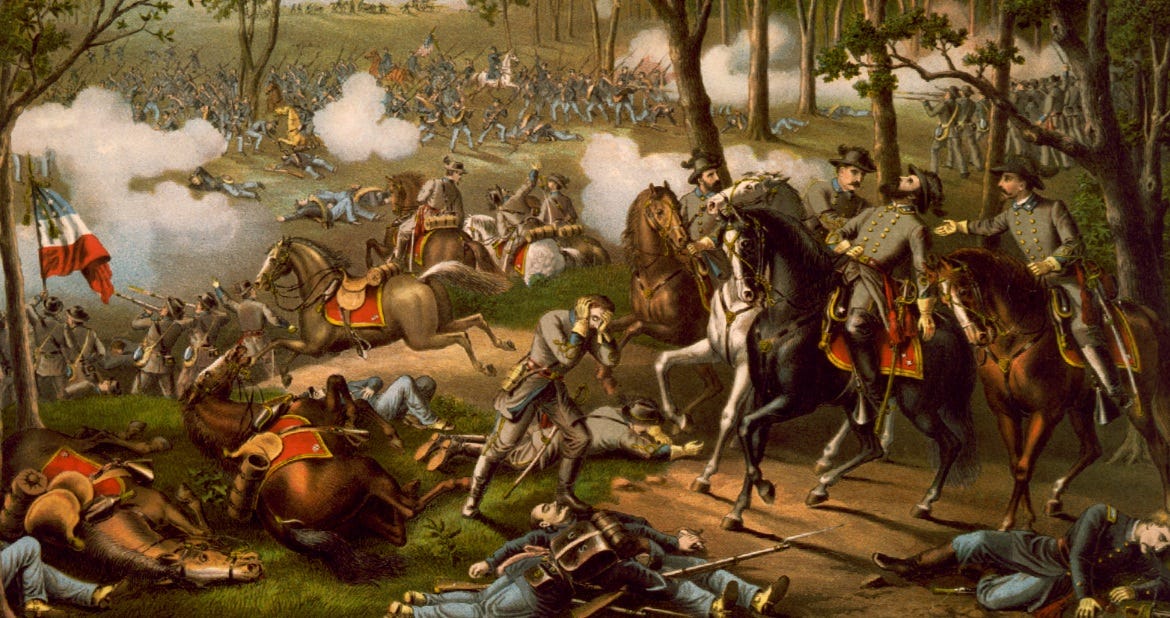
My daughter went to Virginia Military Institute, where Jackson taught before the war. When she arrived as a first-year student, she was required to salute the Stonewall Jackson statue every time she entered or left the barracks. That detail stayed with me. It sent me down a rabbit hole — not about Jackson exactly, but about something connected to him. Something I had completely wrong.
The Rebel Yell.
Most of what Americans know about the Rebel Yell comes from Hollywood. A “yee-haw,” a cowboy whoop, the kind of sound you hear at a rodeo. A “yee-haw” is celebratory. It doesn’t sound like something that freezes a man where he stands.
In the 1920s and 1930s, researchers tracked down elderly Confederate veterans — men in their 80s and 90s — and recorded them doing it. The recordings exist. I’ll link to one below.
They sound nothing like a “yee-haw.”
Listen.
The closest description I can offer is a shriek crossed with a bark. High-pitched, jagged, not quite human. I tried to replicate it after hearing the recordings. My voice isn’t built for it.
Union soldiers who heard it from a distance had a saying: it was either “Jackson, or a rabbit.” The sound was that close to a rabbit’s scream.
Another recording got fed into audio software and multiplied — thousands of voices doing that shrieking bark at once. Picture an open field. Smoke hanging low. Ground churned up beneath your boots. Then that sound, rolling toward you out of the haze.
That sound has a specific origin. It happened on the same afternoon Stonewall Jackson became Stonewall Jackson.
July 21, 1861. First Battle of Bull Run. The Union had come out expecting a quick finish — Lincoln called for 90-day volunteers, that’s how fast everyone assumed this would end. Families rode in from Washington, D.C., to watch the show, where the Union Army would end the rebellion in days. The battle eventually became a Confederate rout.
Late in the afternoon, with the battle turning, Jackson ordered his men to hold their fire until the enemy closed to within 50 yards. Then he gave the order: “Fire and give them the bayonet. And when you charge, yell like furies.”
Union troops heard it for the first time, and it stopped them cold.
That same afternoon, a Confederate general named Barnard Bee pointed at Jackson’s brigade and shouted: “There is Jackson standing like a stone wall.” Bee took a bullet through the stomach shortly after. He died the next day. The name stuck.
The Rebel Yell and the Stonewall nickname — both born on the same hill, on the same July afternoon, two years before Jackson was shot by his own men in the dark at Chancellorsville.
There’s something about Jackson worth knowing, and I didn’t learn it until my daughter went to VMI.
He taught Natural and Experimental Philosophy — essentially physics — and artillery tactics. The physics part was the problem. His natural philosophy classes covered physics, astronomy, and other subjects he had never actually studied.
His solution was to memorize his lectures the night before and deliver them verbatim the next day. If a cadet didn’t understand something and asked him to explain it, Jackson would read the passage again. A little louder this time. That was his entire pedagogy.
VMI’s own superintendent wrote: “As Professor of Natural and Experimental Philosophy, Major Jackson was not a success. He had not the qualifications needed for so important a chair.”
The cadets knew it. They drew caricatures of him on the blackboard — usually an officer with enormous feet, which earned him the nickname “Square Box.” They threw spitballs when his back was turned, dropped bricks as he walked under barracks windows, and pulled linchpins from cannon wheels during artillery drill.
One cadet challenged him to a duel and got court-martialed for it. A group of alumni formally petitioned the board to have him removed. None of it worked.
He stayed ten years.
Something changed as cadets moved into their senior years. The ridicule of freshmen became the respect of upperclassmen. They started to see what he was actually trying to do. He wasn’t teaching physics. He was teaching discipline, obedience, and the capacity to function under pressure. The classroom was the room where it happened.
Then the war started, and the terrible professor became a legendary leader of men.
Within two years, Jackson’s name was known across Europe. His Shenandoah Valley campaigns were studied by military minds in France and Britain. The secret wasn’t strategy alone — it was speed, and the speed came from stripping everything down to almost nothing.
His men carried a day’s rations in a haversack. Not much else. No excess, no comfort, nothing that slowed a march. He pushed them until their legs gave out, then pushed them further. He showed up where he couldn’t possibly be. Commanders on the other side kept making plans based on where Jackson was, and he kept being somewhere else entirely.
You’d think the men hated him for it. Sometimes they did. But the accounts from that period say something else — that he was cheered wherever he went among his troops. They respected him in the way soldiers respect a commander who runs them hard because he knows what he’s doing. They sensed he cared about them, even when he was grinding them into the dirt. That combination — relentless and trusted — is rare in any era.
He was shot before anyone could see how far it would go.
In 2020, VMI removed the statue my daughter used to salute. Strong feelings on all sides, and people I respect disagree about it. What stays with me is simpler than the argument: the statue pointed back toward a man who turned out to be one of the more extraordinary military minds in American history. You never would have guessed it, sitting in his classroom.
That gap between who someone appears to be and who they turn out to be — that’s the thing.
Same as the Rebel Yell. We thought we knew what it sounded like. We were wrong.
Listen to the recordings. Then tell me a “yee-haw” would have stopped an army.
You won’t hear this version in textbooks.
Or in movies.
If you want the real details—
Subscribe.


SC Gwynne's 'Rebel Yell' is a great read for anyone interested in Stonewall Jackson.