

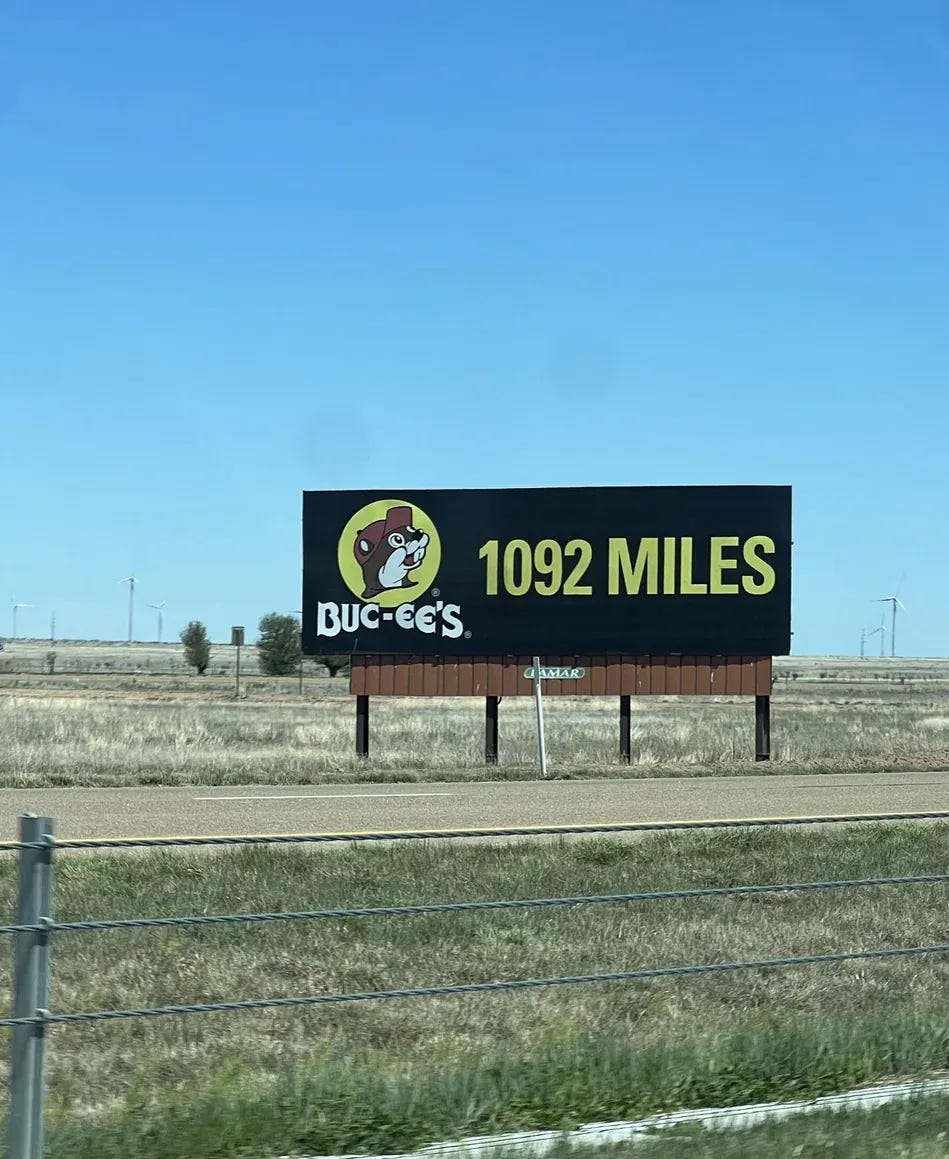
I drive 1,448 miles to Ohio four times a year.
Buc-ee’s is part of my ritual.
The billboards start a thousand miles out. The sign is visible a mile away, and I pull in with 200 other cars, all headed for the same 120 pumps.
Buc-ee’s is America in one highway exit:
Give free people room, and they build BIG.
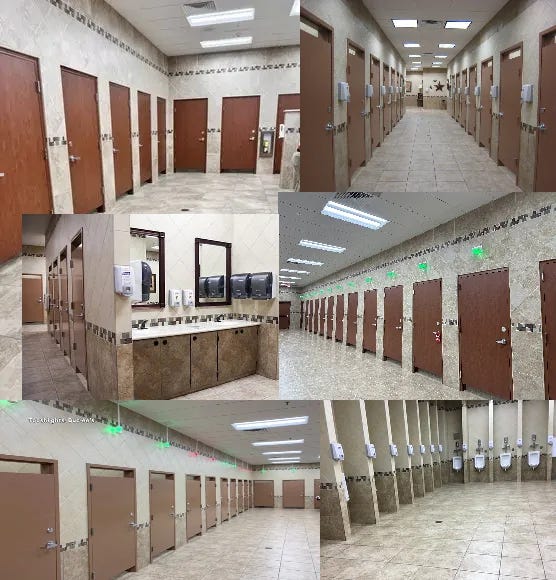
Seventy-two spotless toilet stalls. Seventy-five thousand square feet. Fresh brisket. Cheap gas. Beaver Nuggets.
James Madison would understand the Buc-ee appeal.
In Federalist No. 10, Madison wrote that people have different abilities, and that protecting each person’s freedom to use them is “the first object of government.”
He believed that protected freedoms would produce huge dividends.
Unequal abilities would produce unequal wealth, too. But he bet liberty was worth the disorder. Two centuries later, drivers line up at a 120-pump gas station because a Texan was free to think ridiculously big.
Madison's generation started it.
Jefferson Supersized the Country in 1803
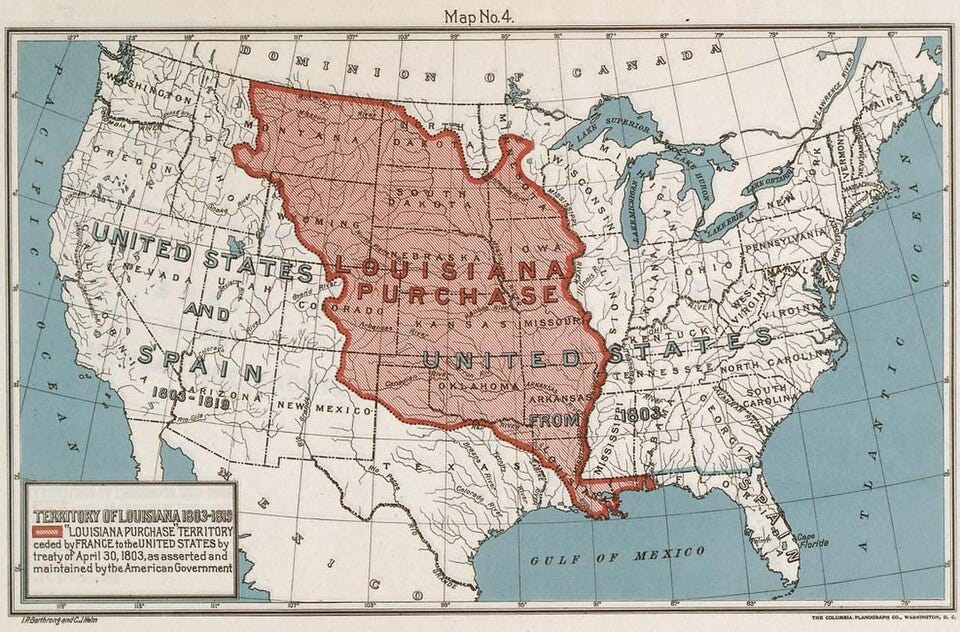
France offered the Louisiana Territory to America in 1803.
Napoleon needed cash for his wars in Europe and wanted a quick transaction. Thomas Jefferson had spent his career arguing for a limited federal government that stuck to the letter of the Constitution.
The Constitution didn’t mention buying 828,000 square miles from a foreign king.
Jefferson didn’t care.
Fifteen million dollars, or four cents an acre, for land most Americans had never seen and no one had fully mapped. The purchase doubled the size of the United States overnight.
Jefferson looked at the biggest opportunity of the young nation’s life and decided to throw the dice in the Louisiana Territory.
The Mississippi River, the port of New Orleans, and the farmland that would feed the country for two centuries. It all of it came from a man ignoring his own rulebook because the deal was too large to refuse.
Past Passport is for history lovers optimisitic about the future. Three times a week. Free.
Europe Builds The Same. Just Much Smaller.
Italy and France have solid service stations with coffee and bathrooms. They are also a fraction of the size, because those countries never made the bet the Founders made.
The World Cup brought the difference to America this summer. Foreign fans streamed in and started filming Buc-ee’s as if it were a national monument.

A Scottish visitor named Blair McNally looked at the scale of American everything and said it was “tenfold compared to what we have” back home. A German fan built a following posting his first walk through one. They were delighted, the way you are when you realize something you did not realize was allowed.
Every driver wants a few of the same things and then wants to get moving again. The American version asked a bigger question and answered it at 75,000 square feet. The bathroom stop became the destination.
No Ceiling = No Floor
American scale carries a bill. Alongside the marvels come the overreach, the cut corners, the monopolies, and busts.
The Founders knew people were not angels. Madison said as much in Federalist No. 10: the same freedom that lets people build also lets them overreach, and you cannot separate the two.
He wagered on freedom.
Building big has never made anyone virtuous. It shows what people do when you take the chains off: they reach further than they were supposed to.
The Beaver in the Parking Lot
George Washington wouldn’t know what Buc-ee’s is. James Madison wouldn’t know what Beaver Nuggets are.
But both men were betting on something they couldn’t yet see: that free people, left alone, would keep building bigger than anyone expected. That bet is still paying off.
Past Passport is a community of history lovers optimistic about the future. We look back to see how people got through hard things — and came out fine. Three times a week. Free.
Claude Introduces Opus 4.8
The heavy Claude model right now is Opus 4.8, Anthropic’s most capable, widely released model. It’s built for the hard-core stuff: production code, multi-step reasoning, long documents where you need the thing to hold a whole argument in its head at once.
On the toughest problems, it’s the tool you want. But it’s costly, so use it wisely.
This essay is not the toughest problem. Most of what I did here was line editing, cutting a phrase, testing a sentence against my voice rules, and checking whether Madison actually said what I claimed.
That work doesn’t need the bazooka. Reaching for the most powerful model to trim a comma is like hunting a rabbit with a bazooka. You’ll get the rabbit. You’ll also waste the shell and make a mess.
So the real skill isn’t always using the biggest model. It’s knowing which job needs which tool. I used the powerful one for the structural passes, the research pulls, the cohesion check. For the small stuff, regular Claude was fine.
Long ago, I worked for a convenience store chain based in Texas. I remember talking with the VP about what the stores really needed — clean bathrooms. He looked at me like I was nuts. People didn’t care about that.
Five years later, Buckee’s opened their first store in Luling Tx, not too far from one of our stores.
I’ll let you fill in the rest of that story.
Buc-ee’s really is America in one stop....enormous, efficient, slightly absurd, and somehow impossible not to admire.