

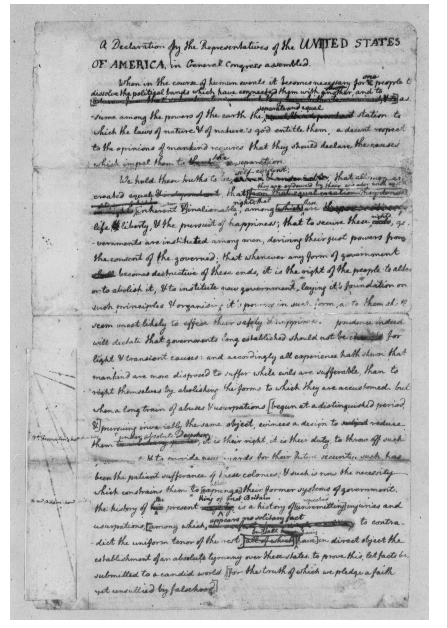
"We hold these truths to be self-evident, that all men are created equal, that they are endowed by their Creator with certain unalienable Rights, that among these are Life, Liberty and the pursuit of Happiness."
What do you remember from the Declaration of Independence?
I remember the first line. After that, my memory gets sketchy.
But the 27 grievances that follow the opening are the most important part.
I need to review them during the week of America’s 250.
You probably do, too.
A 2026 AEI survey found that only 29 percent of Americans have read the full Declaration. Another 26 percent have never read a word.
The 27 built an airtight legal case at the core of the Declaration, laying the foundation for the country we have today.
Jefferson named the sources he based the argument on: Aristotle, Cicero, Locke, and Sidney. Those 27 grievances aren’t a list of complaints.
They’re a complex legal argument that educated readers in 1776 would have recognized on sight.
Without that argument holding up, you might be speaking with an English accent right now. And July 4 is just another day.
Jefferson was filing a criminal indictment.
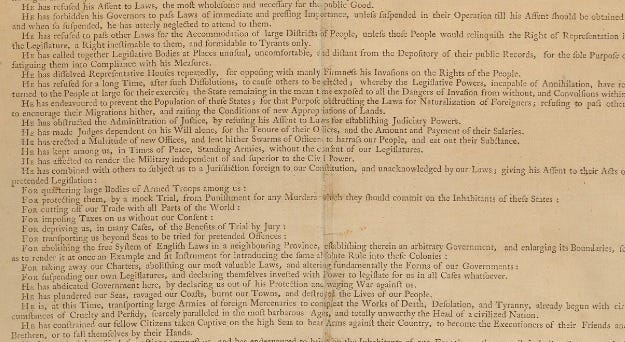
Jefferson let it rip after the famous opener with 27 detailed grievances against the king.
“He has kept among us, in times of peace, Standing Armies without the Consent of our legislatures.” “He has erected a multitude of New Offices, and sent hither swarms of Officers to harass our people and eat out their substance.”
Sounds less like the birth certificate of a nation and more like a furious letter to a landlord.
Think about the last time you had to build a case like that. Not a complaint….a case. You don't write down adjectives. You write down the details: dates, names, dollar amounts. Jefferson did the same thing because he knew the same thing every person filing a real grievance knows: nobody believes emotions.
They believe a list of facts.
Locke wrote the rulebook. Jefferson just filed the paperwork.
Don Hagist, editor of the Journal of the American Revolution, has identified the genre: an impeachment proceeding. English law had standing provisions for declaring a monarch had broken his obligations to his subjects. Jefferson wasn’t writing a manifesto. He was filing a charge sheet under that framework.
That framework came from John Locke’s Second Treatise of Government, written roughly a century earlier. Strip Locke’s argument down: government exists because people consent to it, in exchange for protection of their natural rights.
Break that exchange once and you have a bad king. Break it repeatedly, over years, and you have grounds to dissolve the government entirely.
Theory only gets you so far in a courtroom. Jefferson knew that.
So that’s what Jefferson built: dates and specifics, item by item.
Judges dependent on the king’s will for their salaries. Standing armies kept in peacetime without colonial consent. Trial by jury stripped away. Legislatures dissolved for disagreeing.
Jefferson provides the receipts.
The Declaration’s basis had already killed a man 2,000 years ago.
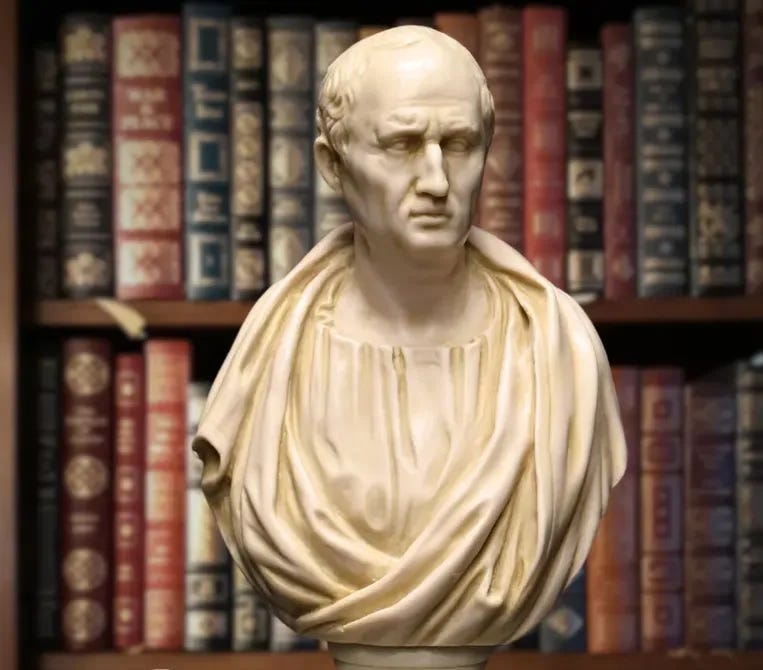
Locke supplied the mechanism for the rebellion. The idea underneath the mechanism was already old when Locke found it, written down some 17 centuries earlier by a Roman on a papyrus scroll, by a man who was killed for writing it.
Cicero, writing in Rome a century before Christ, argued that true law exists above any king or senate: constant, universal, impossible to repeal by a vote. A ruler answers to that law instead of inventing it. He was assassinated for the argument, his name placed on a death list by the men he’d accused.
The American Founders cited Cicero on this point even more than on how to structure a government. The natural-law argument is what they kept reaching for.
Jefferson reached for it too. The opening line of the Declaration, the one everyone can quote, makes Cicero’s exact claim in different words: rights don’t come from the king, they come from something above him, something he never had the authority to grant or take away in the first place. That’s Cicero’s argument, inherited and applied to a king 18 centuries after Cicero made it about a senate.
Jefferson wasn’t shy about naming his sources. Decades later, asked where the Declaration’s ideas came from, he pointed to the “elementary books of public right”: Aristotle, Cicero, Locke, Sidney.
Algernon Sidney is the name most people have never heard, an Englishman executed in 1683 for the same argument: that resistance to tyranny is the people taking back a right they never surrendered. Jefferson read him, cited him, and borrowed the argument that cost him his head.
The pamphlet was already on Jefferson’s desk.
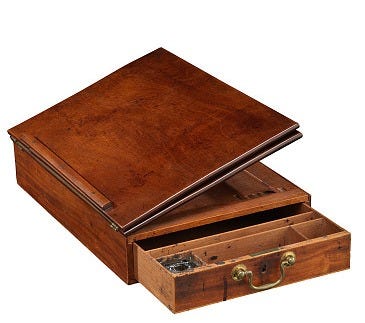
Cicero, Locke, Sidney. None of it was abstract for Jefferson in June 1776. All three were on his mind as he sat in a Philadelphia boardinghouse on the evenings of June 12 and 13, drafting by candlelight, his quill scratching out lines almost as fast as he wrote them.
His own bound collection of papers from that period includes a freshly printed pamphlet from Virginia: George Mason's Declaration of Rights, finished just weeks earlier in the same city where Jefferson was working. The argument he needed wasn't only in old books. It was sitting in his own stack of papers, written by a neighbor, that same month.
The draft went to committee. Adams and Franklin made changes. Congress altered roughly a quarter of the text before adopting it on July 4. The final document is a committee product, assembled from material everyone in that room had already absorbed.
That detail changes the usual story people tell about the Declaration, where one brilliant man invents the case for freedom alone. Jefferson built his case in a legal charging document his contemporaries would have recognized, citing his sources, submitting the draft for revision, and producing something that has now outlasted every government it was written to replace.
Cicero died for the idea. Sidney lost his head for it. Jefferson never paid that price. He only had to write it down, get it past the committee, and hope the war went well.
Past Passport is history with an optimistic streak. Every generation thinks its problems are unprecedented. They rarely are. People before us had less and figured it out. Join us three times per week!
Each year around the Fourth of July, I consider the Declaration.
I also conclude that the colonists didn't have it nearly as bad as we do under our government today.
And nobody does much of anything about it.
I'm thankful for Independence, but the current taxation schemes alone are much more egregious than anything George III or Parliament ever inflicted on the Colonies.
The Declaration is much more powerful when you read it as a case being made, not just a famous opening line. The preamble gives the principle. The grievances show the proof.