

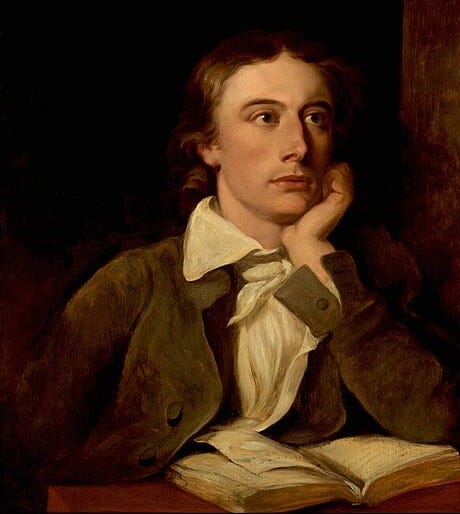
One evening in October 1816, a 20-year-old poet sat down with a 200-year-old book and didn’t sleep until dawn. By morning, he understood Homer for the first time.
Christopher Nolan’s Odyssey opens July 17. Most of the people buying tickets have never read a word of Homer.
That’s how the Odyssey has always worked.
John Keats had read Homer before.
Every educated young Englishman had. Alexander Pope’s translation had been the standard English Homer for a century, polished and elegant. Pope rendered Homer in rhyming couplets. Elegant, controlled, every line squared off at the edges. It was Homer dressed in neoclassical clothes.
That night in October 1816, Keats and his friend Charles Cowden Clarke borrowed a folio edition of George Chapman’s translation, published in 1614. Clarke’s rooms were in Clerkenwell, a working district in central London. October in London meant cold air, wet cobblestones, and the smell of coal smoke. They sat in a small room until dawn with the folio open on the wooden table between them, reading passages aloud.
They were astonished at this Homer. Keats shouted with delight, Clarke later recalled, whenever lines of great energy struck him.
Chapman’s Homer was another story. Where Pope was smooth and urbane, Chapman was raw and muscular, Elizabethan in its energy, loud and vigorous in a way Pope’s version never attempted.
“He spoke, and straight his senses fell from him.”
(Book 5, Chapman’s Odyssey)
Keats had read Homer before. He had never heard Homer like this.
Most people do not discover Homer. They discover one person’s Homer.
Sleepless at first light, Keats walked home through the waking city, roughly two miles across London Bridge and south to his lodgings in Dean Street, with the poem already forming in his head.
By 10 AM, Clarke found the poem on his table.
The Sonnet
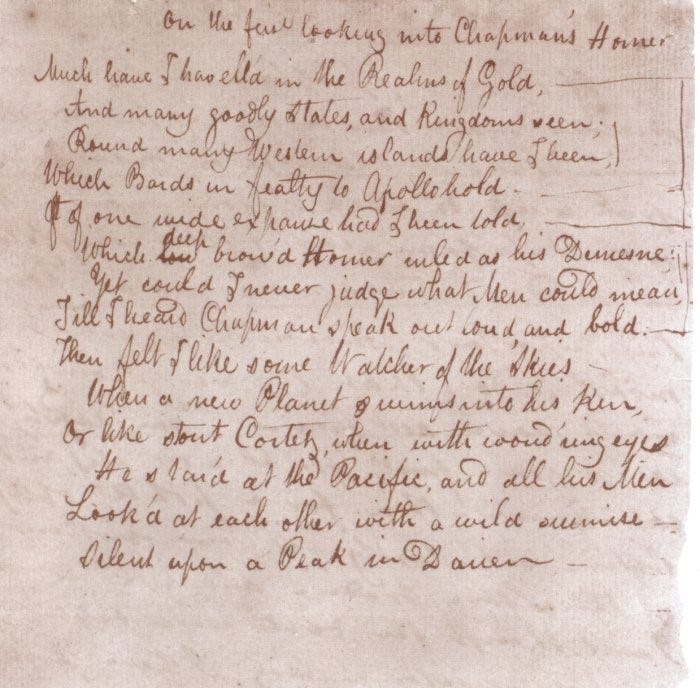
“On First Looking into Chapman’s Homer” is fourteen lines. Keats wrote it in one sitting after an all-night reading session and sent it to Clarke before breakfast. He nailed it almost word for word on the first pass. It has been in print ever since.
Much have I travell’d in the realms of gold,
And many goodly states and kingdoms seen;
Round many western islands have I been
Which bards in fealty to Apollo hold.
Oft of one wide expanse had I been told
That deep-brow’d Homer ruled as his demesne;
Yet did I never breathe its pure serene
Till I heard Chapman speak out loud and bold:
Then felt I like some watcher of the skies
When a new planet swims into his ken;
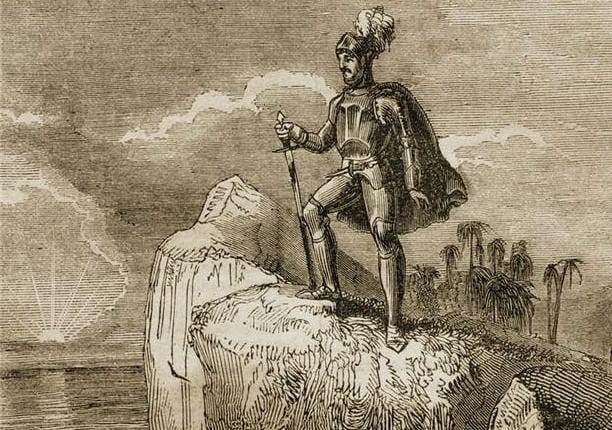
Or like stout Cortez when with eagle eyes
He star’d at the Pacific — and all his men
Look’d at each other with a wild surmise —
Silent, upon a peak in Darien.
— John Keats, “On First Looking into Chapman’s Homer,” 1816
The poem describes the experience of discovery, not Homer's content. Keats compares himself to an astronomer watching a new planet swim into view, and to an explorer standing on a peak staring at an ocean he has only heard about.
He used Cortez as his explorer, though it was actually Balboa who first saw the Pacific from Darien in 1513. Keats either confused the two or chose Cortez because the name fit the line better.
The image survives because the feeling is right.
Most great works arrive twice. First as an assignment, and years later as a revelation.
You know something exists. You have been told it is vast. Then one night, someone hands you the right version at the right moment, and it opens up before you like an ocean.
I tried War and Peace three times before the Pevear and Volokhonsky translation made the first 200 pages feel like a completely different book. The translation made Tolstoy more accessible to me, and I was also older.
A masterpiece is sometimes just a book that reached you before you were ready, then came back later.
Every Generation Gets Its Own Door
Long before translators, rhapsodes, traveling performers who had memorized Homer, recited the poems at festivals across Greece to audiences who would never own a scroll.
Chapman’s translation gave Keats his Homer in 1816. Robert Fagles, whose 1996 translation sold over a million copies, gave a different generation theirs.
The Odyssey has traveled this way for nearly 2,700 years, through performers, scribes, translators, teachers, paperback publishers, and now a filmmaker working in IMAX. The story doesn’t change. The door does.
Nolan’s film will be the Chapman moment for millions of people. They will sit in a dark theater and hear Homer speak out loud and bold for the first time. Some of them will go looking for the book afterward. Some will find Fagles. A few will find Chapman.
Twenty-seven centuries later, Homer is still being performed to crowds in the dark.
That’s how the Odyssey has always worked.
Odysseus doesn’t find you. Someone hands you the right version at the right moment, and suddenly you’re standing on a peak in Darien staring at an ocean you didn’t know existed.
Homer survived the collapse of Bronze Age kingdoms, the fall of Greece, the fall of Rome, lost manuscripts, shipwrecked libraries, bad translations, and 2,700 years of human history.
He will probably survive Hollywood, too.
How to Make Claude ‘Sort of’ Sound Like You
A newsletter called How to AI published a guide last month on building a “voice file,” a compressed document you upload to Claude or ChatGPT so it writes in your voice. I’ve been building versions of these for months, and the approach works.
The file gets Claude closer to sounding like you, but not exactly.
This piece started as an AI draft. I spent several hours editing it back into something I’d actually publish. The voice file removes maybe half the distance between AI output and my actual writing. But I still have to read every sentence out loud and fix what sounds strange and not me.
Give it a try and see how close you can get Claude to sound like you. It saves time. But you will always need to do extensive editing before you hit publish. I usually run at least five drafts after the initial voice dump before I publish my articles.
History shows every generation thought it was over. It never is. I also discuss AI as a history writer.
I first read Keats in high school. Finally, a poet I liked. Then I found out he died young and didn’t produce much. 😥