

You love Art Deco. I love Art Deco. Who doesn’t love Art Deco?
Funny you asked.
Le Corbusier. Merely the most famous architect of the 20th century, round black specs and all.
In 1925, when Paris threw a big shindig to show off the style, he put out a book called The Decorative Art of Today and took a swing at the guest of honor:
“Modern decorative art has no decoration.”
Harsh, Monsieur.
Didn’t matter... the buildings he sneered at soared skyward anyway (or underground, in Moscow’s case), in the worst years anyone can remember.
Gold ceilings in Philly during the Great Depression. Palaces in Moscow’s subway while Stalin’s Great Purge raged up top.
So when somebody under every Art Deco photo wonders “why can’t we build like that anymore?”... relax, friend. We can, anytime we choose to.
If broke, scared people built all this... what’s our excuse? And if we don’t build it again, what then?
Grab your passport, dear reader. We begin in Paris, 1925, at the party Le Corbusier crashed... and end up 33 meters under Moscow.
Social Media, Inc. wants you mad and scrolling. At Past Passport, we nuke the doomscroll with history, art, and beauty. Join us and get:
3 history essays a week. No dull dissertations.
3 weekly notes on how we use AI to create more and consume less.
1 extra issue a month: an AI breakdown or a Stoic essay.
An open DM session on the month’s top article.
First week free, then $5 a month.
The 1915 fair postponed by 1.4 million funerals
French designers first pitched the fair in 1907. Parliament signed off in 1912 and penciled in 1915.
Party time set. Then came August 1914.
And the Marne... and the Somme... and Verdun... and Flanders.
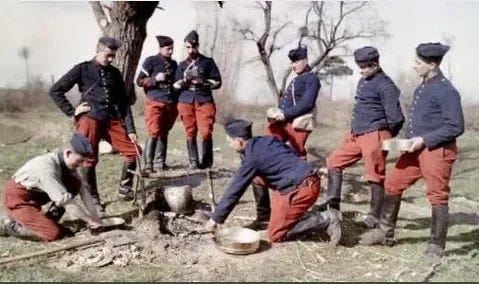
The boys marched off in red wool trousers, the same red their grandfathers had worn. German machine gunners could pick them out across a wheat field. And mowed them down.
On August 22, 1914, about 27,000 French soldiers died in a single day.
Back home, the news came on foot. Picture the village mayor walking up the lane in his good coat... and a mother at the window who knew before he knocked.
Walk into almost any French village today, and there’s a stone monument in the square, names carved in long columns. Sometimes the same family name three times in a row.
By the armistice, about 1.4 million French soldiers lay dead... and the fair went in a drawer.
Paris threw the soirée anyway. Le Corbusier crashed it.
Stubborn folks, the French. They soldiered on with the fair.
On April 28, 1925, six years after Versailles, the gates between the Grand Palais and the Esplanade des Invalides opened. Over seven months, more than 16 million visitors clicked through the turnstiles.
Helen Appleton Read, an American critic on the scene, called her first impression “startling.”
No kidding.
On the Esplanade, René Lalique stacked a 15-meter-high glass fountain, seventeen tiers ringed with 128 glass women, lit from inside after dark. The novelist Colette called it “marvelous,” and lost visitors used it as their meeting spot.
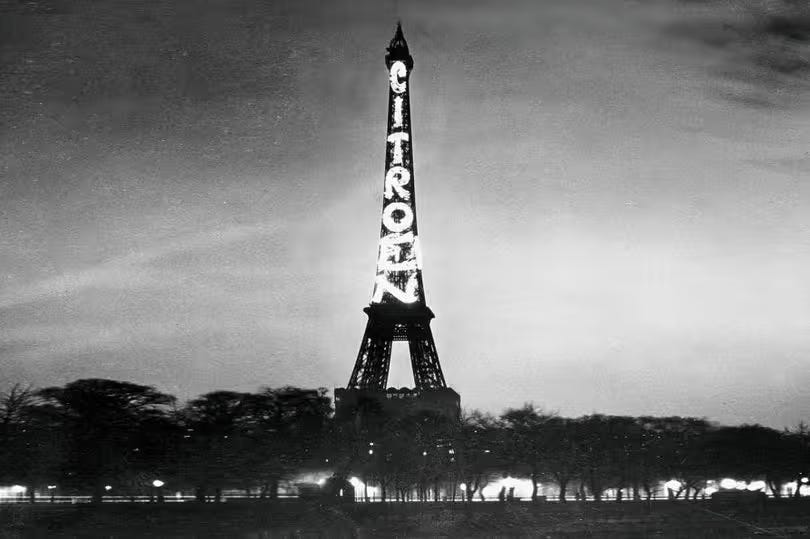
In July, André Citroën rented the Eiffel Tower and wired it with 250,000 light bulbs, spelling his name down three sides in 30-meter-tall letters. Citroën’s own fan club claims you could see it 40 kilometers away. (Subtle, André.)
Now, Le Corbusier’s spot.
His Pavillon de l’Esprit Nouveau didn’t open until July 18, nearly three months late.
A plain white box with Fernand Léger paintings inside and bentwood Thonet chairs, the same kind you’d sit on in any Paris café. A tree already stood on the lot, so he cut a hole in the roof and let it poke through.
The organizers’ review? An 18-foot fence around it. Allegedly to hide construction. Le Corbusier cried foul, and the Minister of Fine Arts, Anatole de Monzie, had it torn down.
Round one to Le Corb.
In his magazine, L’Esprit Nouveau, he mocked the fair in a run of articles. The heading usually credited to them: “1925 Expo: Arts Déco.”
Beware what you mock. In 1966, a Paris show at the Musée des Arts Décoratifs made his nickname official, and “Art Deco” stuck for good.
Your town buries that many sons, then spends a spring six years later on vases and lamps. Silly? Maybe. Or maybe that’s how a country tells itself it’s time to live again.
Americans loved what they saw. Four and a half years later, their money vaporized on Wall Street.
America hung gold ceilings with 25% unemployment
Black Tuesday, October 29, 1929.
Traders dumped 16 million shares on the New York Stock Exchange in a single trading day. The ticker almost busted as panic flashed across the heartland.
You’ve heard bankrupt men in derbies leaped from Wall Street windows. Mostly legend. New York’s chief medical examiner counted 44 suicides in Manhattan the month after the crash... fewer than the 53 the year before.
By 1933, one in four American workers were jobless. In Chicago, Al Capone opened a soup kitchen.
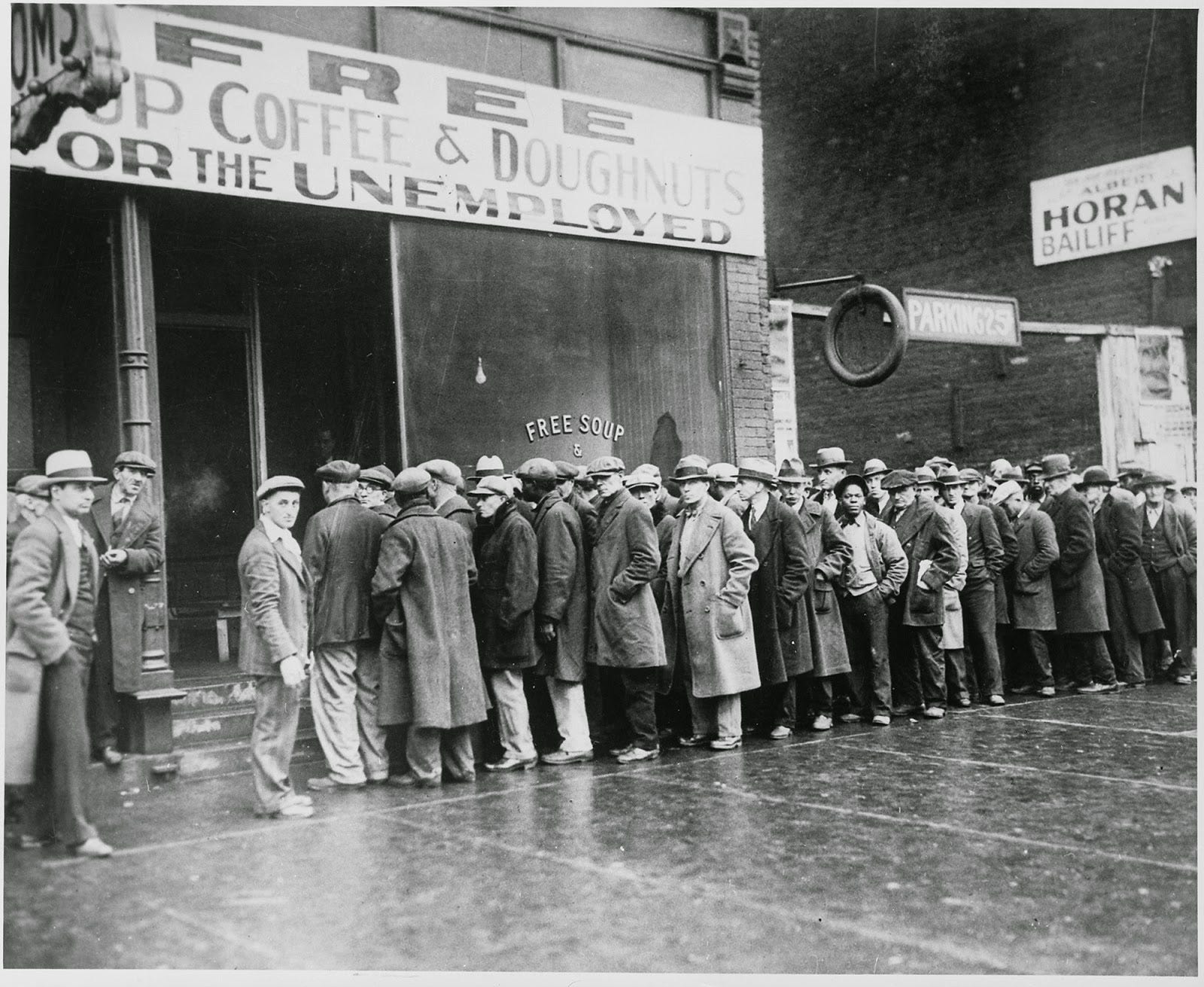
Dark times when the mob fed the poor.
You’d figure the cranes would stop. Nope. The Great Depression was in full swing, but Art Deco had caught on, and buildings went up left and right.
Easy? Not by a long chalk.
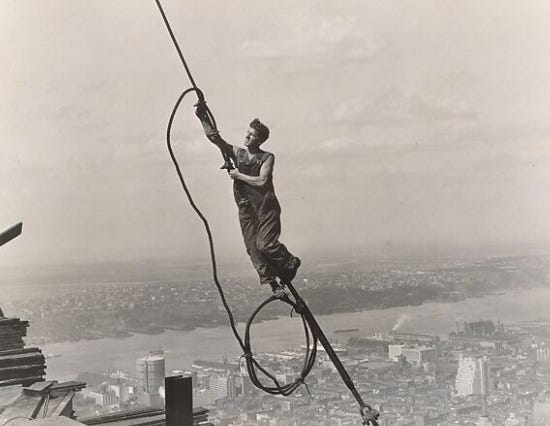
In January 1930, crews started digging for the Empire State Building. The ironworkers raised 57,000 tons of steel in about six months... no hard hats, no harnesses, wool caps and work boots on bare steel 1,000 feet over Fifth Avenue.
A heater tossed red-hot rivets through the wind, and a catcher snagged them in a tin can. Miss one, and it dropped toward the street.
Look out below.
Lewis Hine, a 56-year-old photographer lugging a 4x5 Graflex, climbed up beside them. For the best angles, a crane swung him out over Manhattan in a basket. He nicknamed the crews “sky boys.”
Five of them died. For 1930, that counted as a good safety record.
And if one of those sky boys cut his hand on a rusty beam? Pray. Alexander Fleming had spotted penicillin in a London lab in 1928, but no patient got a dose until World War II was raging.
Then came May 1, 1931.
President Hoover pressed a button in Washington, the lights blazed on in Manhattan, and the owners threw open the doors... to a building about 75 percent empty.
New Yorkers called it the “Empty State Building.” It didn’t turn a profit until the early 1950s. Ouch.
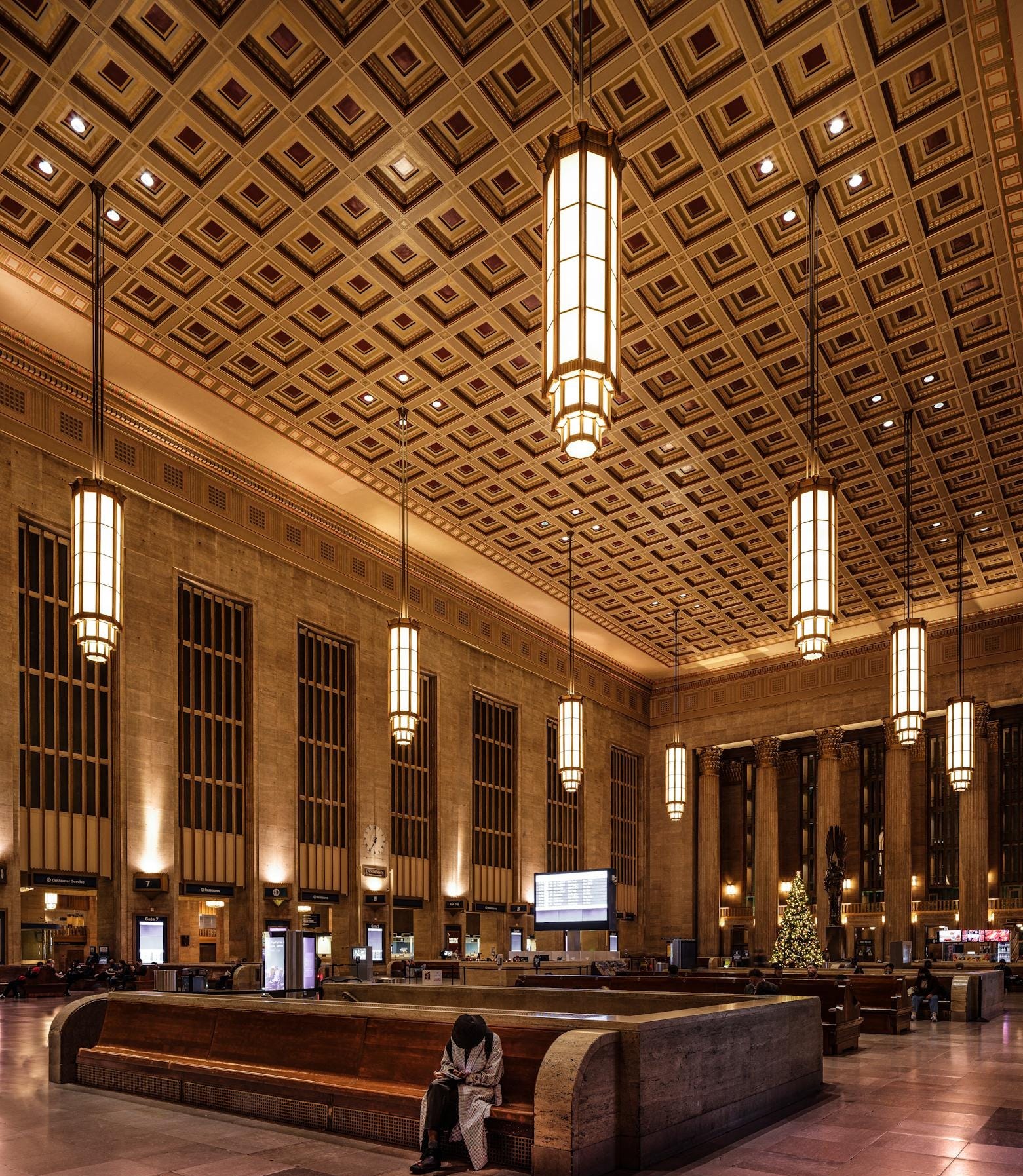
Down the road in Philly, the Pennsylvania Railroad broke ground on 30th Street Station in 1927, when money grew on trees. The station opened in 1933, when money was as scarce as snow in the Congo.
The railroad could have built a simple, unremarkable concrete-and-steel station.
Instead, travelers walked into a 290-foot-long concourse under a coffered ceiling 95 feet up, sunken squares painted gold, red, and cream. Ten Art Deco chandeliers, each 18 feet tall, hung over a Tennessee marble floor.
Breadlines outside. A gold ceiling fit for Versailles inside.
Next time your week goes down the toilet, and the phone won’t quit buzzing with bad news... remember the catcher 1,000 feet up, tin can out, a red-hot rivet flying straight at him.
Meanwhile, 4,600 miles east, Moscow was building too... underneath a reign of terror….
