Livy Wrote 142 Books. Rome’s Humidity Erased 107 of Them.
The fall of Rome didn’t burn the scrolls. It just stopped replacing them.
Editor’s note: AI helped me find a key detail for this essay: Roman statesman Cassiodorus, who built a monastery to copy ancient texts. More information at the bottom of the essay.
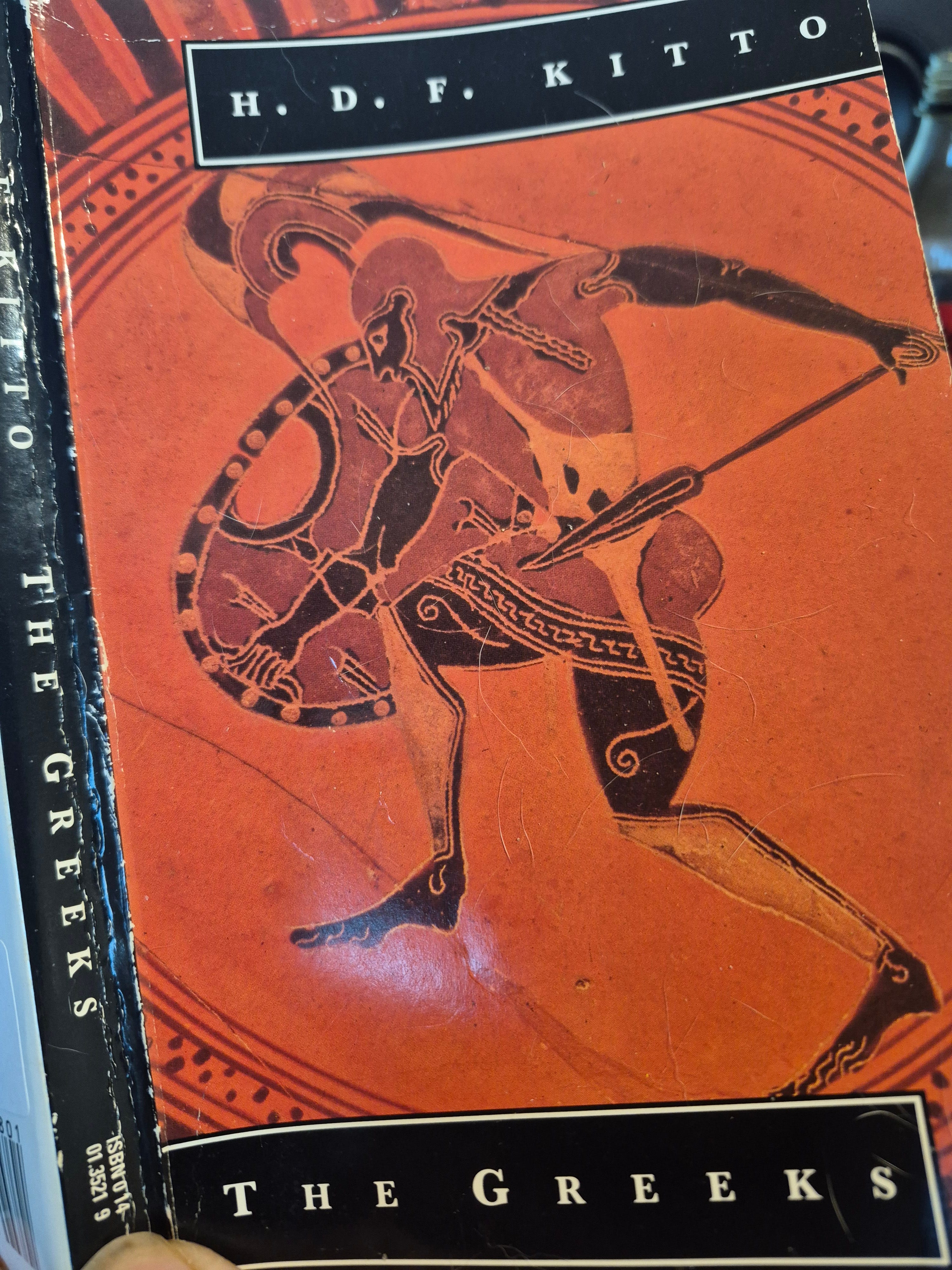
I buy old copies of Greek and Roman histories whenever I stumble across them. Found this one in a used book store last week.
Its pages are a bit yellow, seventy years old, and already brittle in my hands. I started wondering: if a book from the 1950s already looks like it spent a night in the rain, what happened to texts written on papyrus 2,000 years ago?
When Rome fell in 476 AD, the answer was simple. Most disintegrated within a few decades. Nobody was paid to copy them anymore when Rome fell into ruin.
Civilizations survive on maintenance more than glory.
Rome’s Real Problem
Fire and deliberate destruction played their part across the ancient world, but in Rome, the slower killer was the one nobody talks about.
Humidity.
Rome sits in central Italy on the Tiber River, surrounded by hills that trap moisture from the Mediterranean and the river valley below. Summer humidity runs 65-70%, and the city rarely gets the kind of dry season that stabilizes organic material.
Spring and autumn bring rain. Winter is damp. No Egyptian desert here, no volcanic ash sealing things in place. Just a city that remained wet most of the year, sitting on top of a material that dissolved in moisture.
Rome conquered the Mediterranean but lost a war against mold.
Papyrus came from the pith of a reed plant growing along the Nile. Egyptian workers cut the stalks into strips, laid them crosswise in two layers, dampened them, pressed them flat, and dried them into sheets. The process remained largely Egyptian. Rome never fully controlled it. Every scroll in every Roman library depended on a supply chain stretching back to the Nile.

Rome felt that dependency. During the reign of Tiberius, a failure of the papyrus crop caused such scarcity that ordinary business across the empire nearly ground to a halt. One bad harvest in Egypt and Roman courts, merchants, and scribes stalled with it.

In Egypt’s desert, papyrus survived thousands of years. The British Museum holds Egyptian fragments from around 1800 BC because the climate freeze-dried them in place.

A papyrus buried at Herculaneum during the eruption of Vesuvius in 79 AD survived nearly 2,000 years sealed in volcanic ash. Rome had no such luck. A scroll lasting 200 years was extraordinary. Moisture broke down the fibers, and Italy had plenty of moisture.
The entire literary culture of Rome ran on a timer. You didn’t preserve a text once. You kept copying it on a rolling schedule, generation after generation, or you lost it forever. Scriptoria employed trained slaves for exactly this work. Wealthy Romans paid to have their favorite texts recopied. The system held as long as the money and the demand did.
When the Western Empire collapsed in 476 AD, both disappeared.
Tax revenue dried up. Wealthy patrons vanished. The scribes who had spent their lives copying Livy, Aristotle, and Cicero went idle, and nobody replaced the scrolls rotting on the shelves. Nobody needed to burn the books. The books fell to dust and nobody paid to stop it.
The numbers are ugly. Livy wrote 142 books of Roman history. We have 35, which means more than three-quarters of Rome’s greatest history vanished on shelves. Aristotle wrote polished philosophical dialogues that ancient critics compared to Plato’s in elegance and depth. Every one disappeared.
What survived from Aristotle was never meant to survive: his lecture notes. The Nicomachean Ethics, his surviving work on how a person should live, is lecture material.
The Politics, the Poetics, the Physics, all lecture material. The finished dialogues his contemporaries admired are gone. Menander wrote over 100 comedies.
We have one complete play.
An entire civilization laughed at jokes we will never hear again. Plutarch considered him the greatest comic playwright in the Greek world, funnier than Aristophanes.
What We Lost
We’re reading history with missing pages, and the writers who could have told us how Rome felt from the inside, how ordinary people reacted as institutions weakened and the empire slowed down, are mostly gone. Not because somebody decided they were worthless.
Because the papyrus rotted, nobody paid to replace it.
If you want to start reading what survived, the 35 books of Livy are on Project Gutenberg, and they move faster than most people expect.
Seneca Had the Opposite Complaint
Around 49 AD, roughly four centuries before Rome fell, Seneca wasn’t worried about losing books. He was complaining there were too many. He wrote: “What is the use of books and libraries innumerable, if scarce in a lifetime, the master reads the titles? A student is burdened by a crowd of authors, not instructed.” He even mocked the Library of Alexandria as a form of “studious extravagance.”
Four centuries later, the problem had flipped. Ammianus Marcellinus, a Roman soldier and historian writing in the 4th century, described what many Roman elites were actually reading: Juvenal, a satirist, and Marius Maximus, who specialized in emperor gossip and scandal.
The heirs of one of history’s greatest civilizations had drifted from philosophy and history toward the ancient equivalent of tabloids.
Romans worried people were reading too much. Then they worried people were reading the wrong things. Then they stopped paying for the copying, and many ancient writers were silenced for centuries.
The Chain That Almost Broke
The Byzantine Empire in Constantinople kept copying Greek texts for nearly a thousand years after the Western Empire collapsed. Arab scholars in Baghdad translated and preserved Greek science and philosophy during the 9th century, and some of those works were not reintroduced to Western Europe until the Arabic translations.
Plato survived because his Academy kept teaching him. Homer had an advantage almost nobody else possessed. The Iliad and Odyssey survived orally for centuries before being written down, carried by professional bards called rhapsodes who memorized the poems line by line.
Memory turned out to be more durable than empire.
By the 470s, Sidonius Apollinaris, a Gallo-Roman bishop, was praising friends who still maintained private libraries as if praising survivors. The civic libraries were fading. The networks of scholars were collapsing. A few private collections remained. Everything else had been abandoned.
What survived increasingly depended on isolated people making deliberate decisions. One of them was Cassiodorus, a Roman statesman who retired in 540 AD, founded a monastery in Calabria called Vivarium, and spent the rest of his life directing monks to copy whatever ancient texts they could still locate. He viewed his work as spiritual warfare fought with pen and ink. He understood something most people around him didn’t: a civilization can disappear one uncopied scroll at a time.

Efforts continue today to continue reading the great books. The Culturist is reading the Odyssey with their audience right now. The Athenaum Book Club starts the Nicomachean Ethics next week, Aristotle’s surviving work on how to live well, copied by monks, translated by Arab scholars, passed hand to hand for 2,400 years, to land on a reading list in 2026.
Rome didn’t lose its memory all at once. It lost it copy by copy, year by year, while people assumed someone else would handle it.
That 70-year-old book on my desk is already halfway gone.
Hat tip to Modern Caesar, whose piece on why Romans stopped reading sparked this essay.
An optimist writing about how history shows every generation thought it was over. It never is. I also write about how non-technical creators can use AI to improve their work.
How AI Led Me to Cassiodorus
I knew the piece needed a human face in the final section. Not just “monks copied things.” Someone specific. A name, a place, a decision made at the perfect moment.
I asked Claude: who made manuscript preservation a deliberate act after Rome fell? That search came back with two names I hadn’t planned to include. Cassiodorus, a Roman statesman who retired in 540 AD and built a monastery in Calabria specifically to copy ancient texts. And Sidonius Apollinaris, a bishop in the 470s praising friends who still had private libraries as if praising survivors. Neither was in my original outline.
AI is useful for finding a specific person within the broad historical claim. I knew monks saved things. I didn’t know which monk, or where, or that he called it spiritual warfare. Claude found that. It’s a good detail.
The rest of my workflow is Grok for initial research pulls, Claude for drafting and framework passes, ChatGPT for punchy one-liners. Then I rewrote until it sounded like me.


Great article and very detailed. I sometimes still wonder what kind of amazing works we lost and will never hear about again.