

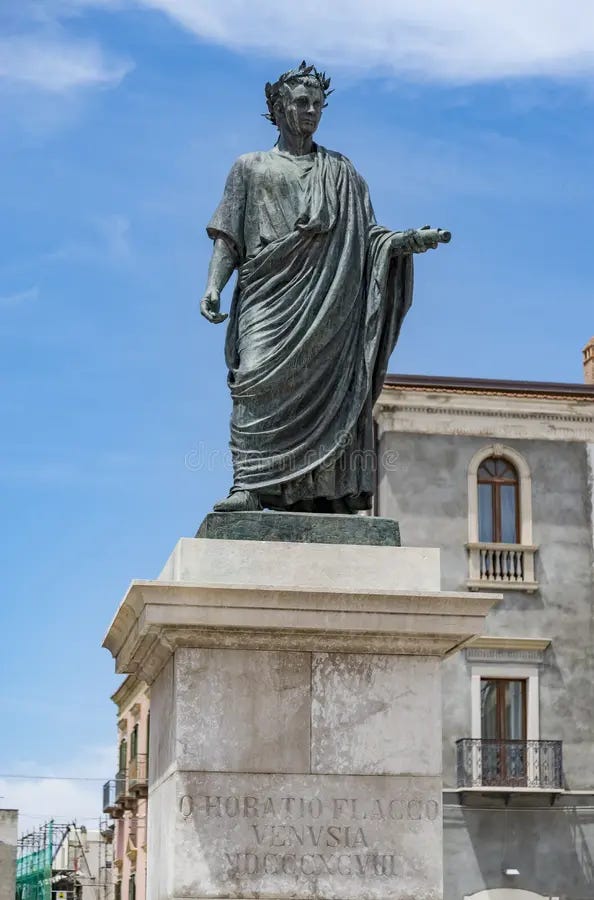
The boomers pulled up the ladder. Interest rates are 6.5%. Starter homes cost $486,000. They got theirs and left none for the rest of us.
My son is 30, and we’ve sparred on this issue several times.
He’s not wrong about everything. Rates soared in 2022. Houses really do cost more relative to income than they did a generation ago. But there’s a stack of history books on my desk about a foot and a half high, and after spending enough time immersed in them, I tell him this:
You have little idea what struggle looks like.
Neither do I.
My grandparents did. Their grandparents did. The ancients really did. We are two well-fed men arguing about who had it slightly easier, standing on Texas land that neither of us had to clear ourselves.
It’s an ancient argument. Around 23 BC, the Roman poet Horace wrote:
“Our parents’ age, worse than our grandparents’, has produced us, more worthless still, who will soon give rise to a yet more vicious generation.”
It sounds like a tweet, but it’s two thousand years old.
Horace was writing during the reign of Augustus, in the most powerful city on earth. Romans would later call it a golden age. He was already convinced his own generation had been ruined by the one before it.
Every generation alive today has said some version of the same thing about the one before it. They had it easier, and they’re spending it without thinking about who comes next.
Rome, 23 BC.
Horace wasn't writing in a vacuum. The late Republic had just absorbed a century of land seizures, debt crises, and civil war. Older, established families consolidated land and money while younger Romans without either watched the path to a normal life close before their eyes.
The Gracchi brothers had tried, and died, reforming land distribution a hundred years before Horace ever picked up a pen, over exactly this kind of resentment between generations.

England, 1349.
The Black Death killed somewhere between a third and half the population of England in about two years. For the peasants who survived, this was an opportunity. Labor was suddenly scarce, so labor got expensive. Workers who had been tied to a manor for life started demanding wages, walking off jobs that didn’t pay, dressing better, and eating better.
The chronicler Henry Knighton watched this from the side of the landowning class and did not see liberation. He saw insolence. He wrote that laborers had grown too bold, that they worked little, dressed and ate like their betters, and that ruin stared the old order in the face.
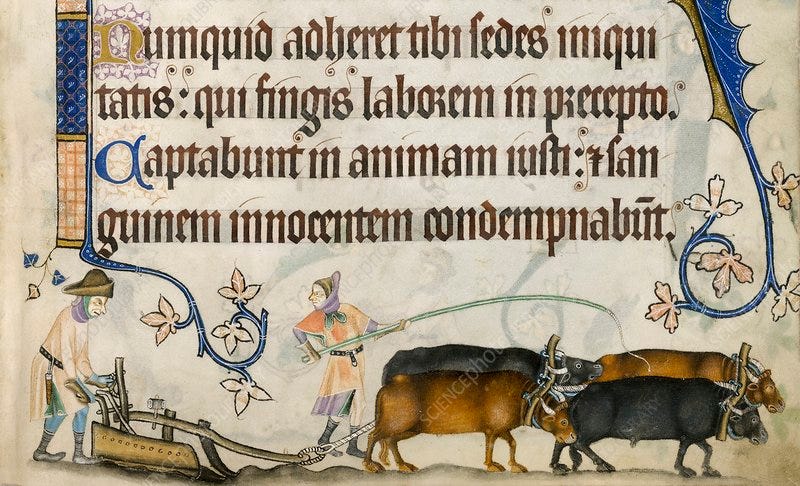
A third of England disappeared. Envy survived without missing a meal.
Athens, 423 BC
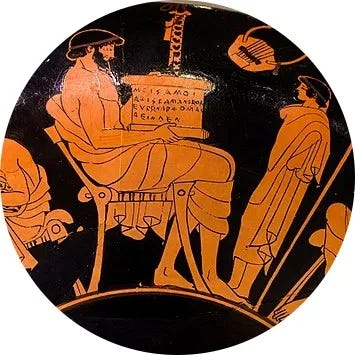
Aristophanes staged a comedy called Clouds about a father, Strepsiades, so eager to chase the fashionable new philosophy in town that he drags his own reluctant son to study it. The “new education” on offer is rhetoric and sophistry, the art of making the weaker argument sound like the stronger one.
The son comes back better at arguing than his father ever was, beats him, and then calmly proves, using the very logic his father paid for, that the beating was justified.
Aristophanes wasn’t writing a “kids these days” joke. He was writing about an older man so seduced by what looked clever and new that he didn’t notice what he was handing his own son, until it came back and hit him. Sometimes the old hand the young something corrosive and call it a gift.
Three different centuries and three different reasons for the resentment. Same shape every time. The people coming up behind you look at what you have and decide you don’t deserve it, or that you’re about to ruin it, or both, and agreeing with you starts to feel like proof. It isn’t. It’s just a bigger room.
None of this means the complaints happening right now are made up. Interest rates are higher than they were twenty years ago. Houses cost more relative to income than they used to. The worry about what AI does to careers is real.
My wife and I lived in the DC area in the early 2000s and couldn’t afford a house anywhere near where we worked. We ended up an hour and a half outside the city just to buy something. Everybody runs into some version of this at some point.
Horace had a poem. Henry Knighton had a manuscript sitting in a monastery. Now, anyone with a phone can find 3.5 million people who agree with them by lunchtime, and 3.5 million people agreeing with you starts to feel like proof. It isn’t. It’s just a bigger room.
The present-day Baby Boomer version.
A familiar argument is playing out about baby boomers. Northwestern Mutual’s research found that only about 1 in 5 boomers expect to leave an inheritance at all, while roughly a third of millennials expect to receive one.
Among wealthier boomers, Charles Schwab found 45% would rather enjoy their money themselves than preserve it for their kids. Online, that reads as a verdict: the generation with the cheapest houses and the easiest pension is spending the inheritance on itself.
Some of that may be true. Some of it isn’t.
A 65-year-old today has a real chance of living into their 90s, and roughly 7 in 10 will need some form of long-term care before they die. Memory care now averages $7,000 to $8,000 a month nationally, higher in many states, with nursing home care running just as high. Medicare doesn’t cover any of it beyond a short stretch tied to a hospital stay, and nobody gets to choose in their 60s whether they’ll need two years of it or twenty.
Boomers aren’t hoarding cash out of indifference to their kids. Many don’t yet know whether they’ll need every dollar just to survive their own old age.

I know a woman whose husband has Alzheimer’s and Parkinson’s. He’s in memory care now. It runs her about $4,000 a week, well over $200,000 a year, and none of it is coming back. Medicare doesn’t touch it. Month after month, it’s pulled straight out of a retirement that was supposed to carry them both into their 90s.
We can make financial plans, but people don’t decline on schedule.
Nobody arguing online about whether boomers are too selfish to leave an inheritance has met her. If they did, they’d find a woman who isn’t spending her husband’s money on herself. She’s spending it watching him forget her name.
That’s the part the surveys can’t capture, and the angry threads avoid. Some of the people in that 45% aren’t choosing themselves over their kids. They’re just trying to survive long enough to find out whether anything is left.
Horace’s generation argued about it. Knighton’s peasants lived through their own version of it. Strepsiades and his son fought about it at the dinner table twenty-four centuries ago. The question never changes: who gets to keep what, who’s owed what, and who decides when “enough” has been reached.
Every one of them was certain about a generation they hadn’t actually looked at closely.
We’re doing it again right now, on a website, in real time, about people who are mostly just trying to die without going broke first.
History doesn’t end the argument. It just tells you how old it is.
History shows every generation thought it was over. It never is. Also discussing AI use as a history writer. Followed by The Culturist — #2 in History.
A note on AI: I’ve been moving my old ChatGPT conversations into Claude.
There’s a setting that does it. Settings, Capabilities, Start Import. Two minutes, and Claude has years of context that it didn’t have before.
I almost didn’t bother. I figured it would just dump a pile of old chats nobody asked for and call it personalization. It’s the opposite problem. Now Claude knows things about how I write that I never typed into this newsletter, and the drafts come back sounding more like me on the first pass instead of the third.
That’s the part nobody warns you about. The tool getting better at sounding like you is essential, not optional. The editing job doesn’t go away. It just moves earlier, to catching the draft that already sounds right before you decide it actually is.
—PP
The best part of history is that it humbles everybody. The young, the old, and everyone convinced their moment is uniquely doomed.
You nailed it.