

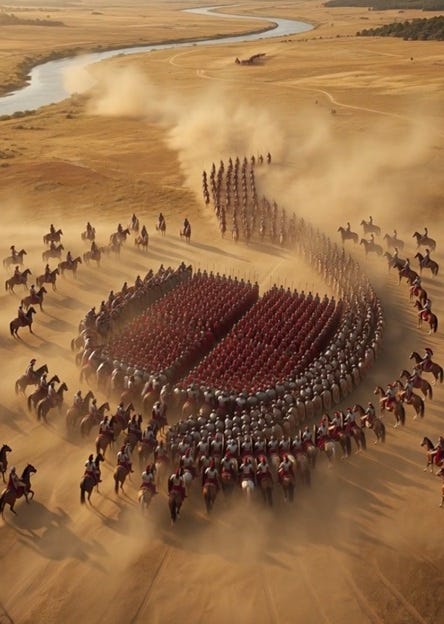
Cannae. August 2, 216 BC.
One of the bloodiest afternoons in ancient military history, fought on a flat, sunbaked plain in southern Italy.
By nightfall, up to 70,000 people were dead.*
Did they have machine guns? How?
Gunpowder wouldn’t exist for another thousand years. Men in those days killed with iron, shields, and horses, packed together so tightly most could barely lift a sword.
Rome brought roughly 80,000 soldiers onto that plain. Hannibal gave them exactly what they thought they wanted.
His weakest infantry, Gauls and Spaniards, held the center and bowed backward as the Romans surged forward, convinced they’d shattered the line.
They hadn’t.
Hannibal’s African veterans waited untouched on both flanks, while his cavalry was already circling behind the Roman rear. By the time anyone realized the retreat was bait, they were standing inside a ring of Carthaginian steel.
Carthaginians, Gauls, Spaniards, and Numidian cavalry did the killing, Hannibal’s whole multiethnic army closing in at once.
But Hannibal's masterpiece isn't the only reason this battle is still discussed. What Rome did after losing that many men is.
A 20-Year Grudge Match Explodes
This was round two. Rome and Carthage had already fought once, in the First Punic War.
Rome won, then pushed its luck, taking Sardinia and Corsica on top of the peace terms while Carthage was busy crushing a mercenary revolt at home.
Carthage's answer was Spain, a source of silver and soldiers Rome couldn't touch.
In 237 BC, Hamilcar Barca sailed from Gades (modern Cádiz) with his army and his nine-year-old son Hannibal. He carved out new territory along the silver-rich Guadalquivir valley and built a new capital, New Carthage
By the time his son-in-law Hasdrubal took over, the operation was fielding 50,000 infantry and a corps of 100 elephants, paid for by that silver and loyal to the Barcid family personally, not the government back in Carthage.
The match was lit in 219 BC.
Hannibal laid siege to a Roman-allied town called Saguntum. Eight months. Rome demanded he be handed over for punishment. Carthage said no.
Hannibal’s answer was insane even by the standards of ancient warfare.
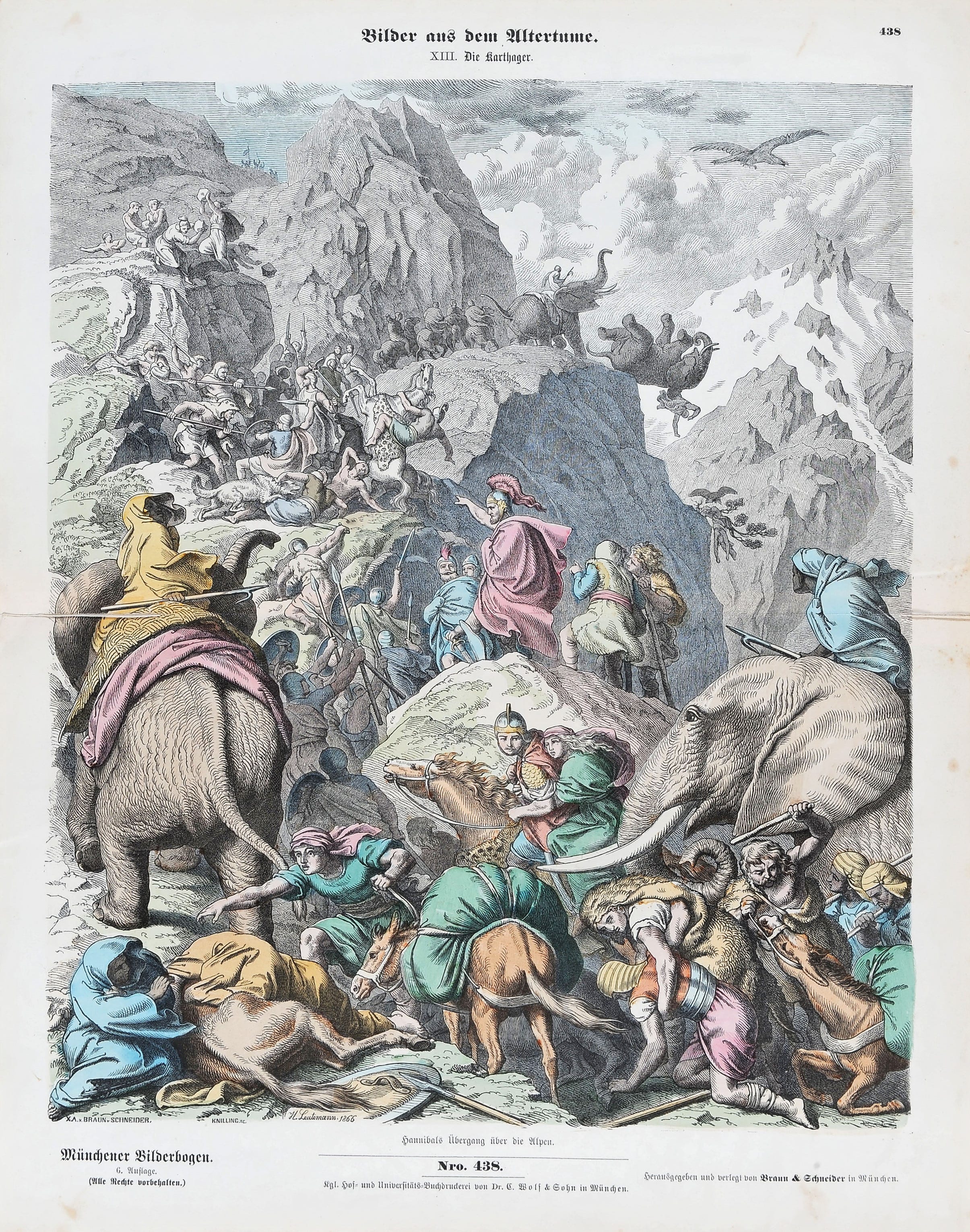
He marched 90,000 infantry, 12,000 cavalry, and 37 elephants out of New Carthage, up through Spain and Gaul, and over the Alps into Italy itself.
By the time he reached the Po Valley, more than 30,000 of his men were gone, lost to cold, disease, and hostile mountain tribes before he’d clashed with a single Roman soldier.
Flat Ground, No Escape
The Cannae battlefield sits on a low hill, barely 42 meters of elevation, overlooking the Ofanto River in Puglia, about 10 kilometers south of the modern city of Barletta. The Ofanto is the ancient Aufidus, the same river the armies fought beside.
This was the Tavoliere delle Puglie, Rome’s grain basket: flat, open farmland, nowhere to disperse, nothing to break a formation.
Hannibal had already taken the ground closest to the water before the fighting started. The larger Roman army was parched before it ever drew a sword.
Hannibal Springs the Trap
August 2, 216 BC
Hannibal placed his weaker Gallic and Spanish infantry in the center and kept his elite African veterans waiting on the flanks. He let the center sag backward under the Roman advance, a controlled retreat, not a collapse.
The Romans, stacked 35 to 50 ranks deep on Consul Varro’s own orders, smelled a breakthrough and pushed forward into the sagging middle.
That’s when Hannibal snapped the trap shut.
The African infantry pivoted inward on both flanks. Hasdrubal’s cavalry, having already routed the Roman horse, swung around and hit the rear.
Three sides shut at once, in minutes. A death trap.
Military strategists still call this tactic “a Cannae.” German planners built the Schlieffen Plan around achieving one. The tactic that trapped and destroyed a Russian army at Tannenberg in 1914 carried the same name, two thousand years later.
No Gunpowder. 100 Dead Every Minute.
How do 70,000 men die in a single afternoon, more than a thousand years before gunpowder?
Once Hannibal’s trap closed, the battle stopped resembling combat and became a human crush. Men were packed together so tightly they couldn’t raise a sword or turn to run.
Ancient accounts describe bodies left standing upright, held in place by the press of the living still pushing and dying around them.
Death came from heat, thirst, exhaustion, and suffocation as much as from iron. A hot wind, identified by some ancient writers as the Vulturnus, blew dust into Roman faces for hours, blinding them as the circle tightened.
Some soldiers, unable to fight and unable to escape, dug shallow holes with their hands and buried their faces in the earth, choosing a quicker death over the slow crush around them.
Consul Lucius Aemilius Paullus, already wounded, refused to abandon his men. He died where he stood with them.
In the days after, Rome learned it had lost roughly 80 senators, a huge share of its entire governing class, along with countless fathers, sons, uncles, and cousins from families rich and poor alike.
By modern estimates, more than one hundred Roman soldiers died every minute for hours. That slaughter rivals the bloodiest days of the Somme and Verdun, achieved entirely with iron, sweat, and human bodies.
A Teenaged Future General Draws His Sword
The survivors drifted south to the nearby town of Canusium. Among them was a young officer, barely out of his teens, named Publius Cornelius Scipio.
There he discovered a group of Roman noblemen quietly planning to abandon Italy and enter the service of a foreign king. Scipio drew his sword, blocked the doorway, and forced them to swear an oath that they would never desert the Republic.
Fourteen years later, he would defeat Hannibal at Zama.
Thanked for Not Giving Up
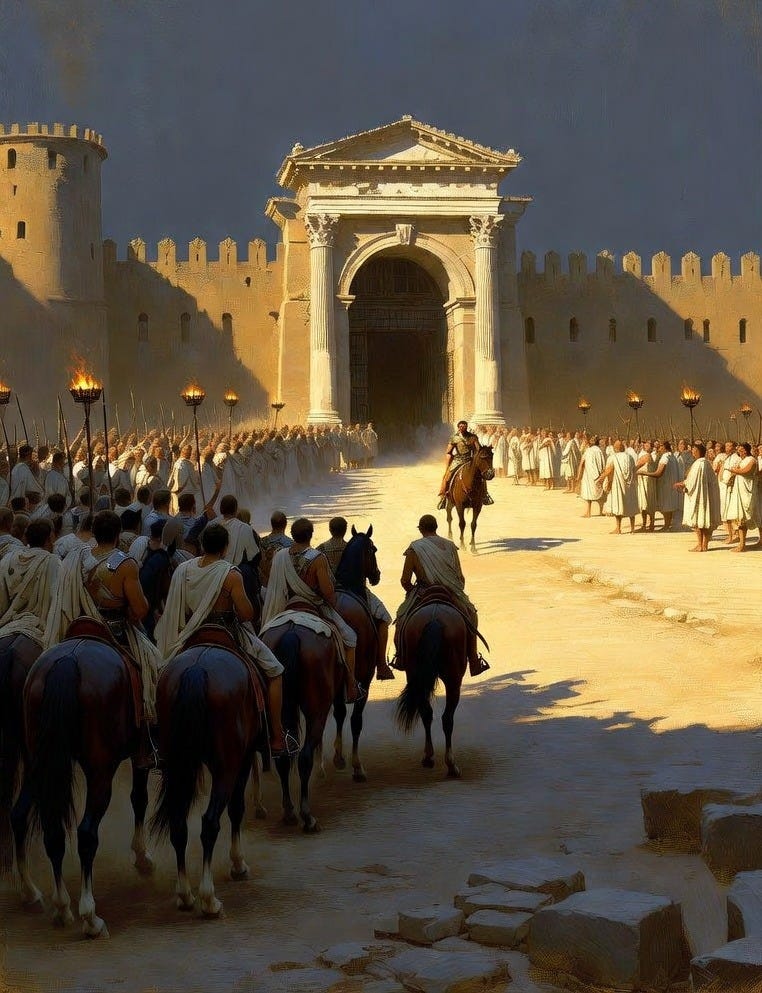
Consul Gaius Terentius Varro, the man who had insisted on fighting at Cannae, escaped with roughly seventy horsemen, gathered what survivors he could at Canusium, and rode back to Rome expecting disgrace.
It never came.
Crowds cheered him at the city gates. The Senate rode out to meet him and formally thanked him in five Latin words: quod de re publica non desperasset, “for not having despaired of the Republic.”
Not for winning. For refusing to quit.
Rome went further. The Senate banned public mourning, ordering the city’s women to grieve for thirty days and then stop. The city was still counting its dead. It refused to let despair become its public face.
No one standing at those gates had a name for what they were honoring. Stoicism, the philosophy built around mastering your response when everything else has slipped beyond your control, wouldn’t exist for another two hundred years. The word came later. The behavior came first.
Thanking the man after losing that many people in an afternoon is not nothing.
Most of us have a version of what happened that chaotic day at Cannae. The work project that collapsed. The diagnosis. The year everything you built caved in on three sides at once. Rome had every reason to call itself finished, and thanked the man who refused to submit.
Varro’s tactical mistakes have filled military textbooks for more than two thousand years. History remembers him anyway for riding home to face the Senate, bracing for disgrace, and getting cheered instead.
Rome Rose From Defeat
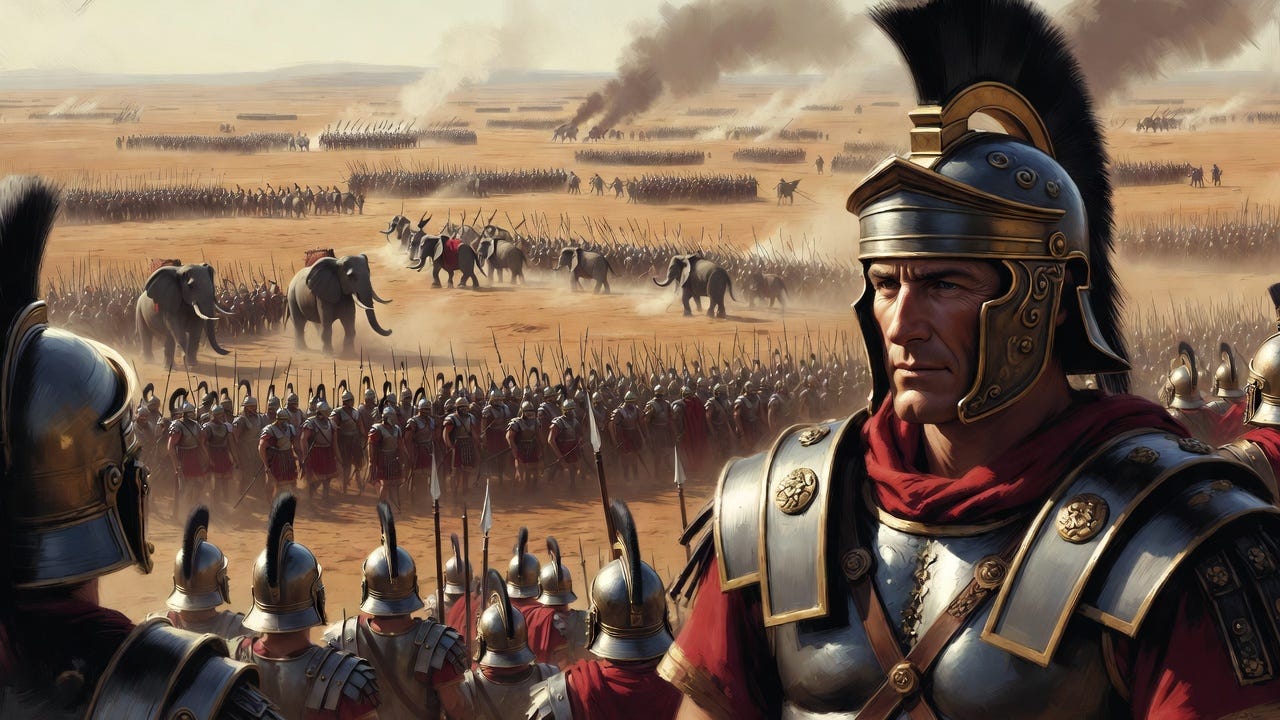
Hannibal’s own cavalry commander, Maharbal, begged him to march on Rome immediately. The city was days away and nearly undefended. Hannibal refused, choosing to consolidate in the south instead.
Maharbal’s reported reply, according to Livy:
“You know how to win a victory, Hannibal. You do not know how to use one.”
The man who’d just inflicted the worst defeat in Western military history for the next 1,600 years still couldn’t make Rome quit. That part was never his to control.
The war ran fourteen more years. Rome came back from Cannae.
Rome raised new legions from freed slaves and boys too young for normal service, because the regular pool was gone. It refused to ransom Hannibal’s prisoners, a hard, deliberate signal that Rome would not submit.
Hannibal spent over a decade undefeated in the field in Italy and still never broke Rome’s will. His own government back home starved him of reinforcements the whole time.
In 202 BC, the same young officer who’d drawn his sword at Canusium, grown into a general now, beat Hannibal at Zama, on Carthage’s own soil. Carthage lost its navy, its overseas territory, and became a tribute-paying client state.
Cannae was Hannibal’s ceiling. It was Rome’s floor.
The worst single day either side inflicted or absorbed decided nothing by itself. What decided it was fourteen years of a city that had every reason to consider itself finished, and refused to.
Rome went on to rule the Mediterranean for another six centuries after that afternoon, enough time to give the world Roman law, Roman roads, and a language that still shapes half the words you’re reading right now.
None of it happens without a beaten consul riding home to a city that chose thanks instead of exile.
*Editor’s Note: Ancient sources disagree on exactly how many died at Cannae. Polybius, the source for the 70,000 figure used above, wrote his account decades after the battle.
Livy's estimate is lower, closer to 48,000. Even at the more conservative figure, it remains the deadliest single day in Roman military history. It is worth knowing the sources conflict, since ancient casualty counts are estimates, not census data.
Every generation thinks the world is ending. Rome thought so 2,242 years ago, standing over 70,000 of its own dead. It wasn't. Join our community of historical optimists as we prove the future is bright. 3 history essays weekly.