Nobody Was "Gay" Until 1868
The Word "Homosexual" Is Only 157 Years Old
Editor’s note: I cover AI briefly in every issue. This time, I write about how I used AI for research and fact verification. If AI isn’t your thing, skip it.
Karl Maria Kertbeny was a 19th-century Hungarian journalist with a legal argument and a vocabulary problem.
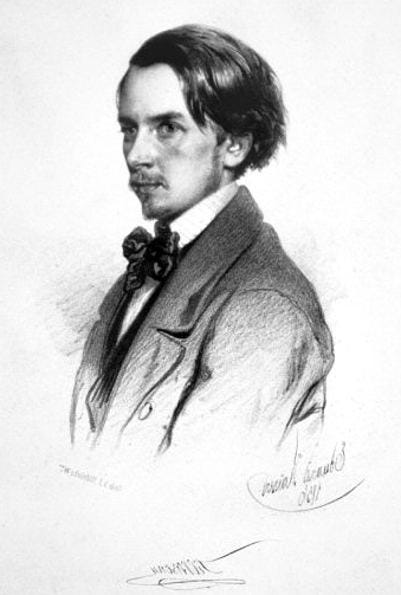
On May 6, 1868, he sat down and scratched out a private letter arguing against a Prussian sodomy law. Somewhere in the middle of the page, almost as an aside, he wrote a word that hadn’t existed in any language before that moment.
Homosexual.
Not in English, French, Latin, or Greek.
This month, tens of millions of people in the West celebrate Pride. New York City’s parade fills the streets at the end of June. The flags, the marches, the identity language, all of it carries an assumption: that the way we think about sexuality now is just how humanity has always thought about it.
It isn’t. And the history is stranger and more interesting than I realized.

We are captives of our culture. Historians call it presentism. It is the habit of reading the past through present-day assumptions. The fallacy is so common it has a Latin label: nunc pro tunc. Now for then.
We look back and assume people sorted themselves the way we do, wanted what we want, and named themselves the way we name ourselves. With sexuality, that assumption is off by about 157 years.
The idea that a person could be defined by their sexual attraction, that it could be a core identity, the thing that names you, is a 19th-century invention. Same-sex activity is ancient. The identity framework built around it is not.
“The Greeks named the act and the role. Kertbeny named the person.”
Greece and Rome Saw It Differently
In classical Athens, the most common form of male same-sex relationship was pederasty: an adult man (the erastes, or lover) and an adolescent youth (the eromenos, the beloved). It was partly erotic and partly educational and woven into elite male culture. The older man guided the younger in athletics, philosophy, and citizenship.
The wrestling grounds, the drinking parties, the hunting trips, all of it happened inside this structure. Vase paintings from the period show the courtship in careful detail: gifts of roosters and hares, the older man's hand extended toward the younger.
A kylix by the painter Douris that still survives today shows an older bearded man holding a hare behind his back while gazing down at a youth whose cloak is pulled up over his head in modesty.

Plato’s Symposium describes men drawn to other men, but describing a desire is not the same as building an identity category around it. The Greeks named the act and the role. Kertbeny named the person.
Thebes took it further. The Sacred Band of Thebes was an elite military unit of 150 pairs of male lovers, built on the theory that men fight harder to protect someone they love. They were undefeated for decades. Philip of Macedon, Alexander the Great’s father, wept when he found them all dead on the battlefield at Chaeronea in 338 BCE. He honored them instead of mocking them.
None of this has anything to do with modern identity. An Athenian man was expected to marry a woman, produce children, and fulfill his civic duties. Having a male beloved didn’t change any of that. Nobody asked which one you were. The question didn’t exist yet.
"An Athenian could discuss Plato in the morning, wrestle naked at noon, sleep with a male beloved, marry a woman, and never once imagine himself part of a separate category of human being."
Rome was blunter about it. Latin had no words for homosexual or heterosexual. The only distinction Romans cared about was active versus passive, who was dominant and who wasn’t. A free Roman citizen could sleep with men or women without losing social standing, as long as he was the active partner.
The passive role carried real stigma, not because of the gender involved, but because submission undermined the Roman idea of manhood. Who you slept with mattered far less than whether you were in charge when you did it.
Classicist Craig A. Williams, writing for Oxford University Press, documented the same finding: the active role was, in his words, “the prime directive of masculine sexual behavior for Romans.”
Romans didn't ask who you slept with. They asked whether you were in charge when you did it.
"Not who. How."
The acceptable partners for a free Roman man were slaves, former slaves, prostitutes, and actors, people of lower social standing. Sex with a freeborn equal was a different matter entirely.
The frescoes on the walls of Pompeii’s brothel, frozen by Vesuvius in 79 CE, show exactly that. When archaeologists found them in the 19th century, they were considered so scandalous that they were locked in a private room at the Naples National Archaeological Museum. Only men could view them, for an extra fee, until the 1960s.
Lucius Cornelius Sulla understood this perfectly. Sulla was one of the most powerful men in Roman history, serving as a general, consul, and dictator, and as the first man to march a Roman army on Rome itself. He kept a male lover his entire adult life: a Greek actor named Metrobius. The historian Plutarch recorded it twice in his Parallel Lives, noting that Sulla “continued his youthful love for Metrobius, an actor” and “made no denial of it.”
Before leaving Rome for retirement, Sulla publicly announced the relationship. Nobody removed him from office. Nobody questioned his fitness to lead. Plutarch disapproved, but his criticism focused on Sulla’s lack of self-control, not on the fact that the partner was male.
Metrobius was a lower-class actor. The attractive man falls into the right category under Roman law. He was Rome's most celebrated female impersonator, a man who played women on stage. By the time Sulla retired, Plutarch noted he was past his prime. Sulla didn't care
Emperor Hadrian, who ruled from 117 to 138 CE, loved a young Greek man named Antinous. When Antinous drowned in the Nile in 130 CE, Hadrian was devastated. He deified him, founded a city in his name, and commissioned portraits that spread across the empire. Hundreds of statues of Antinous survive today, more than those of almost any other figure from antiquity, except the emperors themselves.
People still stop in museums to look at Antinous without realizing they are staring at one of history’s most famous love stories.
The Category Is New. The Behavior Is Not.
What changed in the 19th century wasn’t the behavior. What changed was the framework.
Kertbeny and the sexologists who followed him, men like Richard von Krafft-Ebing, and later Freud, began treating same-sex attraction as a fixed, innate characteristic of a person. A type. Before 1868, sodomy was something a person did. After Kertbeny’s letter, “the homosexual” was something a person was.
The modern world did not invent same-sex desire. It invented a new way to organize people around it.
Michel Foucault made this observation in 1976. Classicist Craig A. Williams reached the same conclusion from the Roman evidence. Both arrived at the same place: the pre-modern world categorized acts. The modern world categorizes people. That change happened in one century.
The vocabulary of modern sexuality, the categories, the identity labels, the idea that who you’re attracted to is the thing that names you, all of it fits inside a window of about 157 years.
The behavior is ancient. The category is young.
I’m an optimist writing about history, showing every generation thought it was over. It never is. Subscribe today for articles three days per week.
Where AI Helped My Process
This piece covers one of the most politically charged topics of our time. Both sides are vehement, and a single misstatement here could damage my point.
That’s where AI helped. I used Grok to research the historical material and Claude to verify it, including the date of Kertbeny’s letter, the Sulla and Metrobius details against Plutarch’s original text, the Craig Williams citation from Oxford University Press, and the history of the Pompeii fresco.
On a topic like this, I couldn’t afford to be approximately right. I needed to know exactly what Plutarch said, exactly when the letter was written, exactly what the academic record supports.
Every source checked out.
I also used Wispr Flow for voice-to-text throughout the drafting process. Talking through ideas and getting them on the page fast has changed how I write; it keeps the thinking natural and cuts the time in half.
AI didn’t write my article or take a position. The research is verified, the facts are solid, and the final draft is mine.


Is homosexuality an inherent characteristic?
I think the Greeks and Romans had it right. These are behaviors people engage in. They have a preference for one "flavor" or another and sometimes that preference is fluid or context-dependent. I don't see any value in creating rigid identity around such behaviors because that comes with a whole bunch of other expectations and not just from others.