People Drive Four Hours to Eat at This Pennsylvania Pizza Hut
The instinct pulling them there outlasted Pompeii. It'll survive DoorDash, too.
The roof of my mouth never stood a chance.
Molten pizza cheese runs 150–180°F straight out of the oven. Mozzarella holds heat as no other cheese — the oils and moisture stay locked together, preventing heat from transferring even after you pull the slice away.
That quarter-sized loose flap of skin hanging from the roof of my mouth afterward? Pizza palate, dentists call it. A classic pan pizza injury.
I ate it piping hot, anyway.
The smell hit me before the food did. Warm dough. Whole-milk mozzarella browning at the edges, richer than what most places use. I walked through the door, and the place was already working its way into my mind.
Red cups. Pac-Man machines. The salad bar Tiffany lamps throw amber light onto checkered tablecloths. Booths that squeaked when I slid in with my family on a packed Friday night.

Most of those old-school restaurants are gone now. Pizza Hut turned itself into a bland box with a delivery window sometime in the 1990s and never looked back.

You’d never know what you were supposed to feel walking through the door of a Pizza Hut that looked like a bank or car dealership.
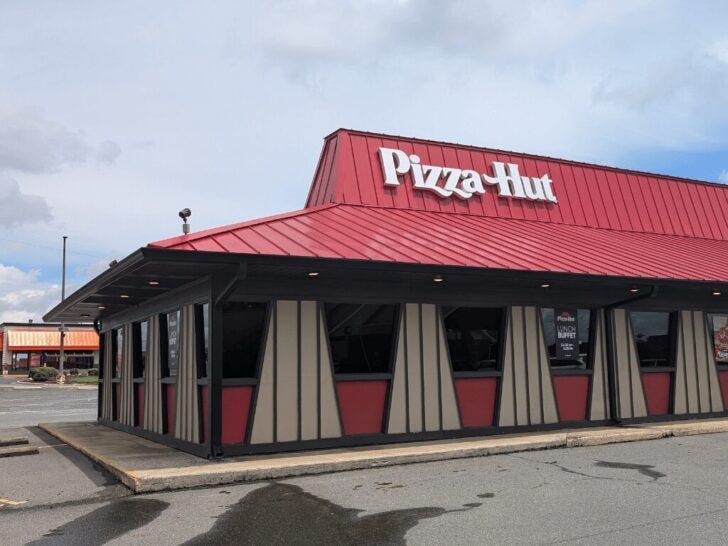
But there’s one in Tunkhannock, Pennsylvania — population 6,000, up in the green hills — that never changed. People drive from New York, Philadelphia, and Florida, hours out of their way, to eat pan pizza under Tiffany lamps in a red vinyl booth. The location does $10,000 on a good night. Families drive up from cities to show their kids what a Pizza Hut used to be.
Turns out someone ran the numbers on that. A company called Daland Corporation, based in Wichita, now operates 94 of these locations across 11 states. They plan to convert at least 80 of them to the Pizza Hut you remember from the 1970s and 1980s.

Nobody in 1987 thought Pizza Hut architecture would someday become nostalgic.
Then the chains flattened everything into gray boxes and delivery windows.
The red roof survived long enough to become a memory people drive hours to visit.
But the instinct it was selling goes back much further.
Pompeii Had Fast Food, Too

Pompeii was buried under volcanic ash in 79 AD when Mt. Vesuvius erupted.
Archaeologists have found around eighty hot-food counters built directly into the streets of Pompeii. They were called thermopolia. Stone counters with ceramic jars sunk into them, some still containing traces of duck, pig, fish, lentils, and wine. Frescoes above the counter advertised what was available.
Some had seating.
Most Romans living in apartment buildings had no kitchens. So they ate out constantly. A warm room. A counter. Other people nearby. Plates knocking together. Steam lifting from the jars.
The resemblance to a fast-food restaurant is unsettling. We see the same layout and logic. The same desire for food and gathering of friends and family.
The Pizza Hut revival reaches back further than people think. Warm food. Noise. Families and strangers sit close together while dishes clatter in the background.
We wrapped that ancient feeling in red vinyl and Tiffany lamps for a few decades.
$100 Per Store. Thousands of Stores. One Smart Architect.
The red roof was engineered to get attention.
Richard D. Burke designed it around 1969, a college friend of the Carney brothers as Pizza Hut franchising exploded across America. His deal was simple: $100 per store instead of a lump sum. Thousands of locations later, he became wealthy from a roof most people assumed was temporary.
He never designed another building as famous.
Burke understood something modern chains forgot. A driver moving 45 miles an hour has only a few seconds to decide whether to stop. The roof made the decision before the sign came into focus. You saw the silhouette and already knew the room waiting inside.
The building was making a promise. Tapping into something ancient inside of us.
Then the chains flattened everything into neutral-colored boxes and delivery windows. Buildings designed to move food instead of holding people.
The Tunkhannock Pizza Hut kept the old promise alive.
People drive hours to collect it.
Nostalgia.
In 1688, Nostalgia Could Kill You
Nostalgia used to be a diagnosis.
A Swiss physician named Johannes Hofer coined the word in 1688. Nostos meant homecoming. Algos meant pain. He was writing about Swiss mercenary soldiers fighting far from home who developed physical symptoms: irregular heartbeat, loss of appetite, and fever. Some doctors believed nostalgia could kill.
Commanders sometimes banned traditional folk songs because certain melodies seemed to trigger outbreaks. Music was a biological hazard.
Over centuries, the diagnosis softened into something bittersweet. The pull stayed the same.
Smell is where it hits hardest. The signal reaches the older parts of the brain tied to memory and emotion before conscious thought catches up. Childhood memories leave deep marks there because those systems are still wiring themselves together when you’re young.
Which is why walking into that Pizza Hut felt strange almost immediately.
Before you registered the lamps or the booths or the cast-iron pan on the table, your brain had already gone backward.
Marcel Proust described the same thing in 1913. The smell of a madeleine dipped in tea sent him so completely into childhood that the past stopped feeling distant.
The smell didn’t remind him. It transported him.
That’s what the warm dough and sizzling cheese were doing.
You thought you missed Pizza Hut.
What you actually missed was the room.
The noise. The smell. Red everywhere. The booth squeaking when you slid in with your family and friends. Your brain had stored all of it somewhere and was waiting for the door to open again.
The red roof was the key.
I write about the moments where the modern world collides with the past.
Art. History. Culture. Empires. For more every week, subscribe today.


