

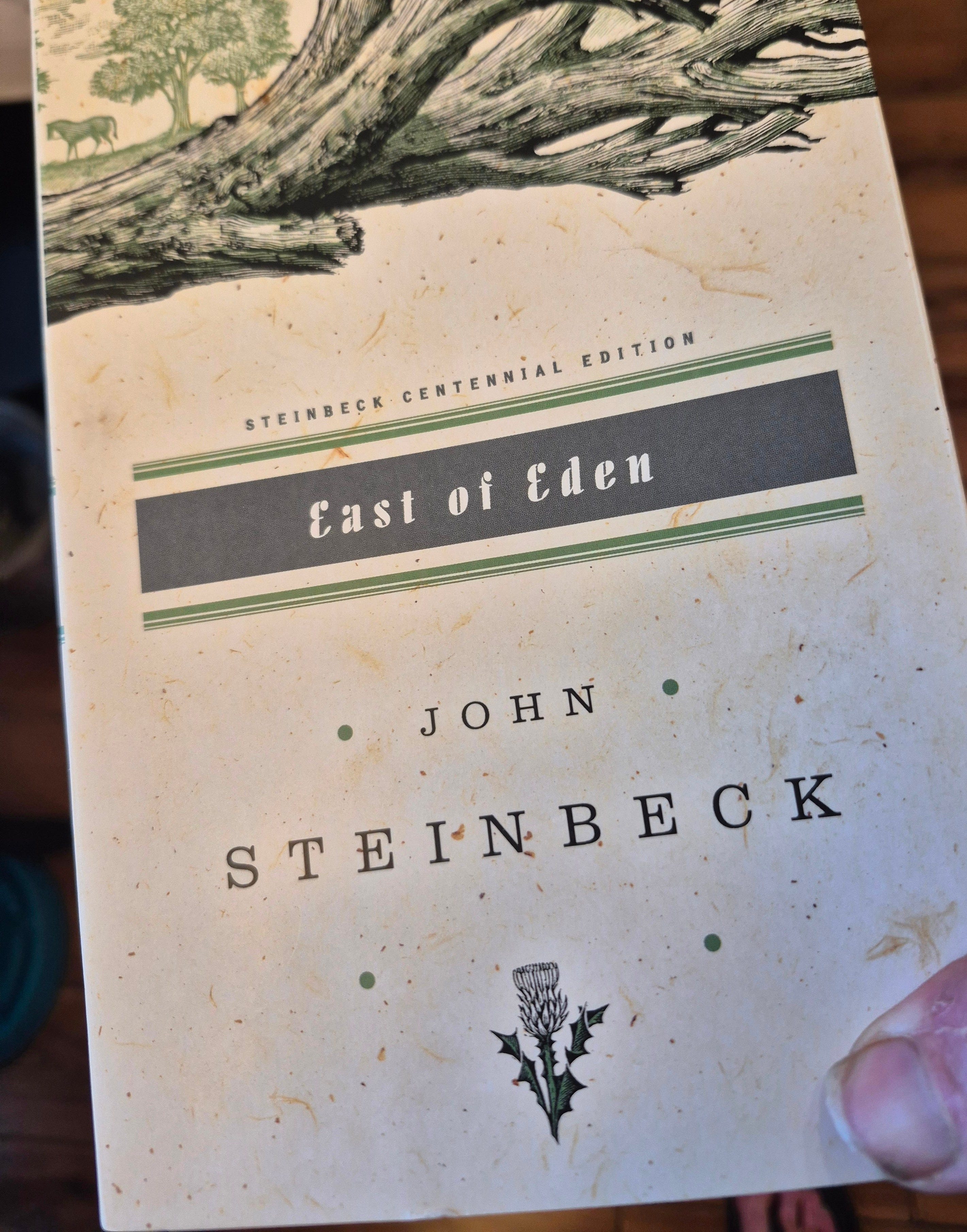
East of Eden might be Steinbeck’s best book. Oh? Who says?
Steinbeck:
“I think everything else I have written has been, in a sense, practice for this.”
— John Steinbeck on East of Eden
You probably know the gist.
Cain and Abel hanging in the Salinas Valley... one good son, one rotten son, and a mom so vile you see the family resemblance.
The bad son was born that way, and that’s The Way It Is.
About that... Steinbeck didn’t write East of Eden about a son born bad. Blame Hollywood for the confusion.
First, Elia Kazan’s 1955 film made James Dean a star... and cut Lee, the cook who explains the book’s Big Idea.
ExCUSE me?
Second, Netflix's entertaining show kept Lee (whew), but Florence Pugh steals every scene. Props to the talented Pugh, but Lee’s big idea gets lost in the haze.
Shame, because Steinbeck wrote the book’s Big Idea for his two little boys after the worst year of his life.
He hung all 600 pages on one Hebrew word, the word God speaks to Cain right before Cain kills his brother.
The word that says nobody is born doomed. Not Cal Trask, not you, and not me.
To understand the book Hollywood keeps missing, start with the year Steinbeck hated most.
Social Media, Inc. promotes negativity and argument. At Past Passport, we disarm the doomscroll with history, art, and beauty. A daily shot of optimism. Join us:
3 history essays a week. No dull dissertations.
1 extra issue a month: an AI breakdown or a Stoic essay.
An open DM session on the month’s top article.
A brighter outlook and a creative streak that comes back. (Mine did.)
First week free, then $5 a month.
Grief Needs Busy Hands

Steinbeck opened his 1949 journal with a line plenty of us have muttered on December 31:
“I don’t think anyone ever so hated a year as I hated 1948… Wife, children, best friend, gone.”
The friend. Ed Ricketts ran a little marine biology lab on Cannery Row in Monterey. If you’ve read Cannery Row, you’ve met him... he’s Doc.
On Saturday evening, May 8, 1948, Ed finished a day’s work in the lab and pointed his old 1936 Buick toward dinner. He was nearly 51.
At the railroad crossing at Drake Avenue, the Del Monte Express came through on its way to San Francisco. The train T-boned the Buick and shoved it several hundred feet down the track.
Ed was a tough customer. He lived three days, awake some of the time, but died May 11. Steinbeck rushed west from New York but arrived too late.
“There died the greatest man I have known and the best teacher.”
And 1948 wasn’t done with Steinbeck yet.
After the funeral, Steinbeck went home to New York. There, his wife, Gwyn, told him she was leaving and taking their two sons, both under 4.
Steinbeck was wrecked. But his response was smart.
He holed up in his family’s old cottage in Pacific Grove and kept his hands busy... sawing the low limbs off the pines to let light into the garden, then planting red geraniums.
Old-school Stoic stuff. Around AD 43, Seneca told a Roman official mourning his brother to bury his grief in his work.
Steinbeck did so, but with a saw in his hands.
The next January, he drafted a letter to his boys. Someone stumbled on it decades later, tucked in his journal:
“You are funny little boys now, and I miss you so. I feel cheated sometimes that I cannot see you growing and be a part of it...”
Wife, children, best friend all gone. Most of us would call that DOOM and pull the covers over our heads until 1955.
Steinbeck finished the journal entry differently: “But perhaps it toughened me.”
Perhaps.
Two years later, his editor handed him a fat blank notebook... and Steinbeck started writing a new book for his boys…..
Great Writing and Steinbeck’s 1000-Word Warm-Up
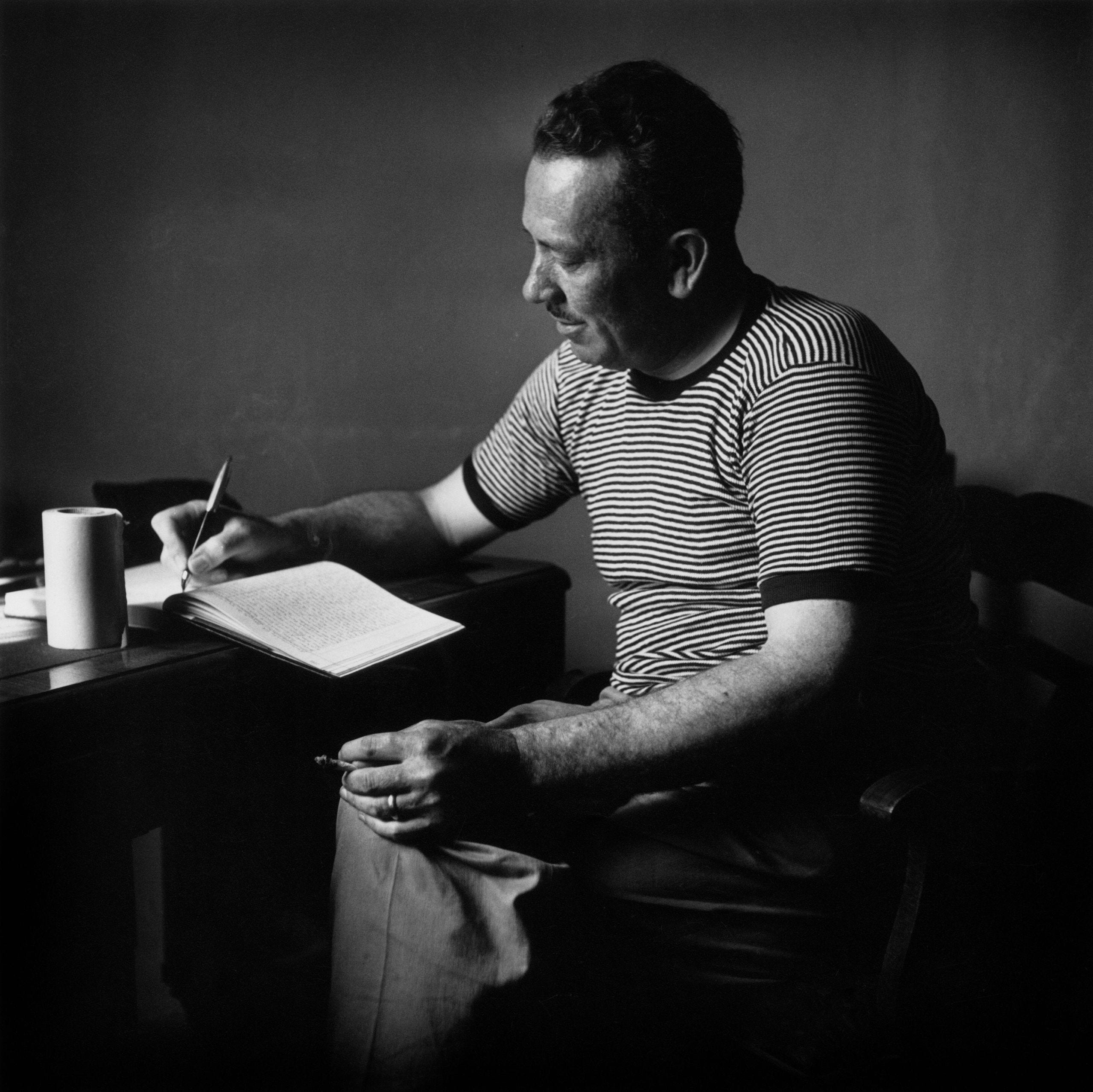
Steinbeck used that beefy notebook differently from most writers. He scribbled the novel only on the right-hand pages.
The left-hand pages held letters to the man who gave him the notebook, Pascal Covici, his editor at Viking Press.
Every working day from January to November 1951, he kept the same order... a letter to Covici on the left, then the novel on the right.
Not one letter was ever mailed.
Never meant them for print, either (good luck with that, Steinbeck). Viking published them in 1969, the year after Steinbeck died, as Journal of a Novel.
Why write an unmailed letter every morning?
Steinbeck claimed it kept his writing muscles in shape... it got his “mental arm in shape to pitch a good game.”
Some mornings the warm-up alone ran past 1,000 words. Then he’d shift to the right-hand page, and work on the novel for four or five hours.
Most of us call two cups of coffee a warm-up. Not Mr. Steinbeck.
He wrote every word by hand in pencil, and he was OCD about pencils, too.
He preferred the soft-lead Blackwing 602. Stamped right on the side: “Half the Pressure, Twice the Speed.”
On good days, the words would “come crawling down my pencil and drip on the paper.”
The letters went to Covici, but the book went to someone else:
“I am choosing to write this book to my sons. It is not written for them to read now but when they are grown, and the pains and joys have tousled them a little.”
Thom was 6½, and John was 4½... a long way from tousled.
And somewhere in all those pencil shavings, Steinbeck handed the book’s biggest idea to the Chinese cook.
The Wisest Voice in the Room Rarely the Loudest
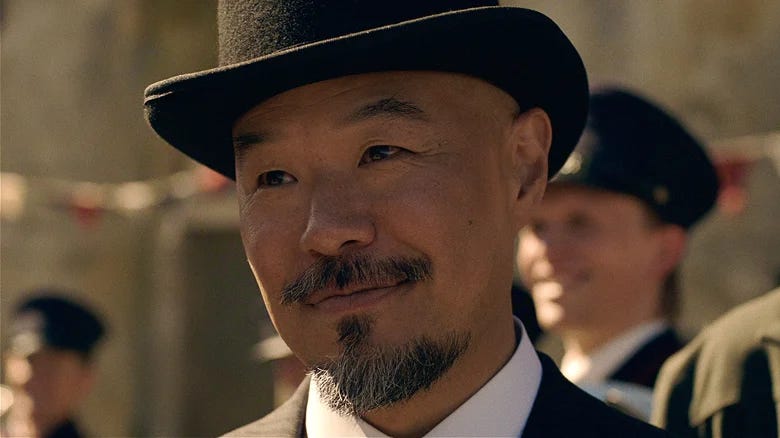
Chapter 15. Adam Trask sends Lee, his cook, to fetch Samuel Hamilton, and the two men ride out together in the rig.
Lee talks the way white Californians expect a Chinese servant to talk... pidgin English, all “me no savvy.”
Samuel doesn’t buy the pidgin routine. Lee was born in America, so what’s up?
Lee drops the accent on the spot and answers in perfect English: “Pidgin they expect, and pidgin they’ll listen to.”
As the rig rolls up to the Trask place, Lee slips the pidgin back on like a leather coat.
Steinbeck made a Chinese cook the smartest man in his book, a bold pick in 1952.
Congress had repealed the Chinese Exclusion Act only nine years earlier. The best-known Chinese characters in pop culture were Fu Manchu the villain and Charlie Chan the detective, usually played by a white guy.
Years later, Samuel reads the Cain and Abel chapter of Genesis aloud, and one line hooks Lee. He never lets it go.
God warns Cain that sin is waiting at the door, and the King James Bible ends the verse with “thou shalt rule over him.”
A promise... you will win.
Lee finds a newer translation, the American Standard Version, and it says “do thou rule over him.”
An order... you’d better win.
Which is it?
Lee can’t stand not knowing, so he takes the question to a group of old Chinese scholars in San Francisco. The old men hire a rabbi and spend two years learning Hebrew so they can read the verse in the original.
Two years. Most of us won’t read the new fridge instructions.
In the Hebrew, the key word is timshel. Lee comes back with its meaning: thou mayest.
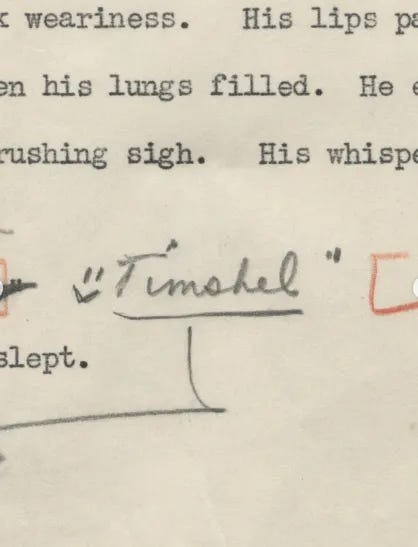
Not a promise, and not an order... a choice.
You might beat the sin crouching at your door, and... you might not.
Lee says it may be the most important word in the world, because even Cain, with his brother’s blood on his hands, “has still the great choice.”
Steinbeck had backup, too. A 1917 Jewish translation of Genesis ends the verse, “but thou mayest rule over it.”
Steinbeck does call Cathy a monster, born that way. The book asks whether her son is, too.
Cal Trask spends half the book flat sure he was born bad, like his mother.
Timshel says he wasn’t.
Nothing Is Written Yet

Open your phone tomorrow morning, and you’ll get the King James version of the future: thou shalt.
The economy shalt crash, and your kids shalt inherit the wreckage. Every headline is a promise, and the ending is doomy.
Funny thing about the future, though... it’s never as settled as the headline. It might even turn out better.
All that negativity costs us.
Researchers at Flinders University surveyed 800 university students in Iran and the US in 2024, and in both countries, the more students doomscrolled, the more existential dread they reported, along with a creeping sense that life means nothing.
Past Passport exists to call out that DOOM for what it mostly is: nonsense.
Netflix sold you the evil mother. Steinbeck wrote the book to his sons... about her son, the one who got to choose.
The critics missed that the first time, too. When East of Eden came out in September 1952, most of them blessed it as heavy-handed and preachy.
Readers got it. By November, the book was No. 1 on the bestseller list, and it’s never gone out of print. Ten years later, Steinbeck won the Nobel. The copy in my hand is the Steinbeck Centennial Edition, printed for his 100th birthday in 2002.
It turns out books aren’t born doomed, either.
So pick the worst thing in your newsfeed, the one that looks settled. The headline says thou shalt... history mostly says thou mayest.
An old Hebrew verse and a 1952 novel won’t make tomorrow sunshine and rainbows. But they might buy you a lower-stress Tuesday... and more room to decide what to do with it.
Online negativity used to sap me, too. That stopped when I founded Past Passport, and now I bathe daily in art, history, and beauty.
If you know anyone stuck in negativity, share this essay with them. A subscription is only $5 a month, with the first week free.
Be sure to follow me on X @PastPassport, too. My new Doomscroll Buster video series breaks up online negativity with short takes on art and beauty, great books, historic places, and ancient battles. All free.