

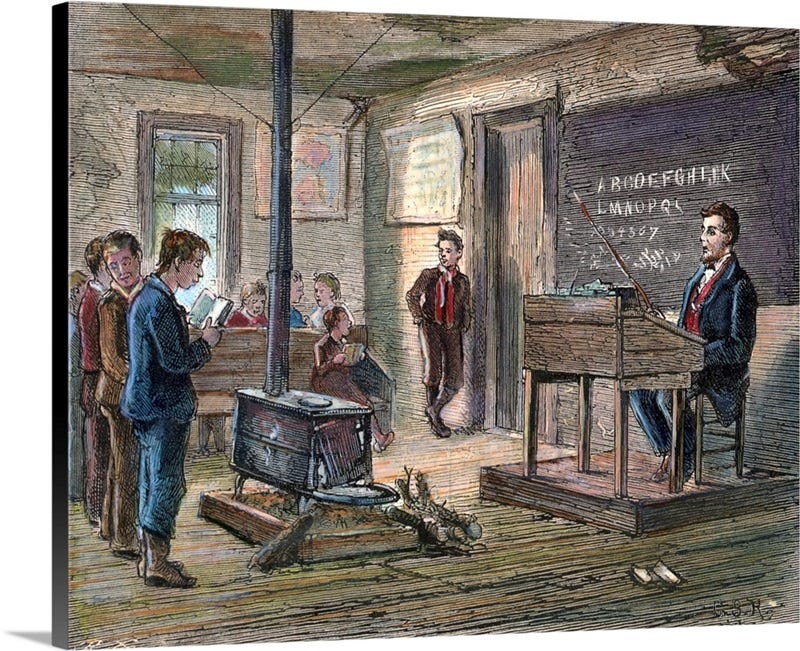
I was 16 in 1987, sitting at a high school assembly in Ohio. A pastor stood up to deliver the opening prayer. My first thought wasn’t about the prayer. It was: are they allowed to do that?
Even at that age, I just knew the line between school and church was supposed to be there, and I wondered if someone had stepped over it.
That line has been getting stepped over, argued about, and redrawn since before my high school existed.
Now multiply that by 5 million kids
This week, Texas just put 5 million students on the latest version of it. The new required reading list runs about 200 titles.
Elementary kids get Adam and Eve and David and Goliath. Middle schoolers get the 23rd Psalm and the Book of Jonah. High schoolers get 1 Corinthians 13, the “love is patient, love is kind” passage, taught alongside Jane Austen’s Pride and Prejudice. Dickens is on the list, too, and a eulogy for Reagan written by Margaret Thatcher, paired with Shakespeare’s Julius Caesar.
Every outlet covering the vote calls it unprecedented. A first of its kind.
It isn’t.
America fought this exact fight before it had a public school system worth fighting over.
Philadelphia found out the hard way, in 1844. The only thing new about Texas in 2026 is that nobody died this time.
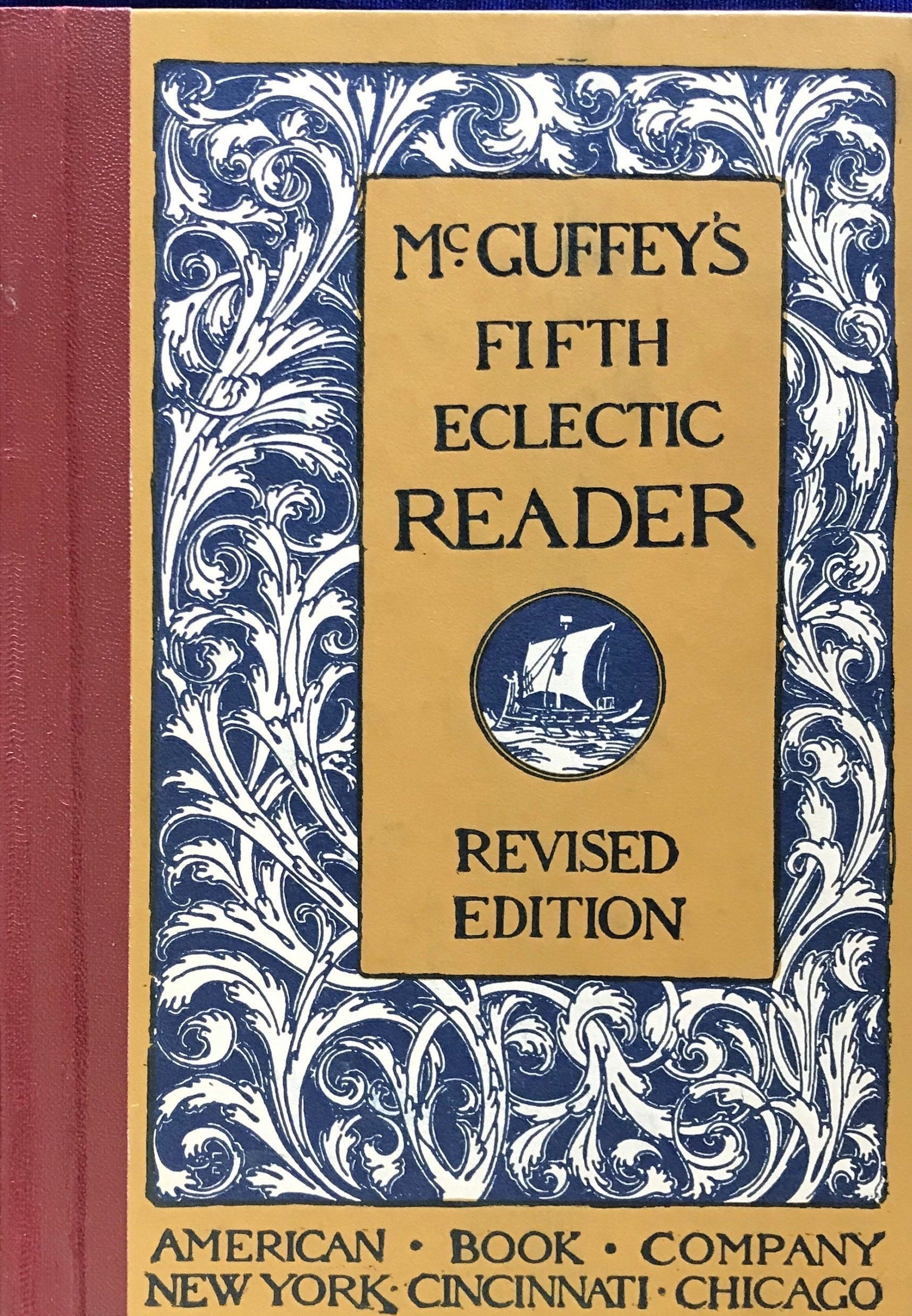
By then, Philadelphia’s public schools opened every morning with the King James Bible. Not as a suggestion. Pennsylvania law required it. The textbooks weren’t neutral either. Most American schoolchildren were learning to read from the McGuffey Readers, written by a Presbyterian minister who said flat out that no source had supplied more of his material than scripture.
The “nonsectarian” public school curriculum, nationwide, ran on one denomination’s Bible and one minister’s idea of morality. The problem was Philadelphia’s fastest-growing population didn’t read that Bible.
Irish Catholic immigrants used the Douay-Rheims translation, and their bishop, Francis Kenrick, wrote a polite letter to the school board in 1842 asking if Catholic children could read their own version instead.
The board’s answer was the kind of compromise that pleases no one. Catholic students could use a Bible without footnotes. The Douay had footnotes. So the Douay stayed banned, and the request that started as a courtesy turned into a rumor: the Catholics want the Bible gone entirely.
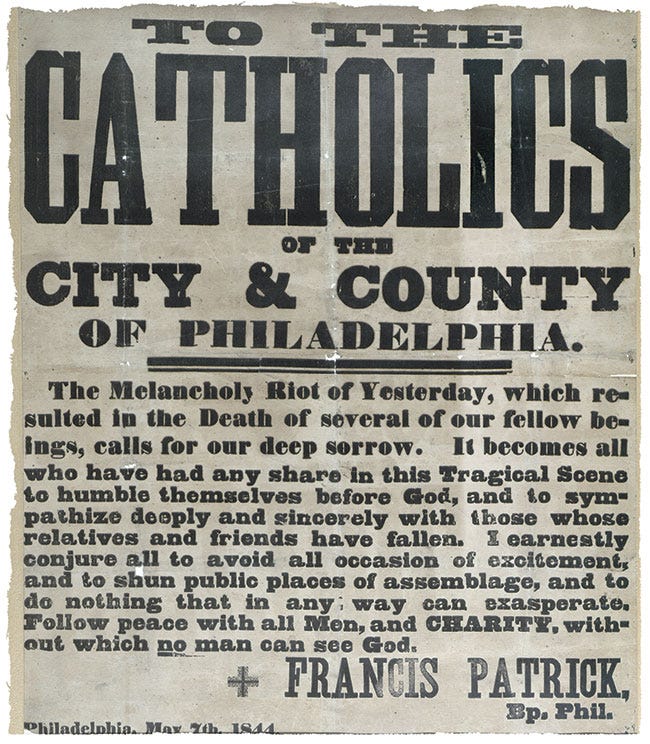
That rumor was false. It didn’t matter. By May 1844, nativist crowds were rallying in the streets of Kensington over a Bible controversy built almost entirely on a misunderstanding.
Three days of rioting killed at least two people. A second riot in July killed more. Two Catholic churches burned. Pennsylvania called in over a thousand militia to put it down.
The fight that started it was not about whether children should read the Bible in public school. Everyone agreed they should. The fight was about whose Bible, read which way, by whom.
That argument never really ended. It changed shape.
A Boston mob burned a convent in 1834 over the same complaint. New York Catholics raised it before Philadelphia did. In 1886, Wisconsin parents took the King James question all the way to their state supreme court, which ruled in 1890 that mandatory Bible readings violated the separation of church and state, even readings done “without comment.”
In 1963, a Pennsylvania teenager named Ellery Schempp brought a Quran to class to protest his school’s morning Bible reading, and his case went to the U.S. Supreme Court, ultimately ending school-sponsored Bible reading nationwide.
Each generation thought it was the one settling the question at last. None of them were.
182 years and counting
Texas is standing in the same spot Philadelphia stood in 1842, asking the same question a school board asked then: what belongs in the common curriculum of a country that doesn’t share a single religion?
The 2026 version comes with a 200-text reading list instead of a single King James Bible, and it is adopted by vote rather than by a bishop’s letter. The structure of the argument is remarkably familiar. The only thing missing is muskets and riots.
The republic has run this exact argument for nearly 200 years without ever needing an emperor to settle it. Rome had Augustus deciding which poets got read and which got erased. The Soviet Union rewrote its textbooks every time a leader fell out of favor. America’s version happens in school board meetings, court filings, and now, apparently, cable news segments. People show up, argue, vote, and go home. Then somebody sues, a court rules, and the country adjusts and moves to the next round.
That is the system working exactly as designed: loudly, slowly, and without anyone burning down a church over it this time.
I never got an answer about that pastor and that assembly. I still don’t know if it was technically allowed. What I know now is that the question itself, asked by a kid in an Ohio gym in the 1980s or by a school board in Austin in 2026, has echoed through American history almost since the republic began.
America turns 250 next week. We traded the McGuffey Readers for Chromebooks. The argument over what every child should read isn’t going anywhere.
AI Note
Grok pulled the news cycle on the Texas news. I gave Claude the 1844 riots and the voice rules and asked for a draft that didn’t take a side on Texas, just showed the side-taking is older than the country’s school system. The opener is mine, a real memory from a high school assembly in Ohio.
I added the 250th anniversary tie-in at the end and asked Claude to fold in the McGuffey Readers, since the textbooks were never neutral either. The closing line is mine. AI writes the first draft. I wrote the last one.
Excellent read and very timely.
Great article!