The Beauty Standard Didn't Evolve. It Was Engineered.
A Greek aristocrat would have looked at the modern red carpet and started ordering bread, olives, and honey cakes.
This NY Post story on Demi Moore at Cannes has 41.7 million views this morning.
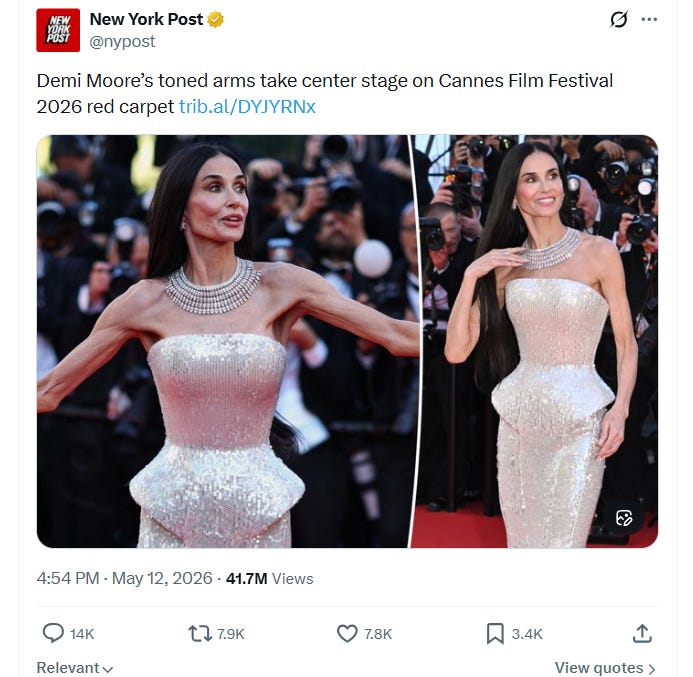
People stopped scrolling. Some admired her beauty, while others expressed concern and unease.
That argument has been running for 100 years. Almost nobody knows how it started.
The Beauty Standard Didn’t Slowly Evolve
In 1901, the ideal body had full hips, rounded shoulders, and skin that suggested leisure. By 1925, one researcher tracking Vogue found bust-to-waist ratios had dropped roughly 60 percent. Sixty percent in twenty-five years.
The flapper silhouette arrived with a flat chest, narrow hips, and a boyish frame. In 1918, Lulu Hunt Peters published Diet and Health: With Key to the Calories.
Millions of copies sold. Calorie counting became a moral act involving discipline and self-control.
Something was now encoded in thinness that hadn’t been there before. The question is where it came from.
The Origin Story Nobody Wanted to Write Down
Sabrina Strings spent years asking a simple question: where did the thin ideal actually come from? Not fashion or health. She followed it back into the 18th and 19th centuries, where European and American writers linked fuller bodies to blackness, “savagery,” and a lack of restraint.
Thinness became coded as disciplined, white, refined, and controlled. The moral freight attached to a thin body was constructed and built, in part, on racial anxiety.
What the Greeks Spent Hundreds of Hours Carving Into Stone
Stand in front of the Venus de Milo in the Louvre.
She was carved around 150 BCE — Aphrodite, the Greek goddess of love and beauty. Rounded shoulders. A stomach that folds slightly at the waist. Hips with weight behind them. The body looks warm and fed.
No sculptor in those workshops was chiseling toward visible ribs.
The ancient Mediterranean lived on the razor’s edge of hunger. Harvests failed. Winters stretched on. Grain ships sank. A body with softness meant something very different than it does now. It suggested health, fertility, and enough food in the house to survive another season.
Thinness belonged to laborers, the sick, and the poor.
A beautiful woman never looked hungry.
“The girl herself was not too thin.” — Catullus
A Roman poet born in 84 BC wrote that down because it needed saying. Which means someone thought thin was worth aspiring to even then — and he was pushing back.
Ovid wrote about women with softness on their bodies. Wide hips, full thighs, skin that suggested leisure. The Roman word gracilis didn’t mean skeletal. It meant balanced. Proportional.
But the reason those ideals existed at all was economic. A hard winter could still empty granaries in 100 AD. Grain ships from Egypt disappeared in storms. Bread prices spiked fast enough to start riots. Against that backdrop, a well-fed body carried social meaning, much as a Rolex does now.
Roman banquets piled tables with bread still warm from ovens, olives glistening in oil, roasted fish, and honey cakes. Wealth had calories attached to it. People could see it sitting at the table.
That alters what beauty becomes.
Botticelli and Rubens Were Painting the Same Ideal
Florence, 1485.
Botticelli paints Venus rising from a placid sea.
The painting wasn’t hanging in a museum — it was commissioned for a Medici villa, made for one of the wealthiest families in Europe to hang in a private room. The people who saw Venus every day were the people who set the standard.
Look closely at her.

Her stomach softens at the waist. Her hips widen naturally. She looks nourished and rested. Scholars and artists were pulling ancient manuscripts from storage across Florence, translating them, arguing about them in candlelit rooms. The body Botticelli painted was a deliberate return to what the ancients believed beauty looked like.
Peter Paul Rubens, a century later, working out of Antwerp.
His women hung in the courts of kings. Philip IV of Spain collected them. The Habsburgs collected them. The most powerful men in Europe looked at round buttocks, plump thighs, curved bellies — rolls and dimples, skin catching the light differently in every fold — and called it beauty.
The word Rubenesque exists because language needed a name for his idea of beauty.
When the Signal Flipped
For most of history, eating well signaled wealth because food was uncertain. Once abundance became ordinary, the signal reversed.
A visible rib cage sends one message in a world of supermarkets and social media. It sent a completely different one in a world where famine was a living memory passed from parents to children.
The ideal kept thinning through the 20th century. Twiggy in the 1960s, heroin chic in the 1990s. Ozempic culture now. Actual American women got larger on average over the same period. The gap between real bodies and the approved body widened decade after decade.
That may be why the Demi Moore photos pulled 41.7 million views. The thin ideal looked almost too successful. Pushed to the extreme now. Thin enough that people couldn’t decide whether they were looking at beauty, discipline, or something slightly alarming.
The Paintings Remained the Same. We Didn’t.
Look at the women in the old paintings.
The stomachs. The hips. Thighs pressing into silk and velvet. For most of Western history, beauty looked nourished. The painters weren’t documenting exceptions. They were painting ideals.
The canvases never changed.
We did.
I write about the moments where the modern world collides with the past.
Art. History. Beauty standards. Empires. The things people once believed without realizing they believed them


I thinking throughout time, beauty standards remained the same. Just one or another attitude towards beauty came to be propagated, but it never works like that. People still have their own opinions.
People were in better shape in the past so the ideal was not too far from reality. The reality today is a lot worse. People eating unhealthy carbs. Obese. So that is why it must seem the beauty standards have changed. But as you said, we did.