

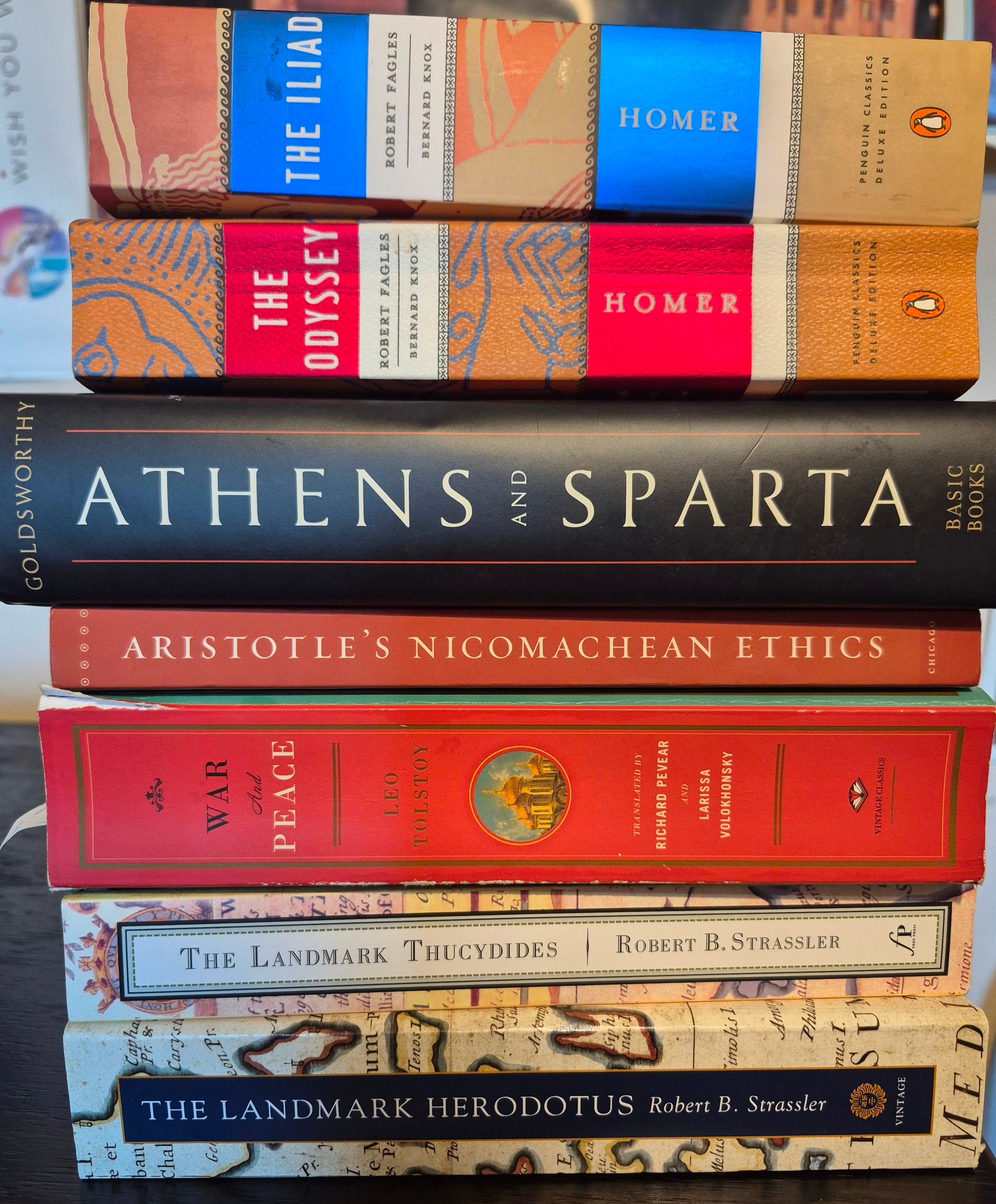
My desk is stacked with roughly 27 pounds of great books that would have seemed like witchcraft to a Roman senator in 500 AD.
The Iliad and Odyssey, Fagles translations, Penguin Classics deluxe editions. Aristotle’s Nicomachean Ethics. The Landmark Herodotus and Thucydides, both thick enough to use as doorstops. War and Peace. I paid maybe $75 for the pile, delivered to my door. Two are on my phone for free.
Some of these books took 2,000 years to get here.
Not because of fire or censorship. Because papyrus rots in 75% humidity, and scribes need to be paid. When Rome collapsed in 476 AD, scribes were no longer essential, and the scrolls containing the greatest works of the ancient world rotted on shelves no one maintained.
What We Lost As Rome Distinigrated
Livy wrote 142 books of Roman history. We have 35. Menander wrote over 100 comedies. Plutarch considered him the greatest comic playwright in the Greek world. We have one complete play. An entire civilization laughed at jokes we will never hear.
The laughter lasted an evening, and the silence has lasted two thousand years.
Then there’s Aristotle.
He wrote polished philosophical dialogues that his contemporaries read and admired. Cicero called his prose a river of gold. Every one of those dialogues is gone.
What we call Aristotle today, the Ethics, the Politics, the Poetics, are his lecture notes, compiled and published after his death. Substantial works that were carefully preserved. But not what the ancient world considered his best writing. The river of gold dried up while the papyrus rotted.
The equivalent of losing Aristotle’s dialogues would be losing Shakespeare’s plays and keeping only his rehearsal notes.
One Man’s Decision
In 540 AD, one of the most powerful men in Rome walked away from public life.
Cassiodorus had been chief of the civil service under the Ostrogothic kings, the most senior administrative post in what remained of the Western Empire. He was 65 years old. Rome was dissolving. The Gothic War had torn through Italy, destroying libraries alongside cities. Even Christian texts were disappearing.
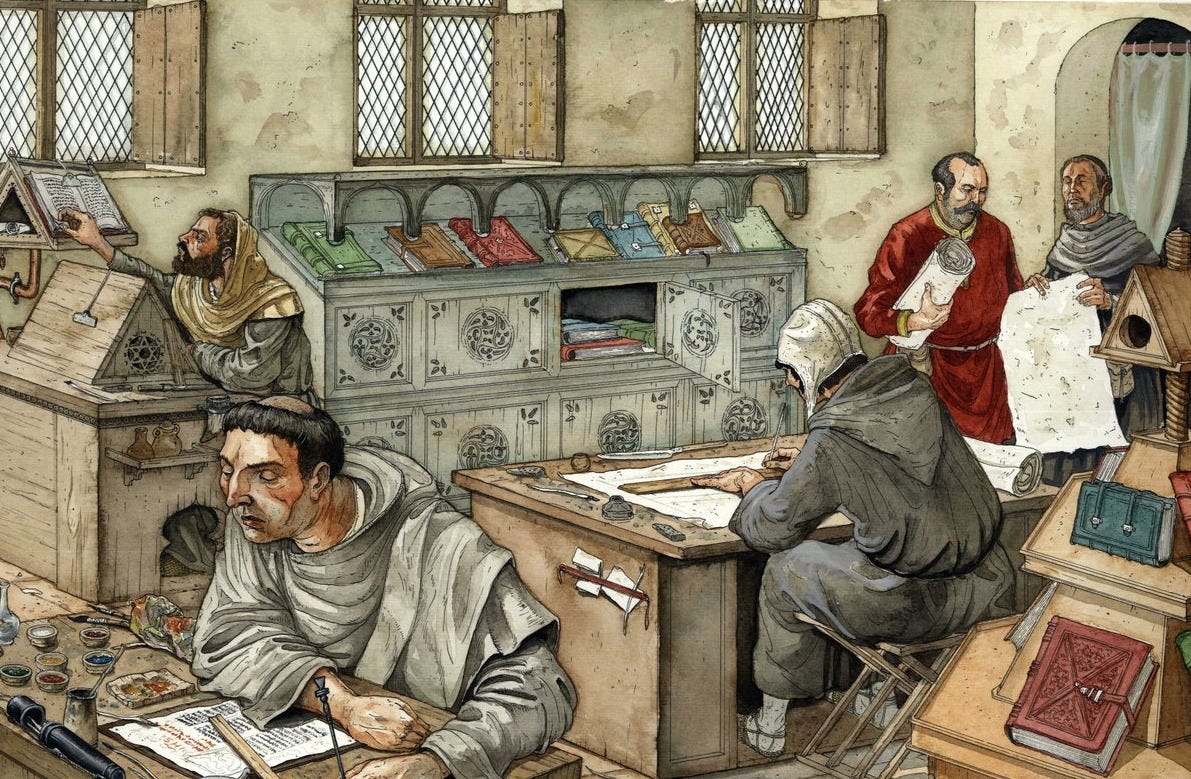
He journeyed home to Calabria in the far south of Italy and built a monastery on his estate. He called it Vivarium, after the fishponds on the property. Then he built a scriptorium specifically for copying ancient texts and directed his monks to use it.
The room had a sundial for daylight hours, a water-clock for nights and cloudy days, and a lamp that fed itself oil from a reservoir so copying could continue after dark. Cassiodorus engineered the space to run without interruption.
The monks copied pagan authors alongside Christian ones. Cassiodorus had a specific theological argument for it: classical texts supported Christian learning, and saving Cicero and saving scripture were the same project. The ancient world and the Christian world were not enemies on a shelf.
He wrote a guide for his monks called the Institutiones that treated classical education as essential to Christian formation. That document spread through European monasteries for centuries after his death. He didn’t just save books. He made the theological case that books were worth saving. That case outlived the building he built to prove it.
Vivarium died around 580 AD, roughly when Cassiodorus did. He didn't save everything. Plenty was already gone, and more would follow. But the copies had left the building, other monasteries had the model, and the argument that classical learning and Christian formation belonged together had taken root. That idea outlasted him by centuries.
When Rome dissolved, most people protected themselves. Cassiodorus and those like him protected the books.
A Different Chain in the East
Cassiodorus was one link in the chain. Homer survived because there were others.
Homer survived first through oral tradition. Professional bards memorized the poems line by line for centuries before anyone wrote them down. When the texts were finally committed to writing, preservation shifted east.
Emperor Constantius II established the Imperial Library of Constantinople in the 4th century specifically to save ancient manuscripts, Homer among the priorities. As papyrus deteriorated, Byzantine scholars transferred texts to parchment. Roughly 300 medieval manuscripts of the Iliad or Odyssey survive today, most of them Byzantine.
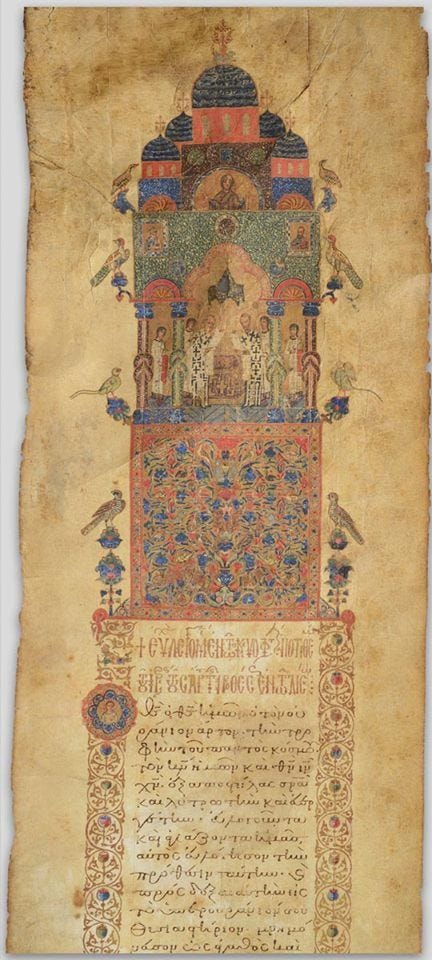
Few scholars in medieval Western Europe could read Greek. What they knew of Homer came mostly through a Latin summary. The full poems returned to the West through Byzantine scholars fleeing Constantinople after its fall in 1453.
The books on my desk came through multiple chains. Cassiodorus is one of them. Constantinople is another.
The Stack on My Desk
The Landmark Herodotus at the bottom of my pile is 1,024 pages, maps in the margins and footnotes on every page. Thucydides is next to it at 700. Herodotus finished his histories around 425 BC. That text passed through Byzantine copyists, medieval monasteries, and scholars who understood what they were holding. At several points in that 2,400-year journey, one careless generation could have ended it.
Cassiodorus understood that. He was 65 years old, watching a civilization dissolve, and he decided the answer was to sit down and start copying.
The stack of ancient books on my desk is the answer to that decision. And yours are too.
The older I get, the more I suspect civilization survives the same way families do: not because it’s inevitable, but because somebody decides it’s worth the effort.
If you want to keep reading about how the ancient world survived to reach us, subscribe to Past Passport below.
AI Helped Me Flesh Out The Full History
The first draft of this essay focused almost entirely on Cassiodorus and the Western preservation effort. Claude flagged two things I had undersold.
First, the Byzantine scholars in Constantinople had been copying Greek texts continuously for nearly a thousand years after the Western Empire fell. Homer’s survival ran through the East, not through Western monasteries. Leaving that out would have been historically misleading.
Second, Cassiodorus wasn’t running a neutral preservation project. He had a theological argument: classical texts supported Christian learning, and saving Cicero and saving scripture were the same mission. He wasn’t just rescuing old books. He was building a case for what Christian education should look like. That’s a different and more interesting story than “monk saves library.”
AI flagged the gaps. I filled them in.
That is some top shelf reading.