The Brutal Process That Forged Blue Paint in Ancient Rome
Blue wasn’t found in Rome. It was made through heat, sweat, labor, and time.
Blue didn’t exist in ancient Rome.
They had to make it with heat and labor.
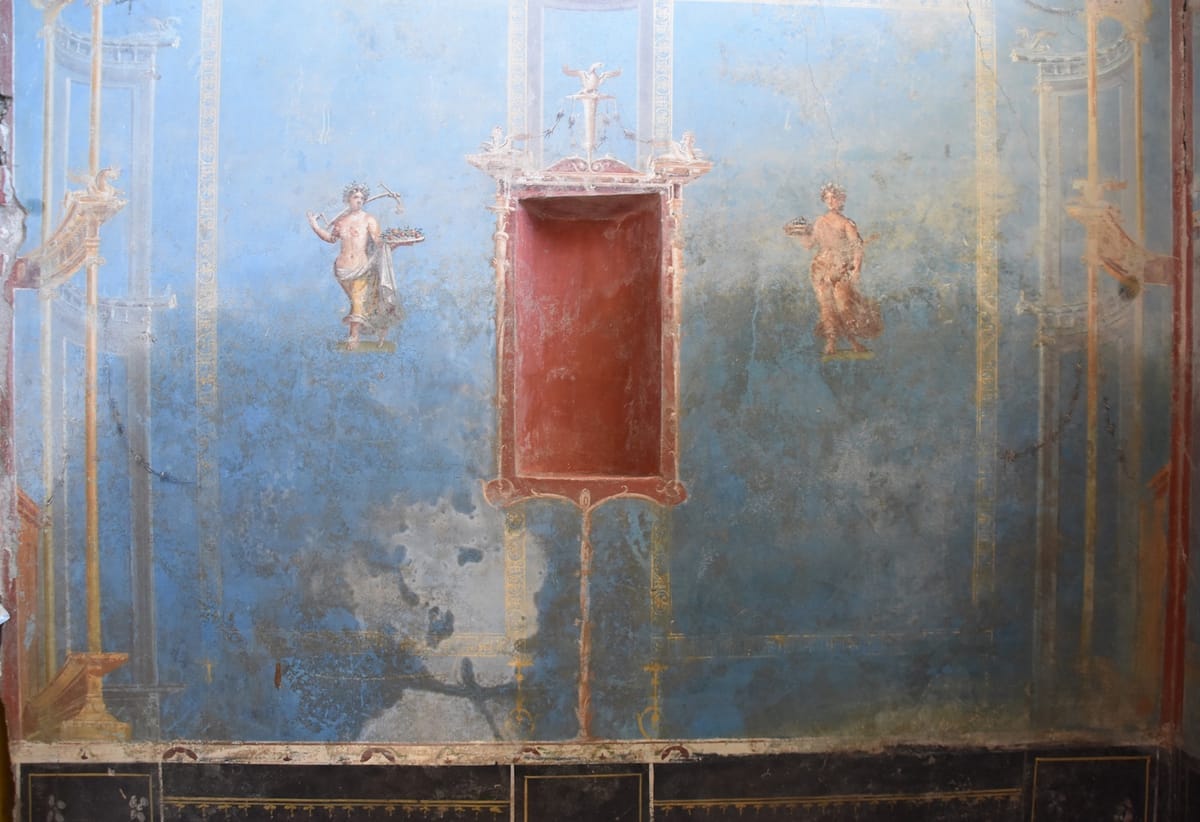
What you’re seeing on these walls—
was forced into existence with brute strength.
This is a reader-supported publication.
I write short pieces on the details most people miss—
how things were actually made, built, and used.
The parts you don’t see unless someone points them out.
↓ Get the free reports:
The 10 details most people miss in Rome
The 5 details people miss in Pompeii
Few people think about blue paint today.
Easy. Cheap. Buy at any hardware store.
In ancient Rome
Rare.
Difficult to make.
Expensive.
How Ancient Rome Made Blue Paint
It started as ordinary sand.
Pale. Dry. Nothing close to blue.
Sand was mixed with crushed copper — green and dull, nothing like what would eventually cover the walls of Rome and Pompeii.
Lime and ash were added.
The minerals ground together.
Dry at first. Then thicker.
Grit pressing into callused skin as it was worked by hand.
Nothing about it resembled blue.
The mixture was placed in a furnace, fed with logs—sometimes charcoal when more heat was needed.
Kilns burned hot enough to fuse sand, copper, and lime into something that looked like sky.
Wood snapped and cracked as it burned.
Flames pushed through the opening, uneven and restless.
Craftsmen fed the roaring fire constantly.
Hours of it.
Sweat running down arms.
Heat scalding skin from the fire.
Inside, the temperature climbed beyond anything they could measure.
They judged it by feel.
By the color of the flames.
By the weight of the air against the skin.
What we now know is that it took something close to a thousand degrees —
a narrow range where the color finally appeared.
Hot enough to change the material itself.
Deeper in, the fire changed.
Charcoal glowing red.
Steady. Hotter.
The kiln burned orange.
Heat pushed outward, pressing against faces.
Smoke thickened the air—dry, metallic, clinging to the throat.
Not just wood smoke. Something sharper.
They stood close anyway.
Inside, the materials began to change.
The sand fused.
The copper reacted.
Slowly, something new formed.
Not paint. Not yet.
What came out was hard.
Brittle. Glass-like in places.
Blue — but trapped inside the material.
So it was broken again with raw human effort. Will.
Hammer. Stone. Pressure.
Back to the beginning.
The chunks were crushed down, over and over, until the color was released—
until it became a fine, soft powder.
Finally, blue appeared.
It stained workers’ hands.
Worked into the lines of their skin.
Even after washing, some of it remained.
A trace of the work.
Only then did it become paint.
Mixed with binders.
Spread across prepared walls.
And then —
It stopped moving.
After all the grinding, the heat, the handling, it settled into its final form.
A surface.
A blue that held.
You can still see it in Rome 2,000 years later.
In fragments where the surface has fallen away, but the blue remains.
In Pompeii, where some of that color was already on the walls when the ash began to fall. It held.
Through heat. Through time.
What you’re looking at isn’t just color.
It’s sand, changed by brute heat and will. Copper forced into something else.
Hands that worked it until it gave in.
Most people walk past the blue.
They don’t see the fire behind it.
I write short pieces on details like this—
the parts of ancient places most people never notice.
↓ Get the free reports:
The 10 details most people miss in Rome
The 5 details people miss in Pompeii


If you saw blue in those days, it meant someone had money and was important.