The First Things Humans Ever Wrote Down Included Someone Missing the Good Old Days
The Sumerians felt it. The Greeks felt it. The people in Ironton felt it. So do you.
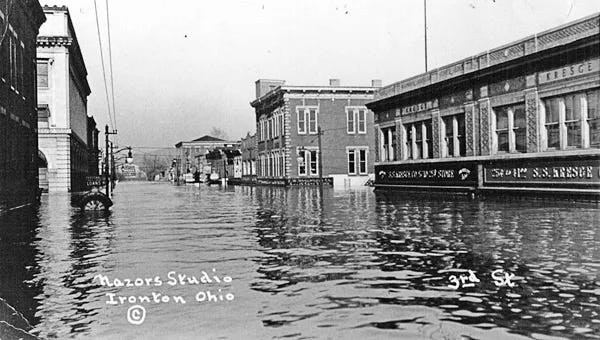
October 1992. I was in my early twenties, driving south from Athens, Ohio, to research the Great Flood of 1937 for a college story. No internet or GPS. Just a red notebook and the feeling that my story was probably sitting in a dusty library room somewhere.
The Ironton Public Library sat close enough to the Ohio River that I remember thinking the flood never completely left the building. The periodical room smelled like wet dust and old paper. The newspapers from 1937 were brown at the edges and brittle in your hands. The wood pulp was literally eating itself.
I turned through the old pages.
The rains poured on January 19 that year. Brown, roiling water swelled over the river banks.
By the 27th, there was twenty feet of water in downtown Ironton. The river crested at seventy feet. Flood stage was fifty. The mayor toured the city by boat and had to duck under traffic lights.
I turned another yellowing page and found an editorial. He wrote that people in Ironton were becoming colder. Meaner. Less neighborly.
The good old days, apparently, were the 1890s.
This was the Great Depression. Soup lines and families sleeping in cars. Seventy-five percent of Ironton underwater for ten days. Roughly 13,300 people were displaced.
An editor wanted it to be 1890 in 1937.
The Good Old Days Form Quickly
Nostalgia settles in fast. Sometimes within a decade.
At its peak, Blockbuster had over 9,000 stores and made more than a billion dollars from late fees. People hated those late fees. They complained about them constantly.
Then the company died in 2010.
Streaming arrived, and now people drive to the last Blockbuster in Bend, Oregon, just to take pictures under the sign.
Americans turned a place they once complained about into a pilgrimage site.
Go back far enough and the nostalgia pattern starts feeling permanent.
Socrates Hated Writing. Writing Is Why You Know That
Socrates thought writing things down was making people weaker.
If knowledge lived on papyrus, memory would rot, he argued. People would stop training their minds. They would read instead of remember. The old oral tradition mattered because knowledge had to be carried by a human being.
Then Plato came along and wrote all this down.
Human Beings Became Nostalgic Almost Immediately
One of the first things humans did with writing was to complain that the world used to be better.
Some of the oldest surviving Sumerian tablets already carry that feeling. Words carved in stone about lost greatness. Decline. The sense that the best version of the world already belonged to the past.

The Epic of Gilgamesh opens with this lament.
The ancient Egyptians built governments around it. During unstable periods, pharaohs deliberately copied the art and language of the Old Kingdom, the pyramid age, from a thousand years earlier.
Nostalgia carved directly into stone walls.
Around 700 BCE, a Greek farmer-poet named Hesiod described what he called the Five Ages of Man. First came the Golden Age. No hard labor. No injustice. Food grew easily from the earth.
Then everything deteriorated.
Silver, then bronze, then an age of heroes. Then his own miserable Iron Age — bad harvests, neighbors you couldn’t trust, children who didn’t respect their parents.
Hesiod wrote:
“Would that I were not among the men of the fifth generation.”
Around 700 BCE, a farmer was already convinced civilization peaked before he arrived.
Athens Was Falling Apart. People Wanted the Old Writers Back.
A few centuries later, Aristophanes penned a comedy called The Frogs.
The plot sounds almost modern. A god travels into the underworld because contemporary writers are terrible and Athens needs one of the old masters brought back from the dead.
The play won first prize in 405 BCE.
Athens had already suffered the Sicilian Expedition by then. Roughly 50,000 men and 200 ships sent against Syracuse. Almost none returned. Survivors were enslaved or left to die in quarries under the Sicilian sun.
The empire was cracking apart.
Spartan armies were closing around Athens.
And the biggest hit in town was nostalgia.
Romans Thought Rome Had Already Declined
Sallust blamed Rome’s collapse on the destruction of Carthage.
Livy warned that wealth and comfort had weakened the republic. Roman writers kept looking backward toward an older Rome of hard farmers, stern fathers, and simple virtues.
Romans spent centuries romanticizing a republic that probably never existed the way they imagined it.
Every Roman generation thought the real Rome had already disappeared.
A Swiss Doctor Classified Nostalgia as a Disease in 1688
In 1688, a Swiss medical student named Johannes Hofer studied soldiers and students living far from home.
Some stopped eating. Some developed fevers. Some became so obsessed with home that they could barely function.
A few died.
Hofer called the condition nostalgia.
He believed homesickness physically damaged the brain. Certain Swiss folk songs were reportedly banned among mercenary troops because hearing them could trigger emotional collapse or desertion.
A Swiss doctor looked at homesick soldiers and concluded longing for the past could kill a man.
I think Hofer misunderstood one thing.
The soldiers probably weren’t only missing Switzerland.
They were missing the version of themselves that still existed there.
The Ironton Library That Smelled Like Wet Dust
I was twenty-two years old when I found that editorial in Ironton. Brown paper, brittle corners. A river town still drying out from catastrophe, while somebody complained that the world used to be better.
I’m in my mid-fifties now. I still think about that room.
Everybody always arrives just after the golden age ended.
Did you learn anything new? Let me know in the comments.
The Romans worried about debt and bad leaders. So do we. Every generation thinks it's living through the end of something. Most of them were wrong. Subscribe as we explore why.


