The Flying 1,000-Ton Lid and the Lie That Lasted Fourteen Years
From Howard Zinn to Augustus Caesar, the fight over what children learn about their country is 2,000 years old. | Past Passport
Editor’s note: Every Past Passport article has an AI section at the bottom. Today's covers Habsburg AI — what happens when AI trains on AI-generated content and the writing gets worse over time. I learned how to avoid it. So can you. If AI isn't your thing, skip it.
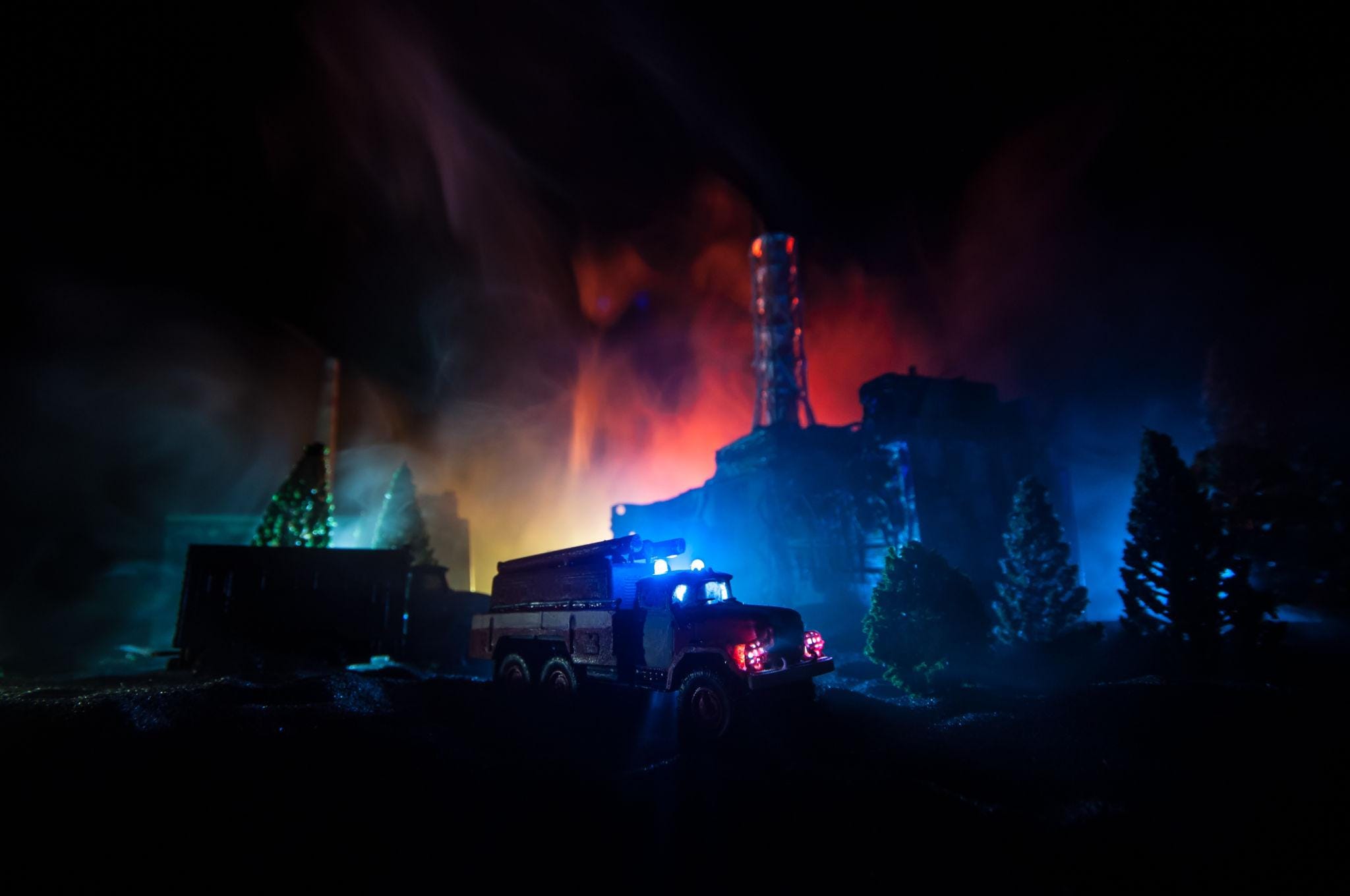
Reactor 4 at the Chernobyl nuclear plant exploded in Ukraine on April 26, 1986. At 1:23 a.m., an explosion equaling 60 tons of TNT tossed the reactor’s 1,000-ton concrete lid into the air like a flipped kopeck coin. Nearly 7 tons of uranium fuel — cesium-137, strontium-90, iodine-131, plutonium-239 — sprayed miles into the atmosphere.
An ominous blue light rose into the clouds, visible for miles. Cherenkov radiation, the glow of an exposed reactor core, beautiful and lethal. Residents of Pripyat stood watching, fascinated. Some were likely absorbing dozens or hundreds of times the safe daily radiation limit, even from a distance.
They viewed the sight from the streets and nearby bridges — some holding their children in their arms — drawn by something that looked like fireworks two miles away. They had no idea what they were looking at.
Two workers died that night. Within four months, 28 more were dead from acute radiation sickness. Eventually 350,000 people were evacuated from 1,838 square miles of contaminated land.
My future wife was 11 years old in Perm, Russia, 1,440 miles away. Neither she nor her family knew for weeks — not about the radiation cloud drifting across Western Russia, Scandinavia, and into Europe. Swedish nuclear plant workers detected it two days after the explosion before the Soviet government admitted anything had happened.
The radio on the kitchen wall, a wired speaker mounted directly into the state broadcast network with one channel and impossible to turn off, said it was a minor accident. The family’s Rubin television said the same. A power plant had been damaged. Everything was under control.
The Soviet government decided she didn’t need to know.
The 49,000 residents of Pripyat, Ukraine, two miles from the plant, were told on April 27 to pack for three days. Buses were waiting outside. Leave the pets, don’t bring much. You’ll be back soon. They left food on tables, money on counters. Pets locked inside. Most never went back.
Thousands of dogs and cats were eventually shot by cleanup crews because they were radioactive. The government had known within hours that Pripyat was finished forever. They told the residents three days anyway, because three days felt manageable, and the truth didn’t.
The KGB issued orders within hours: restrict the mail, cut the phone lines, tell the doctors to write the wrong diagnosis. Soviet authorities flooded the information space with noise until the confusion itself became the story. Gorbachev didn’t address the nation until May 14, eighteen days later, and used part of that speech to call Western coverage “malicious lies.”
She went about her life for fourteen years not knowing any of it.
We watch Russian state television in our house in 2026. The coverage of Ukraine runs the same way: Russia is defending its territory, recovering what belongs to it, responding to aggression that Ukraine started. Confident, consistent, one direction only. Relatives in Perm tell us Ukrainian drones have been hitting the airport and military sites around the city. It hasn’t appeared on Moscow state television once.
The Soviet Union disappeared. The instinct survived.
Augustus, Stalin, Zinn — Same Question, Different Century
Voltaire said history never repeats itself. Man always does.
This week, the argument over Howard Zinn’s A People’s History of the United States flared up again on X. The book came out in 1980 and has sold over 4 million copies. Indiana and Arkansas tried to ban it. Arizona too. The bans mostly failed. Each attempt made the book more famous.
The fight looks like a modern American argument about curriculum and politics. It’s 2,000 years old.
Every society that has ever held power has tried to shape the story its children grow up believing. Whoever controls that story controls what the next generation believes about their country, their enemies, and their place in the world.
The Aeneid was added to the Roman school curriculum within years of its publication. Roman teachers wrote out lines from it for students to copy. Children memorized vast sections of it by heart. Augustus didn’t need a propaganda bureau. Virgil was available.
Dinner at Maecenas’s House

Winning a civil war leaves you with a body count, a list of enemies whose families are still around, and no moral authority. Augustus needed a story.
His close friend Gaius Maecenas handled it. Maecenas was a wealthy Etruscan nobleman, Augustus’s de facto minister of culture without ever holding formal office. He ran a literary circle from his Esquiline Hill estate, found Virgil, and gave the poet enough financial security to spend ten years on something larger than bread money.
The poem Virgil wrote linked Augustus to Aeneas, the Trojan hero, and through him to the gods. In Book 6, the prophet Anchises shows Aeneas a vision of Rome’s future in the underworld, and one figure gets named above all others: “Augustus Caesar, son of a god, who will bring back the golden years to Latium.”
Augustus won the war. Virgil gave him legitimacy.
Public events featured readings. Schools taught it. It cost Augustus nothing that looked like censorship. A cultured friend, a well-funded poet, and a founding myth so beautiful no one wanted to argue with it.
Stalin’s Photo Department — and the Lie Machine That Still Ran in 1986
The Soviets were less subtle.
Leon Trotsky helped lead the Russian Revolution. He stood next to Lenin. He appears in photographs and official documents going back to 1917. After Stalin consolidated power and had Trotsky expelled and eventually killed, Soviet archivists edited the photographs. Trotsky disappeared from images beside Lenin, vanished from encyclopedias, dropped from textbooks entirely.

The philosopher Leszek Kolakowski called the result “a perfect textbook of falsified memory,” designed so the Party could “exercise power over minds and destroy both critical thinking and society’s memory of its own past.”
Chernobyl was that same machine, still running in 1986.
Then the Soviet Union fell in 1991. For a few years, Russians were free to say what they actually thought about it. They did. The old narrative of Soviet greatness crumbled. People who had spent their entire lives inside the approved version suddenly compared notes with each other and with the rest of the world.
That window didn’t stay open long.
Putin’s government introduced updated history textbooks for 10th and 11th graders in 2023. The Soviet nostalgia is gone, but something replaced it: a story about Russian civilization, historical territory, and the reunification of lands that were always Russian. The operation in Ukraine is framed as defense and restoration. State television fills in the rest every night.
Three official histories. One country. One lifetime. My wife lived inside all of them.

Howard Zinn Had a Typewriter, Not a Darkroom
The impulse to control the story doesn’t belong to governments alone.
Zinn’s A People’s History of the United States has sold over 4 million copies. Indiana and Arkansas tried to ban it. Arizona too. Zinn wasn’t suppressing anything — he wrote a book anyone could argue with, buy, ban, or assign. He had no darkroom, no secret police, no KGB files. What he had was a typewriter and a conviction that the official version left too much out. That’s the opposite move from Stalin.
But the underlying question is identical: whose version of the past do the children get?
Somewhere in Arkansas in 2017, a high school teacher opened her classroom one morning and found out the book she’d been assigning for years had been pulled from the curriculum by state lawmakers. She taught American history. She wasn’t allowed to say all of it.
“Objectivity is impossible,” Zinn said, “and it is also undesirable.” He wanted history to serve a social purpose and wrote accordingly. No footnotes — just a bibliography at the back. The book opens with Columbus not as a complicated figure navigating 15th-century politics, but as the opening crime in a long American story of conquest and exploitation.
A Harvard historian and Rear Admiral named Samuel Eliot Morison spent 1939 actually sailing the Atlantic routes before writing his Pulitzer Prize-winning biography of Columbus. His conclusion: Columbus was one of the greatest navigators who ever lived, a man who crossed an unknown ocean four times by dead reckoning, with no charts and no precedent. Morison didn’t ignore what came after. He thought the full man was more complicated than a verdict on page one.
Even historians on the left haven’t been kind. Michael Kazin at Georgetown called it a “scissors-and-paste job” that reduces American history to a single story of oppression with no complexity and no redemption.
The Arkansas teacher, the school board, Zinn, and every government that ever tried to ban his book are all asking the same ancient question. Columbus never changes. The storyteller does.
History Never Repeats Itself. Man Always Does.
The Chernobyl story leaked out through defectors, foreign broadcasts, and the eventual collapse of the system managing it. My wife came to America in 2000 and filled in the gaps from sources no government had written. When she understood the full extent of what had happened — the cover-up, the falsified records, the thousands who died — it wasn’t the disaster that upset her most. It was the fourteen years her own government had kept her inside a lie.
The Aeneid outlived Augustus by two millennia, but so did the record of how it got made — Maecenas’s patronage, the Esquiline dinners, the financial arrangement with Virgil. We can read both the poem and the receipts.
Every banned book in Arkansas ended up with more readers. Every airbrushed photograph eventually gave itself away. The outline of the missing face was still there.
George Orwell watched the Soviets rewrite history in real time and wrote in 1945: “Already there are countless people who would think it scandalous to falsify a scientific textbook, but would see nothing wrong in falsifying an historical fact.”
He was describing Moscow. He could have been describing any century.
Once you see the hand on the pen, you see it everywhere.
I write about history to show how every generation thinks it’s over — and why it never is.
Habsburg AI

AI has a memory problem. Tell it no em dashes, no “it’s not X, it’s Y” constructions, demand specificity. It agrees every time. The rules help. The patterns still leak through.
The model was trained on certain rhythms, and those rhythms keep resurfacing no matter what you tell it.
There’s a name for what happens when this gets worse: model collapse. I love the nickname some researchers gave it: Habsburg AI (h/t: The AI Handbook Substack). The Habsburgs kept marrying within the family for generations. The gene pool got smaller and smaller until the defects compounded.
The same thing happens when AI trains on AI-generated content. The quirks amplify. The writing gets vague
r. An echo of an echo of an echo.
I caught 11 em dashes in my own article this week after banning them. The model agreed to every rule I set. Then Claude ignored them anyway.
Don’t make my mistake: don’t trust the AI too much. Read it like you’re looking for something specific, because you are. You have to stay the editor. AI writes the first draft. You write the last one.
Past Passport is a history newsletter, but we also write about our AI journey as non-technical users.
The mistakes we’ve made. The lessons we’re learning. The breakthroughs that changed how we work and write.
We’re figuring it out in real time. You can too.


