Nothing Seemed Wrong That Morning in Pompeii—Until It Was
Small earthquakes. Uneasy nights. Some had already left. Most stayed. No one understood what was about to happen.
This dog died in Pompeii.
It was still chained to a post. No escape.
You can still see this dog’s final moments—
frozen in ash nearly 2,000 years later.
It’s still there.
Most people never notice details like this.
I write short pieces on the things hidden in plain sight—art, history, and places you thought you understood.
↓ Get them in your inbox
The final morning in Pompeii looked like any other.
The sun was already warm on the walls and cobblestone streets.
A thin layer of dust clung to the grooves worn by cart wheels.
In one house, a dog lies on its back, body twisted.
Head arched. Front paws crossed. Back legs drawn in tight.
A collar and chain hold him to a post in the atrium.
The metal links pull taut.
He has nowhere to go.
The house around him is still.
The dog was fixed in place. But not everyone in Pompeii was.
For days, the ground shook. Small earthquakes — cups rattling, doors shifting, people waking in the night.
Some packed what they could and left.
Food sat warm on tables.
Doors stood open.
Belongings crammed into carts. Bundles tied and slung.
Families moved through the streets toward the city gates.
The stone at their base was worn down by centuries of cart wheels.
Grooves cut deep into the rock.
Many did not look back.
They did not all go to the same place.
When Mount Vesuvius erupted in 79 AD, many were already gone.
Some walked the roads out in worn sandals toward nearby towns — Nuceria, Stabiae. Others turned toward the coast.
Most simply left the city behind them.
Others stayed.
Some tried to flee too late.
Doors stayed open that morning. Flour was ground and set in ovens. Lentils and chickpeas were served in small restaurants.
The smell of bread, oil, and garum drifted through the narrow streets. Voices carried through them.
The morning moved forward as it always had.
By midday, something began to build above the mountain.
Tremors increased.
A light film of dust settled over the streets.
The mountain roared.
A cloud of ash and rock rose 21 miles into the sky, spreading like a Mediterranean pine tree* until it blotted out the sun.
The air turned hot and thick, hard to breathe.
Ash, pumice, and rock rained down on Pompeii, slowly filling streets and homes.
Roofs gave way. Escape routes narrowed, then closed.
By late afternoon, the sky had gone dark. The city fell into night.
The Mediterranean sun would not touch Pompeii’s plaster walls again for nearly two thousand years.
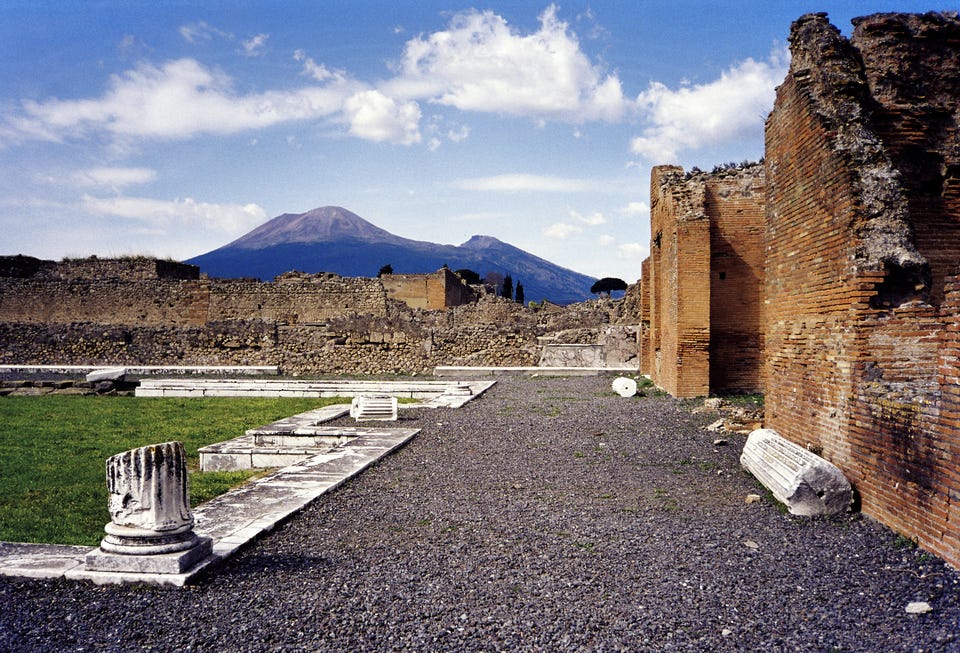
Today, in Pompeii, the streets and walls remain.
In one house, a dog remains at the doorway.
*The eruption cloud was described by Pliny the Younger as resembling a Mediterranean pine tree.
I notice the rare details most people walk past. They make history real again.
Do you notice them, too? Then,


I kept wondering who decided to leave — and who stayed.