I first met Julius Caesar in the fifth grade.
That’s when I learned, “Et tu, Brute?” and that he was stabbed to death on the Ides of March.
However.
What Mrs. Snook taught us in history class would earn a “Partly True” rating from Internet fact-checkers.
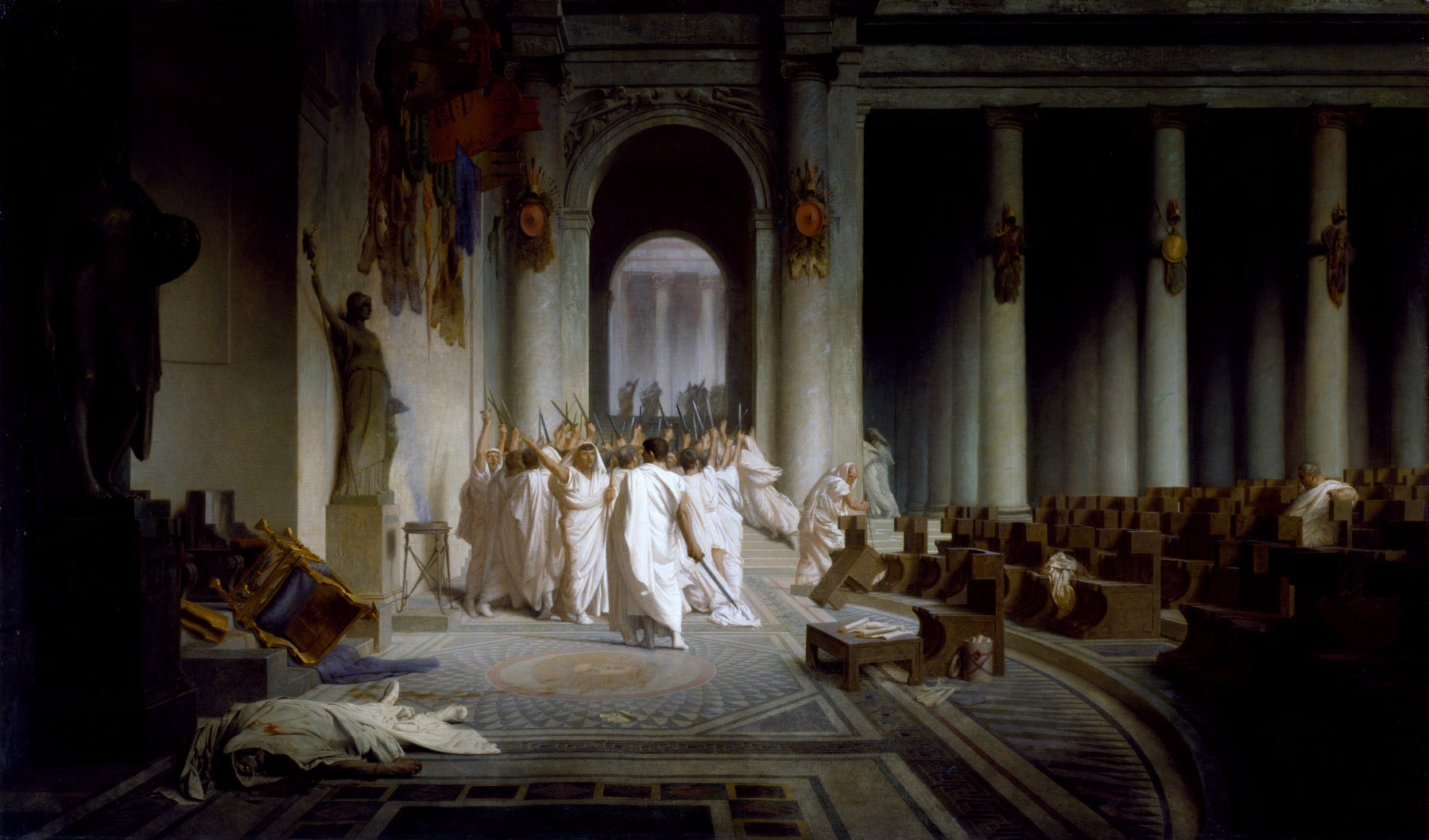
The stabbing happened. March 15th, 44 BC, at a meeting of the Senate. Fact Check: True.
Nicolaus of Damascus, writing within decades of the event, confirms it. So do Suetonius and Plutarch, roughly a century later.
Caesar's alleged last words, however, are Fact-Check: False.
No ancient source reports Caesar saying “Et tu, Brute?” Shakespeare made it up more than 1,600 years later, for his play Julius Caesar.
The dramatic line stuck so well that it became the entire Roman history lesson for generations of American fifth graders.
But the ‘Et tu, Brute?’ version also omits something important….that I didn’t learn until I picked up ancient Rome history books decades later.
There wasn’t just one Brutus among the killers. There were two.
And the famous one isn’t the one who broke Caesar’s heart.
Thank you for reading! Your support makes Past Passport possible. Paid subscribers get:
3 weekly history essays. Easy reading. No dull dissertations.
3 weekly quick summaries of how we use AI to create every essay.
1 monthly extra newsletter, rotating between a full AI breakdown for writers and video, and a Stoic philosophy article.
Open DM sessions on the month’s top article.
Only $5 per month.
The Brutus We All Know
I learned about one Brutus in fifth grade. Marcus Junius Brutus, specifically.
He wasn’t some obscure politico who got lucky with a famous line. Marcus was a big-time political heavyweight in Rome. He’d reached praetor, one rung below consul, the second-highest office you could climb to in Roman politics.
Married to Porcia, daughter of Cato the Younger, one of the most rigid and respected defenders of the old Republic.
This Brutus believed in that Republic. Thought Rome shouldn’t answer to one man for life, no matter how brilliant that man was.
So when Marcus joined the conspiracy to murder Caesar, nobody was surprised. That’s why his name survived 2,000 years of history. Not because he struck the fatal blow, but because his motive fit the moment.
Shakespeare needed one name to carry the weight of betrayal. Marcus already had the reputation. The principled friend-turned-killer story is…Shakespearean…in its perfection.
One problem, though. Marcus betrayed Caesar for an idea: that killing him would save the Republic. The OTHER Brutus betrayed the man who trusted him.
The one Mrs. Snook didn’t tell us about in 1981.
Almost His Son

His name: Decimus Junius Brutus Albinus. Distant cousin of Caesar’s. And, by most accounts, one of Caesar’s most trusted friends.
His closeness to Caesar wasn’t in question. Cicero’s own letters to him read like correspondence between true friends, not just political allies. Nicolaus of Damascus, writing within decades of the assassination, describes Decimus as one of the men Caesar trusted most.
Years before the assassination, Caesar charged him with a fleet. Told him to deal with the Veneti, a Gallic tribe with ships too tall to board and too thick to ram.
Decimus won decisively anyway, not with brute force, but with an innovative idea. Long hooked poles that tore down the enemy’s sails instead of trying to sink their hulls.
Caesar’s undersized fleet shouldn’t have won that fight. Decimus is why it did.
You don’t hand off that level of responsibility to just anybody.
And the Veneti campaign wasn’t the only sign of their close friendship.
Decimus was included in Caesar’s will. He was named a secondary heir, next in line if Octavian, Caesar’s chosen heir, couldn’t inherit. Appian, writing generations later, thought it was close enough to an adoption.
This wasn’t a man on the outskirts of Caesar’s inner circle, waiting for a reason to turn on him. He was the ultimate insider.
Why Did Decimus Turn Traitor?
We don’t know for sure.
There’s an unflattering theory. Decimus’s surviving letters from late 45 BC show a change…something colder, more calculating. Historians studying them describe a man developing what one called “a nose for betrayal and a thirst for vengeance.”
Succession may have been on his mind. Watching Caesar increasingly build up his young grand-nephew Octavian as heir, Decimus may have seen his own future shrinking; secondary heir isn’t the same as heir.
A man that close to the top, watching the ladder pulling away from his grasp, had every reason to wonder: what happened to his own future if Caesar lived another twenty years and Octavian consolidated the throne first?
Caesar’s Last Morning
The night before his assassination, Caesar dined at the house of Marcus Aemilius Lepidus, his second-in-command.
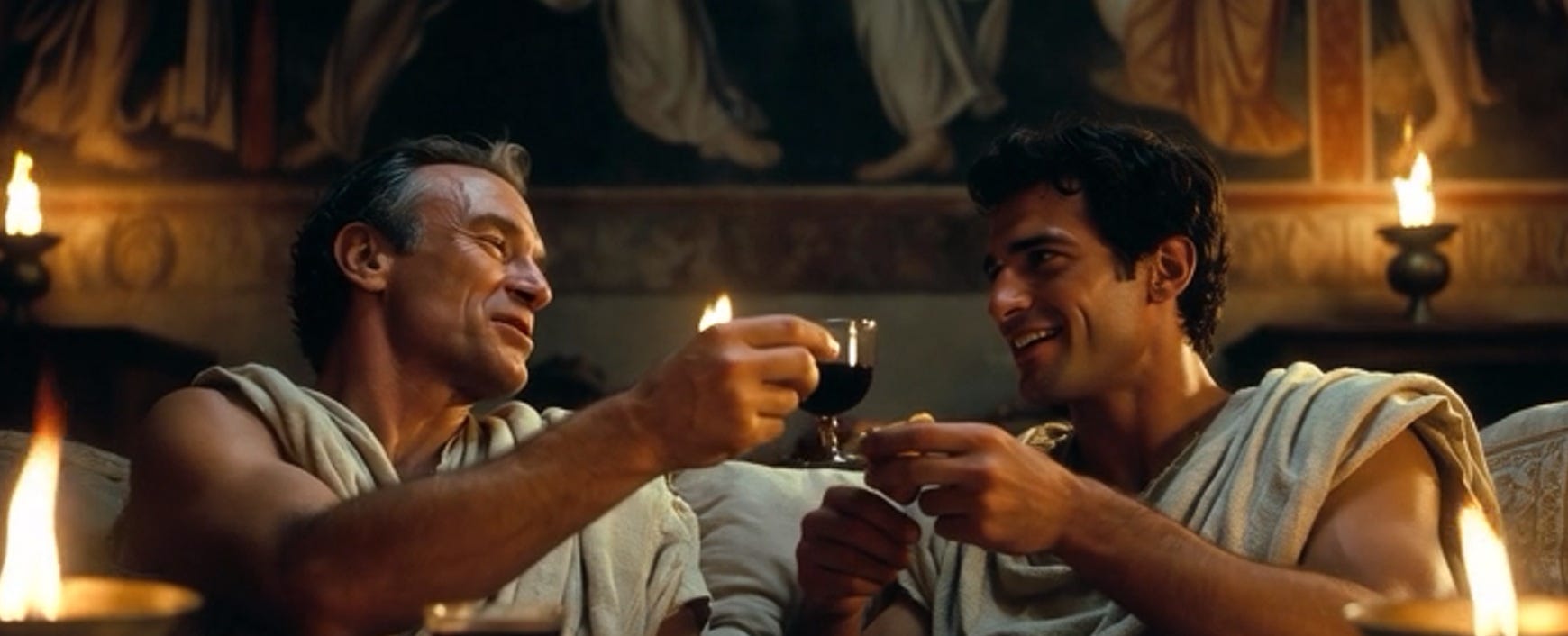
The talk turned to death and what the best kind looked like. Caesar, only half-listening, barely glanced up from his paperwork. “A sudden one,” he said.
That night, the doors and windows of his bedroom blew open. Caesar woke to find his wife, Calpurnia, groaning in her sleep. She dreamed their house had collapsed. That she was holding his murdered body in her arms.
By morning, Caesar had decided: he was staying home. The Senate would meet without him that day.
That’s when Decimus stepped in to influence matters.
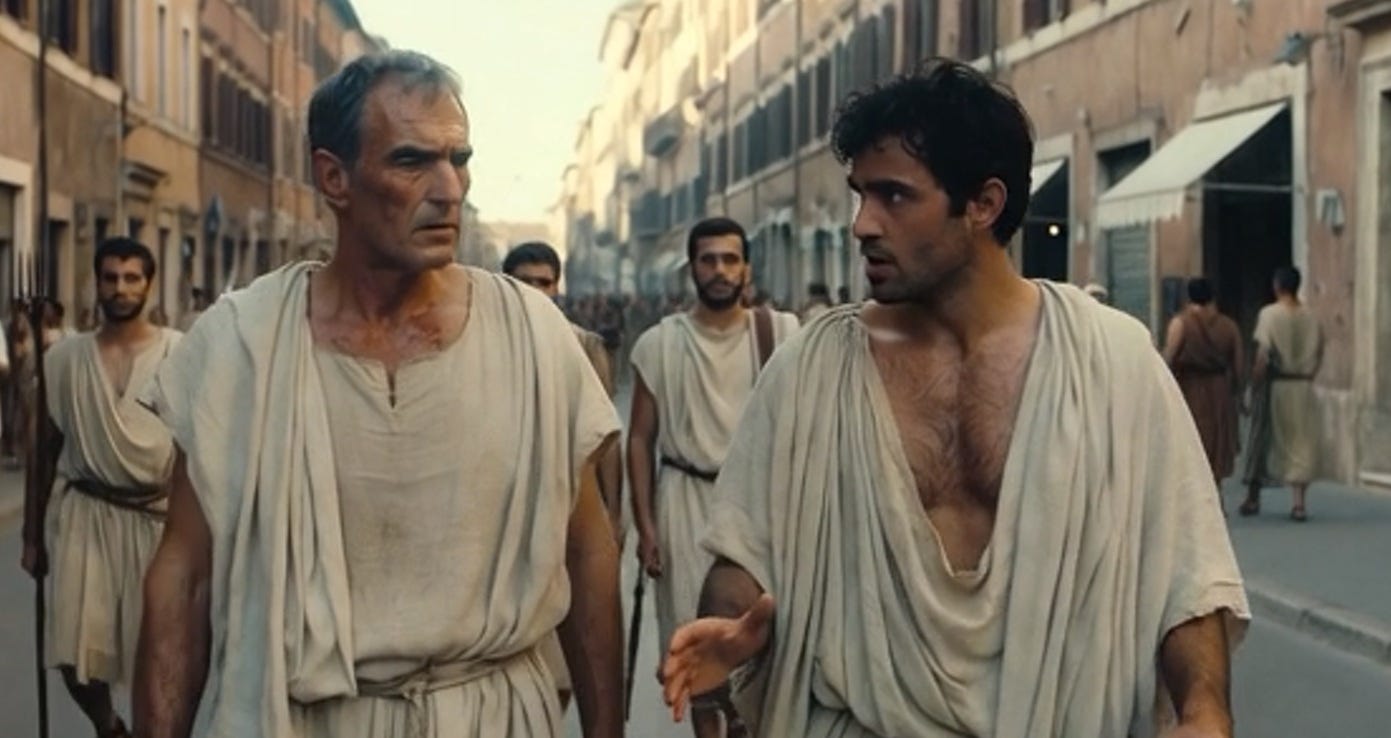
Plutarch records him dismissing Calpurnia’s dream, telling Caesar it meant nothing. Then he took Caesar by the hand and led him out the door himself.
Caesar didn’t die because he ignored warnings. He died because the one person he trusted most walked him into the room where 60 scheming men waited with knives.
Et Tu, Brute?