

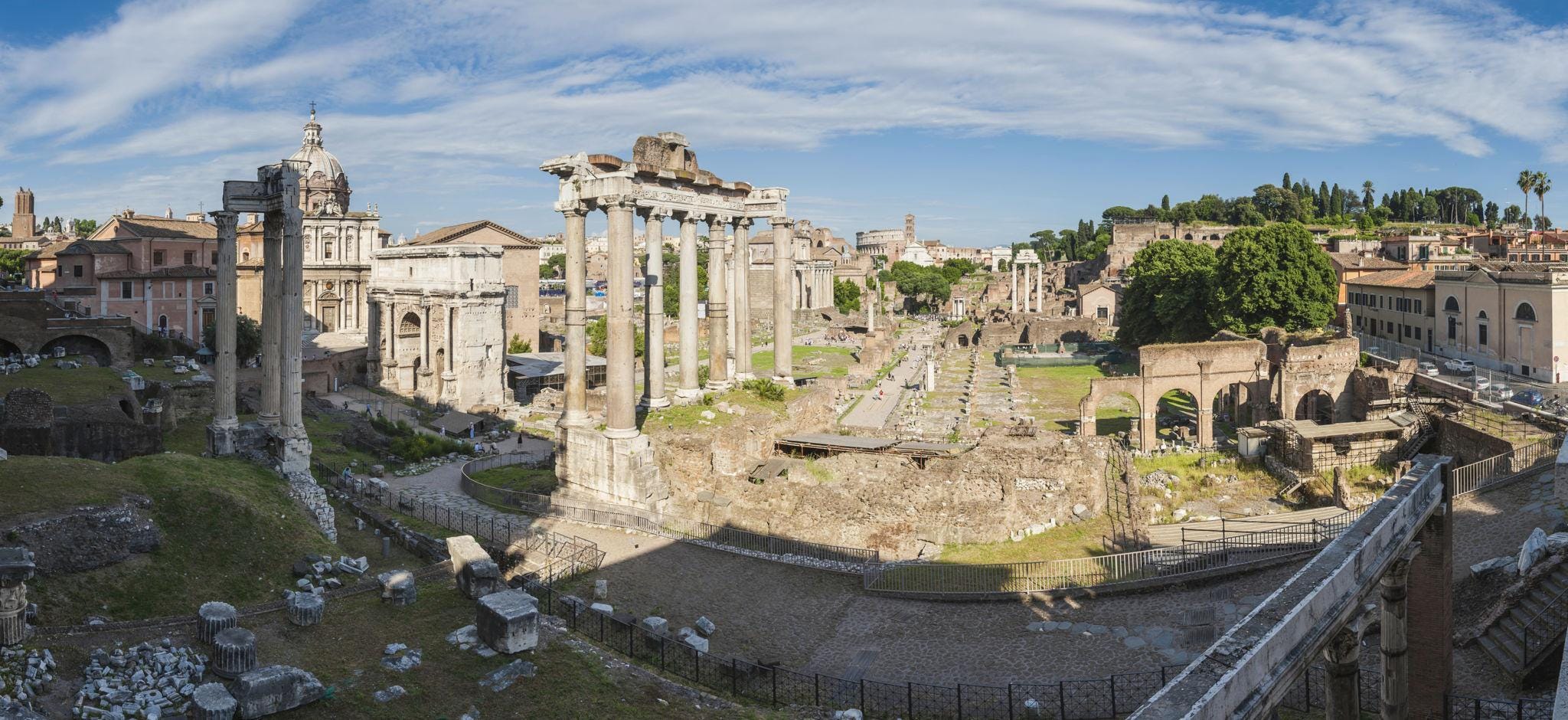
I enter the Roman Forum through the Arch of Constantine, white gravel crunching under my shoes as I descend into the ancient world.
The ruins, ten feet below the current city level, stretch before me, white and gray marble glowing in the late afternoon sun. Tourists drift past with strollers. I stop beside a row of columns and study the stone.
A woman passes on my right and leaves behind a trace of Italian perfume, something floral and warm.
Standing here today, you’d never know the marble was painted. Every column, every temple, every statue. The color is gone. But it was here.
I think about what this place smelled like two thousand years ago. Not perfume. Garum, the fermented fish sauce Romans poured over nearly everything, sharp and briny and inescapable. Roasting meats. Lentils simmering in clay pots. Frankincense drifting from the temple doors. Underneath all of it, horses and cattle, manure ground into the stones by thousands of feet and cart wheels every day.
It was not a quiet or delicate place.
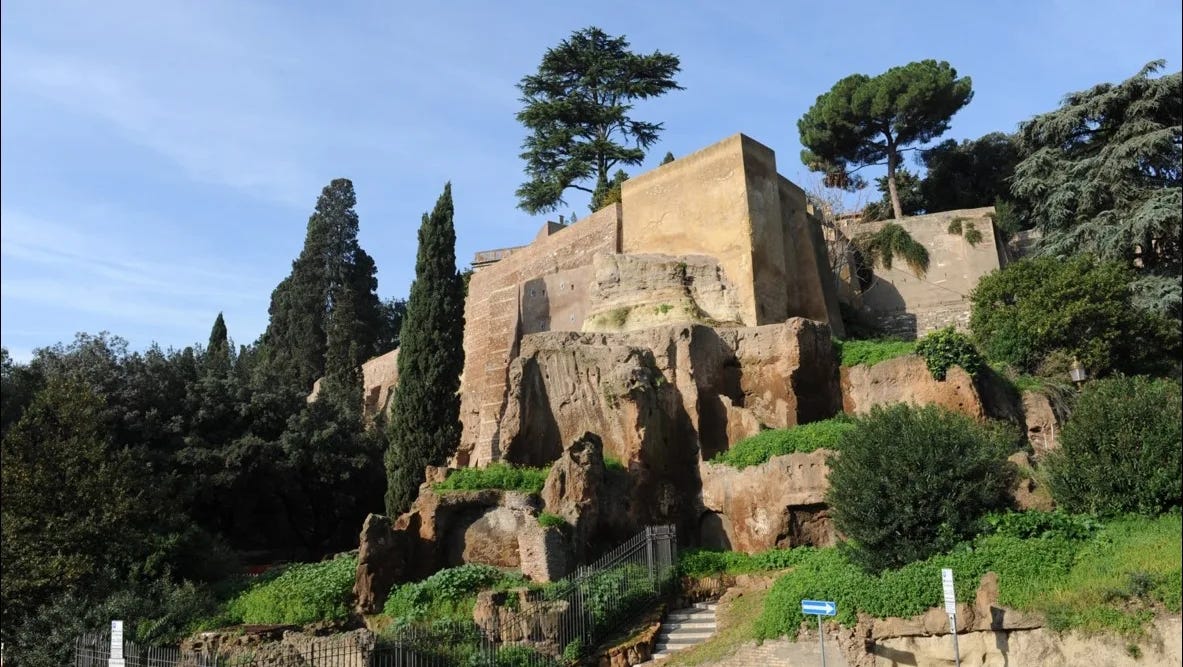
Men were executed within sight of these temples. The Tarpeian Rock rises above the Forum on the Capitoline Hill, a steep cliff where traitors and other condemned criminals were thrown to their deaths. The drop was only about 80 feet. Enough to kill and serve as a warning.
The Romans even made it a proverb: The Tarpeian Rock is close to the Capitol. It meant that the distance between glory and destruction is short.
A few hundred yards away stood the Rostra, the speaker’s platform where politicians addressed the crowd. After Cicero was murdered in 43 BC, Mark Antony ordered his severed head and hands nailed there for public display. Romans walking through the Forum to buy food, settle debts, or attend a religious festival passed beneath them.
The smell of roasting meat and incense mingled with politics, commerce, religion, and, occasionally, death. Rome concentrated everything in one place.
I look up at the white marble, and a question comes to me the same way it always does here.
Why do we think these buildings were white?
The paint disappeared. But the strange part is that we built entire cities on the assumption it never existed.
What everyone believes
The image is everywhere: Rome as a city of blank stone, gray columns, white marble. Films, textbooks, architecture. When people picture the ancient world, they picture monochrome.
It’s an understandable mistake. Every museum, every textbook, every film about ancient Rome shows the same thing. The image feels authoritative because it’s everywhere.
That image is a mistake. And the evidence that proved it wrong survived in places the Renaissance never thought to look: inside microscopic pigment particles, inside buried cities, inside chemistry.
What Rome actually looked like
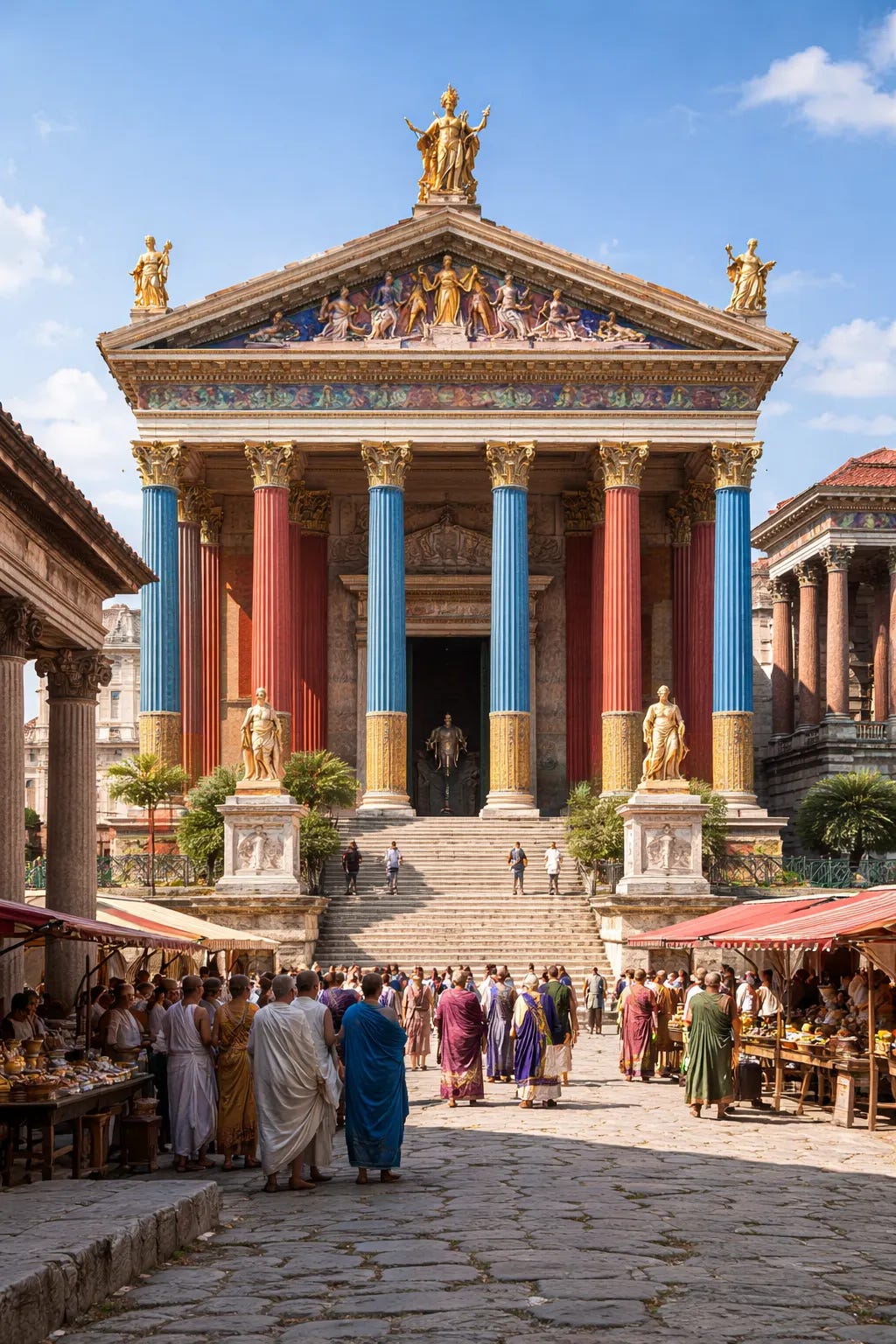
The Roman Forum was painted. Reds, blues, greens, yellows. Color applied deliberately across columns, temples, and statues, meant to be seen from across a crowded square.
The technique was meticulous. For interior surfaces, Roman painters used buon fresco, applying pigment directly to freshly laid wet lime plaster. As the plaster dried, a chemical reaction permanently locked the color into the wall surface. For exterior architectural surfaces, craftsmen used encaustic wax and limewash, different methods, same intention.
Roman builders also inserted sheets of lead inside walls to stop water from attacking the paint from behind. This was not decoration as an afterthought. It was engineering. The color was meant to last.
What it looked like in practice was specific and deliberate. Temple entablatures were painted top to bottom: capitals and architraves in deep carmine reds, cornices in blue, ochre, yellow, and green. Tympanums, the triangular spaces above temple doorways, were blue. Roof tiles were pigmented. Every architectural element had its own color, part of a visual system designed to be read from a distance.
Some of those colors required serious effort to produce. Egyptian blue, one of the most prized pigments in the ancient world, wasn’t found in nature in any usable form. Roman craftsmen made it by heating sand, crushed copper, limestone, and soda together in kilns heated to nearly 1,000 degrees.
What came out was hard and brittle. Workers broke it apart with hammers and ground it down by hand until it became a fine powder. It stained their hands for days. If you saw blue on a building in Rome, someone had worked hard for it.
Red came from cinnabar, ground from mercury sulfide ore. Yellow from ochre, a clay mineral requiring its own extraction and processing. Every color on those buildings had a cost.
In Pompeii, buried under volcanic ash in 79 AD before the centuries could strip it, the colors survived: deep crimson walls, vivid blues, warm yellows.
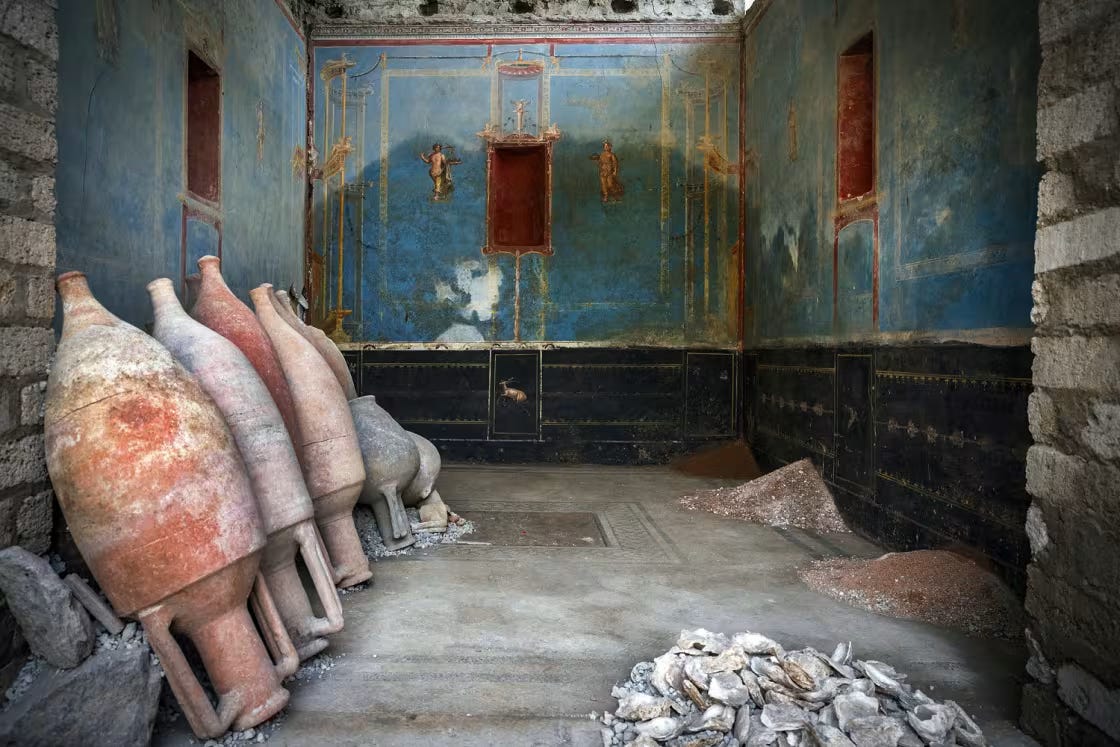
The Forum almost certainly looked similar. Not acres of pale stone. Something closer to a painted city, alive with color in the afternoon sun.
The color faded over the years. And the absence of evidence became evidence of absence.
How the color faded
The centuries did their work.
Sunlight bleaches pigment slowly. Rain pulls it off in layers, season after season. The organic binders that held color to stone broke down long before anyone thought to look for them. What remained was the marble underneath. Hard, pale, indifferent to time.
By the time Renaissance scholars reached these ruins in the 14th and 15th centuries, the color was almost entirely gone. They didn’t think the color had disappeared. They thought the white marble was the point.
Some went further. Archaeologists Vinzenz and Ulrike Koch Brinkmann, who have spent four decades studying ancient polychromy, documented cases, primarily on sculpture, where Renaissance collectors scraped away surviving traces of paint to fit their idealized vision of antiquity. They didn’t just misread the ruins. They cleaned them to fit the theory.
The Greeks and Romans had surely chosen to leave their marble bare. Pure form, pure intellect. Painting sculpture was something less refined minds did. Medieval minds. The white stone wasn’t a stripped ruin. It was, they decided, a statement of genius.
So Michelangelo carved in unpainted white marble. Renaissance architects built in unpainted white stone. The aesthetic they established, monochrome and severe, became the defining ideal of classical art for centuries. One misunderstanding in Renaissance Italy eventually put white columns on the Potomac.
Thomas Jefferson copied the wrong version

The American founders were obsessed with Rome. Jefferson at William and Mary, Madison at Princeton, Adams at Harvard, Washington in his private studies — all of them devoured the poetry of Horace and Virgil, the speeches of Cicero, the histories of Plutarch and Tacitus. The writings of Thucydides, Livy, Polybius, and Cicero were constantly cited to argue for an Enlightenment-informed republic. Rome wasn’t background reading. It was the operating manual.
So when Jefferson visited France in the 1780s as American minister and stood before the Maison Carrée, a well-preserved Roman temple in Nîmes, he knew exactly what he wanted. He used it as the model for the Virginia State Capitol. Palladio, whose books Jefferson studied obsessively, had drawn those same ruins a century earlier, in white as well.
Nobody in the chain had seen the buildings painted. Later, as the new country designed Washington, D.C., Jefferson pushed for a capital that projected the weight of antiquity. He sketched a design for the US Capitol based on the Roman Pantheon.
What he saw was what everyone saw: white stone, gray columns, clean marble lines. The founders wanted to build a republic modeled on Rome. They just didn’t know what Rome actually looked like.
The style spread fast. By the mid-1800s, Greek and Roman Revival architecture was everywhere in America: courthouses, banks, state capitols, plantation houses. White columns from Philadelphia to Tennessee. People called it the National Style.
All of it was built from the same source: bleached ruins that a previous century had decided were pristine on purpose.
America copied a myth
Washington DC, the Lincoln Memorial, the Supreme Court — all of it modeled on ancient Rome. Ancient Rome didn’t look like that.
America built a copy of a ruin already missing half of what made it real. The people who handed it to us thought the missing half was never there.
Today, multispectral imaging and ultraviolet light can detect traces of pigment still clinging to marble surfaces after two thousand years. Microscopic flecks of Egyptian blue. Traces of red ochre. The color is mostly gone, but it left fingerprints. We can see what was there. We just couldn’t see it for fifteen centuries.
I walk further into the Forum. Somewhere nearby, a child is eating gelato and the smell of it, strawberry, sweet and cold, drifts past for a second and disappears.
I look back at the marble glowing in the afternoon sun.
Somewhere in the last two thousand years, between the rain and the sun and the Renaissance and Thomas Jefferson, a string of entirely reasonable decisions added up to something that was never quite real. Artists copied what they saw. Architects copied the artists. Jefferson copied the architects. America copied Jefferson.
A painted city became a white one, but not because anyone intended to rewrite history. Because the missing paint looked enough like the truth to survive.
The Forum looks exactly the way it’s supposed to look.
It just took two thousand years of forgetting to make it that way.
History shows every generation thought it was over. It never is. I write about history, how it changes, but man stays the same. I also write about using AI as a history writer.
How AI Helped Me With Research
One of the best uses I’ve found for AI is research. It surfaces detailed sources and little-known facts quickly — the kind of specific details that make a history article worth reading rather than just accurate.
For this piece I used Grok for initial research queries and Wispr Flow to capture my raw thinking via voice-to-text. Claude drafted the first version from my voice notes.
Some say the problem with AI is hallucination. I don’t find that my main issue. The one I run into: AI claims certainty where the historical record is muddled. The record is often contested or incomplete, and AI doesn’t signal that. My editing is partly about finding those moments and determining what is actually known. If a fact isn’t certain, my final draft says so.
An example from this article: the exact pigments used on specific Forum buildings. AI gives confident answers about Roman polychromy. The actual archaeological record is fragmentary. We know color was widely used, but precise color schemes for specific structures require significant scholarly inference. I make sure the article reflects that.
I like the National Style. Glad they got it “wrong.”
Great read. This is why history is so fascinating. Even the stones can be misunderstood.