

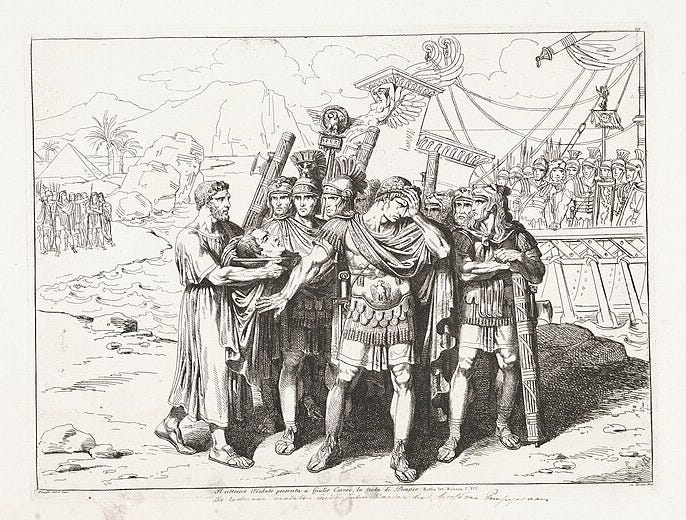
You're standing on the waterfront in Alexandria, Egypt's capital, with the Pharos lighthouse towering over the harbor behind you.
A Greek schoolteacher pushes through the crowd with a gift from the king.
Inside is the severed head of Rome’s most famous general.
It was 48 BC. Julius Caesar was the man on the waterfront, and eight weeks earlier he had crushed Pompey the Great at Pharsalus. The Egyptians expected gratitude.
He wasn’t.
Then they pressed Pompey’s signet ring into his hand, carved with a lion gripping a sword. Plutarch tells us that Caesar wept.
Most retellings make this Caesar's kill. The sources don't.
When Pompey died, Caesar was still at sea, a few days behind him. He had spent the war pardoning his enemies. In a letter Cicero preserved, he called mercy “a new way of winning.”
The men who sent that head thought they were giving Caesar what he wanted. Within six years, the boy king of Egypt and all three men who ran his council were in the ground.
None of them died of natural causes.
Try Past Passport free for 7 days. Paid subscribers get:
3 weekly history essays. Easy reading. No dull dissertations.
3 weekly quick summaries of how we use AI to create every essay.
1 extra monthly newsletter, rotating between a full AI breakdown for writers and video and a Stoic philosophy article.
Open DM sessions on the month’s top article.
1-week free trial, then just $5 per month.
A schoolteacher sentenced Pompey to death
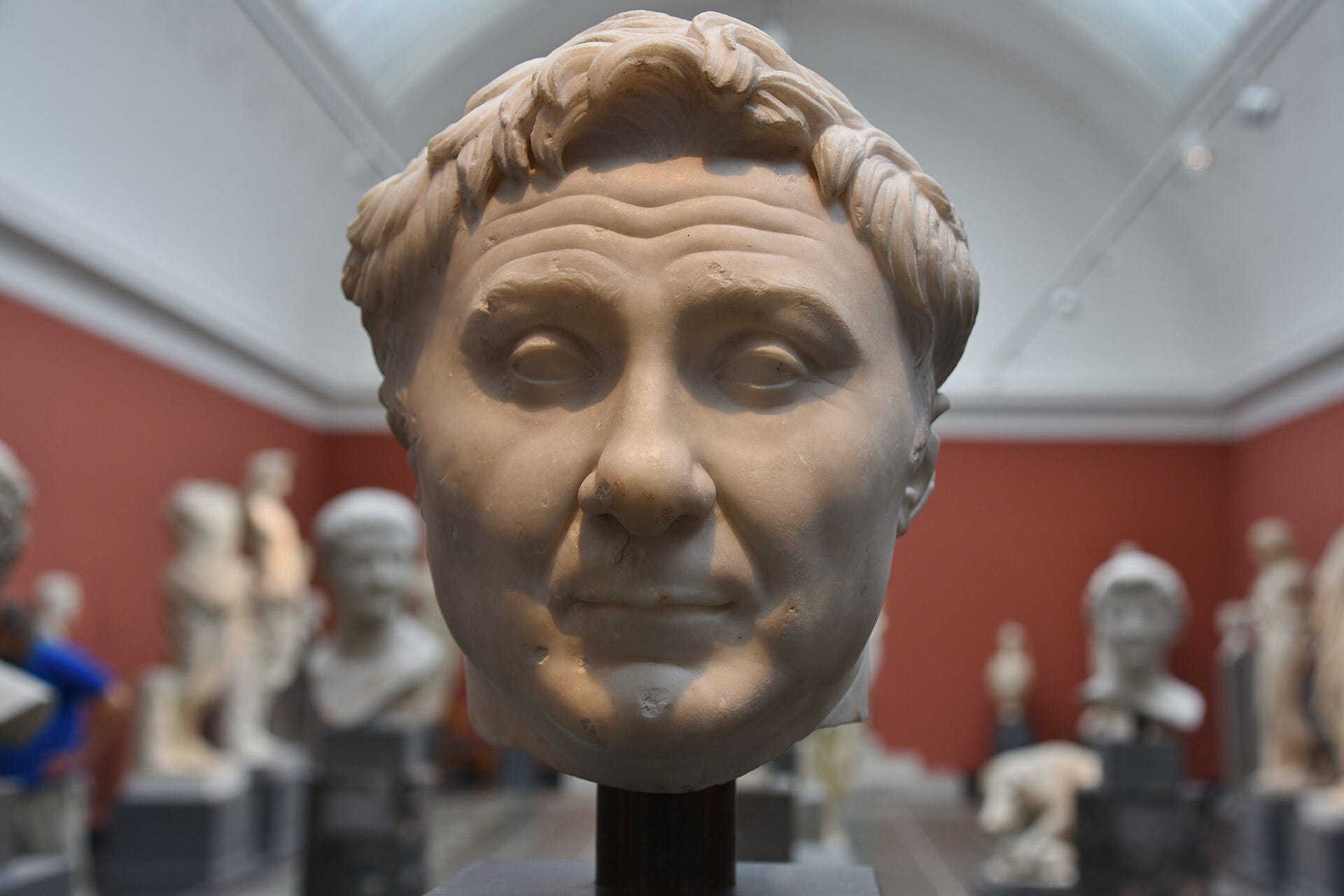
Caesar and Pompey had once been partners, and Pompey married Caesar’s daughter, Julia. After she died in 54 BC, the partnership disintegrated. By August of 48 BC, they faced each other at Pharsalus, in central Greece.
By Caesar’s own count, Pompey had 45,000 infantry to his 22,000 (and Caesar had every reason to round up). Caesar broke that army in an afternoon.
Pompey ripped off his general’s insignia and rode out the back gate of his camp.
He picked up his wife, Cornelia, on Lesbos. Plutarch says that when the messenger told her, she dropped to the ground speechless. She had been expecting a victor.
Pompey sailed for Egypt, and he had reason to think Egypt owed him. In 58 BC, its king, Ptolemy XII, had been thrown out by his own people.
He fled to Rome and moved into Pompey’s villa in the Alban Hills. Three years later, with Pompey’s backing, a Roman army put him back on the throne.
That king was dead now. His son, Ptolemy XIII, was about 13 and at war with his own sister, Cleopatra. Pompey dropped anchor off Pelusium, where the boy’s army was camped along the beach, and asked for shelter.
You don’t let a 13-year-old decide what to do with the most famous general in the Roman world. His council decided.
Pothinus, a eunuch, controlled the palace, and Achillas commanded the army. The third seat went to Theodotus of Chios, the boy’s paid rhetoric teacher. Plutarch says he got it because the council lacked better men.
Some of the council said to take Pompey in. Some said to send him away. Theodotus said both were mistakes.
Take Pompey in, and Caesar becomes your enemy. Send him away, and Pompey blames you for his ruin while Caesar blames you for letting him go. The third option was to invite him ashore and kill him.
Plutarch says Theodotus smiled when he delivered the line that settled it:
Nekros ou daknei.
Dead men don’t bite.
The council sided with the schoolteacher. Pompey the Great, who had ridden through Rome in three triumphs, was a dead man before his boat touched sand.
Pompey knew the man who stabbed him
The Egyptians rowed a tiny boat out to Pompey’s ship.
Achillas was there. So was Lucius Septimius, a Roman officer who had once served under Pompey. Septimius had stayed in Egypt with the Roman garrison left behind after Ptolemy XII regained his throne. Now he worked for the son.
Achillas called up to Pompey in Greek and invited him down. The water was too shallow for a warship, he said.
Cornelia had a bad feeling. The boat was too small and too few people had come, and along the shore Egyptian warships were filling with men.
Pompey went anyway. Before he climbed down, he turned to Cornelia and quoted Sophocles:
Whoever goes to a tyrant becomes his slave, even if he arrives a free man.
In the boat, Pompey looked at Septimius and asked if they hadn’t served together once. Septimius nodded and said nothing.
Nobody else spoke either. The oars dipped and pulled for a long way, and Pompey unrolled a short speech he’d written in Greek for the young king and read it over to himself.
From the ship, Cornelia watched the boat nose into the shallows. A crowd from the king’s court had gathered on the sand to greet him. She started to relax, and if you’d been on that deck, you would have too.
Pompey’s freedman, Philip, took his hand to help him stand.
Septimius drove his sword into Pompey’s back. Then Salvius, a centurion, drew his dagger, and so did Achillas.
Pompey pulled his toga over his face with both hands. Plutarch says he groaned and said nothing else.
Cornelia’s scream rang across the water. Her ships hauled up their anchors and fled.
The Egyptians sawed off Pompey’s head and left his body naked on the sand. The head was for Caesar.
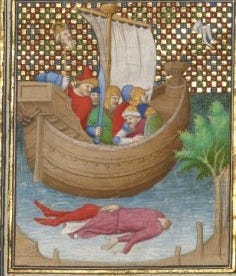
After the crowd drifted off, Philip washed the body in seawater and wrapped it in his own tunic. An old Roman who had fought in Pompey’s first campaigns came down the beach to help. The two of them gathered the rotten planks of a wrecked fishing boat and burned Pompey where he lay.
Pompey the Great had been one of the richest men in the world. His funeral pyre was a broken fishing boat.
Three men share the blame. A Roman he once commanded held the sword, and a schoolteacher talked the council into it. The order itself went out in the name of a 13-year-old boy.
