

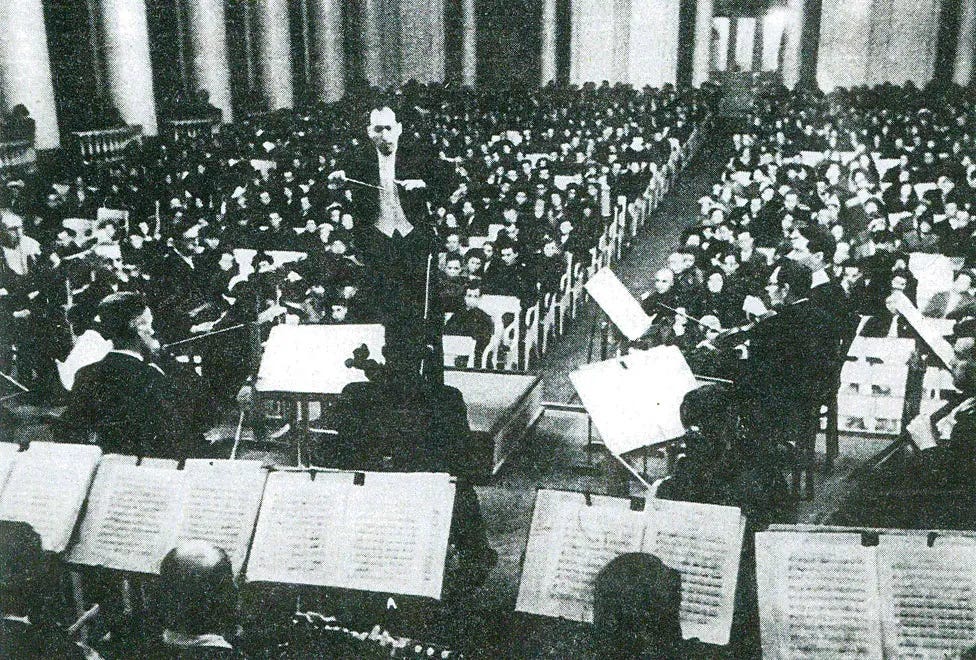
On the evening of August 9, 1942, day 335 of the Nazi siege, every chandelier in Leningrad’s Philharmonic Hall was switched on...
...all of them, for a symphony nobody thought could be played.
The exhausted orchestra took the stage in whatever they had... a few tailcoats, civilian jackets, army shirts, navy uniforms, all hanging off their starved bodies.
In rehearsals, players had collapsed at their stands. Three of them died before the concert.
The German Army was starving Leningrad to death. The defiant city answered with a symphony... proof that beauty can outlast the worst that human beings can do to each other.
The composer, Dmitri Shostakovich, had gone on the radio in September 1941 with the Germans at the gates. He told the city about his new symphony “so that listeners tuned in to me now should know that life in our city is normal.”
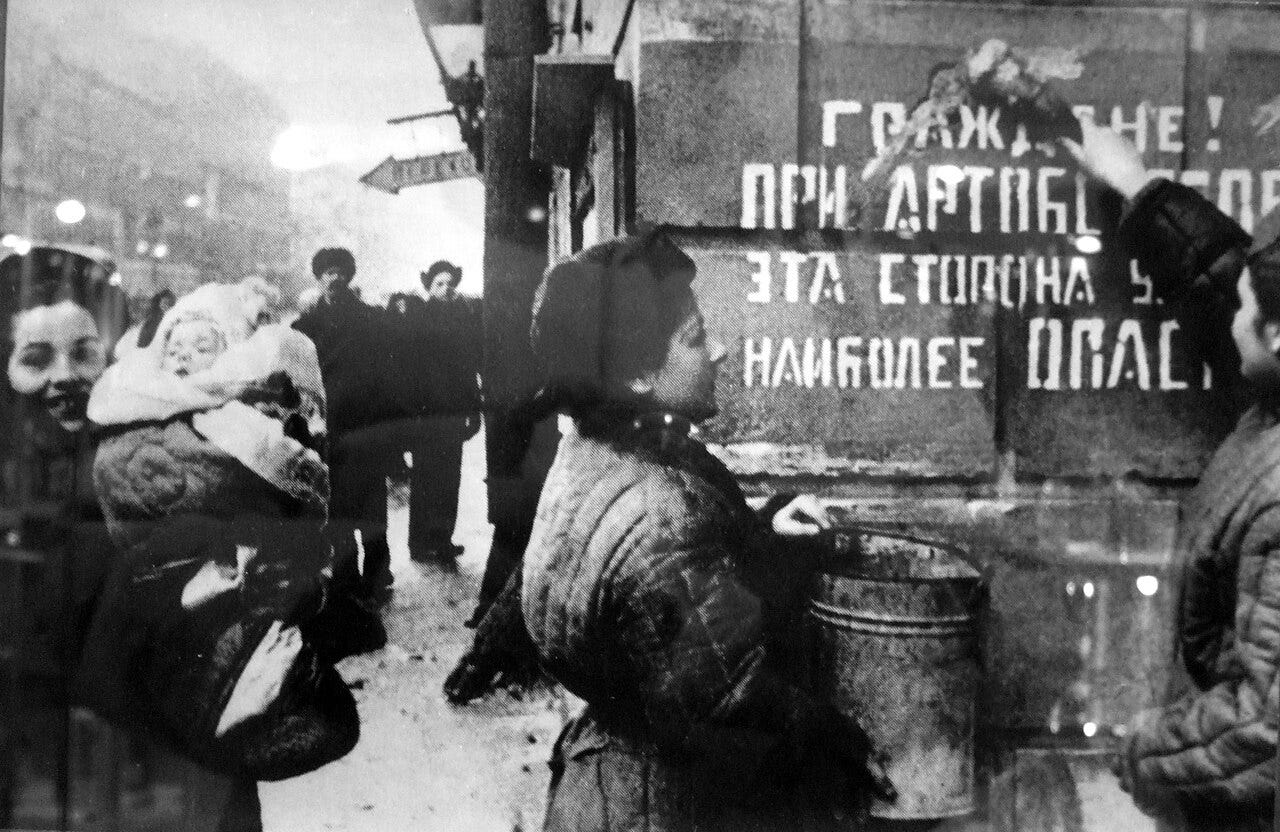
Life in Leningrad was anything but normal. At least 630,000 civilians would die before the siege lifted.
My wife’s grandfather was lost in that siege, probably in the Sinyavino marshes southeast of the city.
The swamp never surrendered his body.
Social Media, Inc. sells constant negativity. Past Passport nukes the doomscroll with history, art, and beauty.
Join us:
3 history essays a week (no dull dissertations)
1 extra issue a month: an AI breakdown or a Stoic essay
An open DM session on the month’s top article
A brighter outlook, and a creative streak that comes back (mine did)
Your first week is free, then $5 a month.
He wrote Symphony No. 7 in a fireman’s helmet
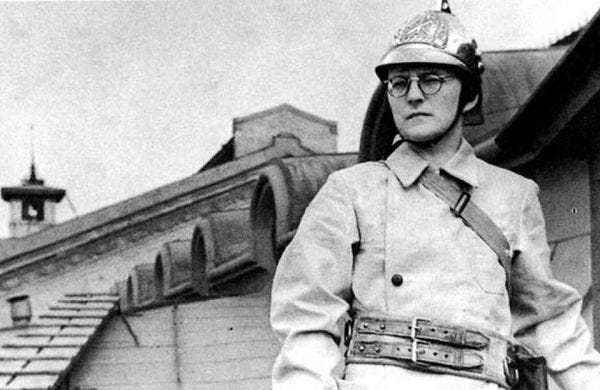
Shostakovich wanted to serve his motherland. He tried to enlist in the Red Army in the first days of the Nazi invasion of the Soviet Union. The army said no because of his eyesight.
Dmitri still wanted to do his part. He joined the fire brigade at the Leningrad Conservatory, climbing to the roof to watch for German firebombs... then going back downstairs to write music.
I love this about Shostakovich.
The Red Army turned away one of the country’s most famous composers, so he climbed onto a roof and stood guard anyway.
Nobody hands you the job you want when things go south... you grab what’s available and make the best of it.
A photographer caught him on a rooftop, a fire hose in his hands, the city’s rooftops behind him. A year later, his face under that fireman’s helmet would fill the cover of TIME.
He started writing the symphony on July 19, 1941. By September 3, the first movement was done, with German guns already bombarding the edge of the city. The third movement followed on September 29.
In that same September broadcast, he called on the city’s musicians:
“Remember that our art is threatened with great danger. We will defend our music.”
He played the new movements on his piano for friends in his apartment while falling Nazi hells rattled the windows.
On September 30, he was ordered to evacuate. On October 1, he flew out of Leningrad with his wife and children, leaving his mother and sister behind.
He finished the score far to the east on December 27, and it premiered there on March 5, 1942.
By the end of that first winter, the Leningrad Radio Orchestra had gone silent. Its last broadcast crackled out on January 1, 1942, and only about 15 of its 40 musicians were still alive in the city.
In the summer of 1942, a 20-year-old pilot fought into the besieged city, carrying medicine and the score.
Karl Eliasberg ran the Radio Orchestra, the only symphony orchestra left in Leningrad. He opened the score: four thick volumes, nearly 80 minutes of music written for more than 100 players. His thought: “We’ll never play this.”
He pulled musicians out of a machine-gun company
Back in the spring, Eliasberg got a list of the city’s musicians and scanned it name by name. The dead were blacked out. The living were circled in red and ordered to report for duty.
Posters popped up across Leningrad. The radio called for every musician in the city to report.
The ones who came were skin and bones. “My God, how thin many of them were,” one organizer remembered.
Still not enough.
General Leonid Govorov, commander of the Leningrad Front, ordered every soldier who could play an instrument to report. Players walked in from a machine-gun company and an anti-aircraft regiment.
The weakest went to a makeshift hospital in the Astoria Hotel to add some weight before rehearsals.
Somewhere in that same city, Shostakovich’s mother and sister were still waiting out the siege.
Eliasberg built his orchestra out of whoever was left alive and could still hold an instrument.

Notice where that list starts: with the names still circled in red, far from the 100 players the score demanded.
Make your own red-circle list.
That project you’ve been waiting on better conditions to start? Get moving on it today, and write down only what you’ve already got... the free hour on Saturday, the friend who’ll read a rough draft. Build with that. You’ll figure out the missing pieces later.
Eliasberg never waited for a full orchestra to plan the premiere, even with German shells blasting the city.
The dead drummer was still breathing
Eliasberg worried most about the brass and woodwinds... horns need powerful lungs, and the city was short of breath.
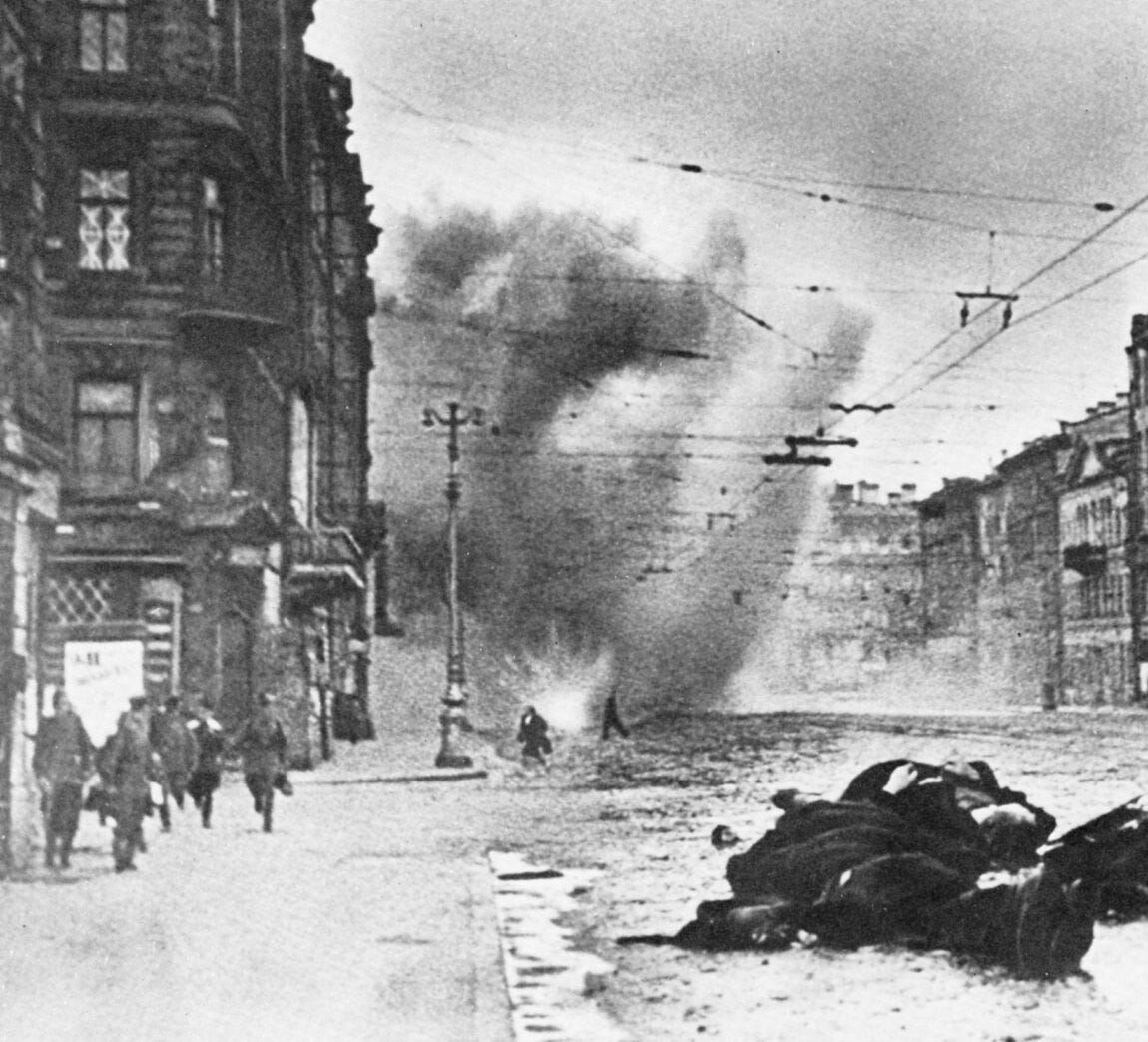
At the orchestra’s first rehearsal that spring, the starving players had crashed after about 15 minutes. Nazi shelling broke up the sessions that came after.
Picture trying to play Shostakovich with German artillery shells slamming into the streets outside.
I love the tenacity in the face of brutality.
Then word came that the drummer, Zhavdet Aydarov, was dead. Eliasberg went to the makeshift morgue to pay his respects.
Leaning over the body, he heard Aydarov breathing.
They pulled him out, gave him an extra slice of bread, and put him back behind the drum. His snare part in the first movement repeats the same two bars more than 170 times.
Shostakovich had written that march in the summer of 1941, with the Germans closing in on the city.
Aydarov later credited the premiere to the conductor’s “strict discipline and sternness.”
Give yourself a rotten first rehearsal.
First drafts are typically awful (ask how I know).
So write the ugly first page this week, or play the clumsy first song, and quit after 15 minutes if that’s all you’ve got.
Eliasberg’s orchestra lasted 15 minutes that spring and 80 on August 9.
General Govorov bought the orchestra 80 quiet minutes
Govorov was a grizzled artilleryman. His order for August 9, 1942:
Not a single German shell explodes in Leningrad while the music plays.
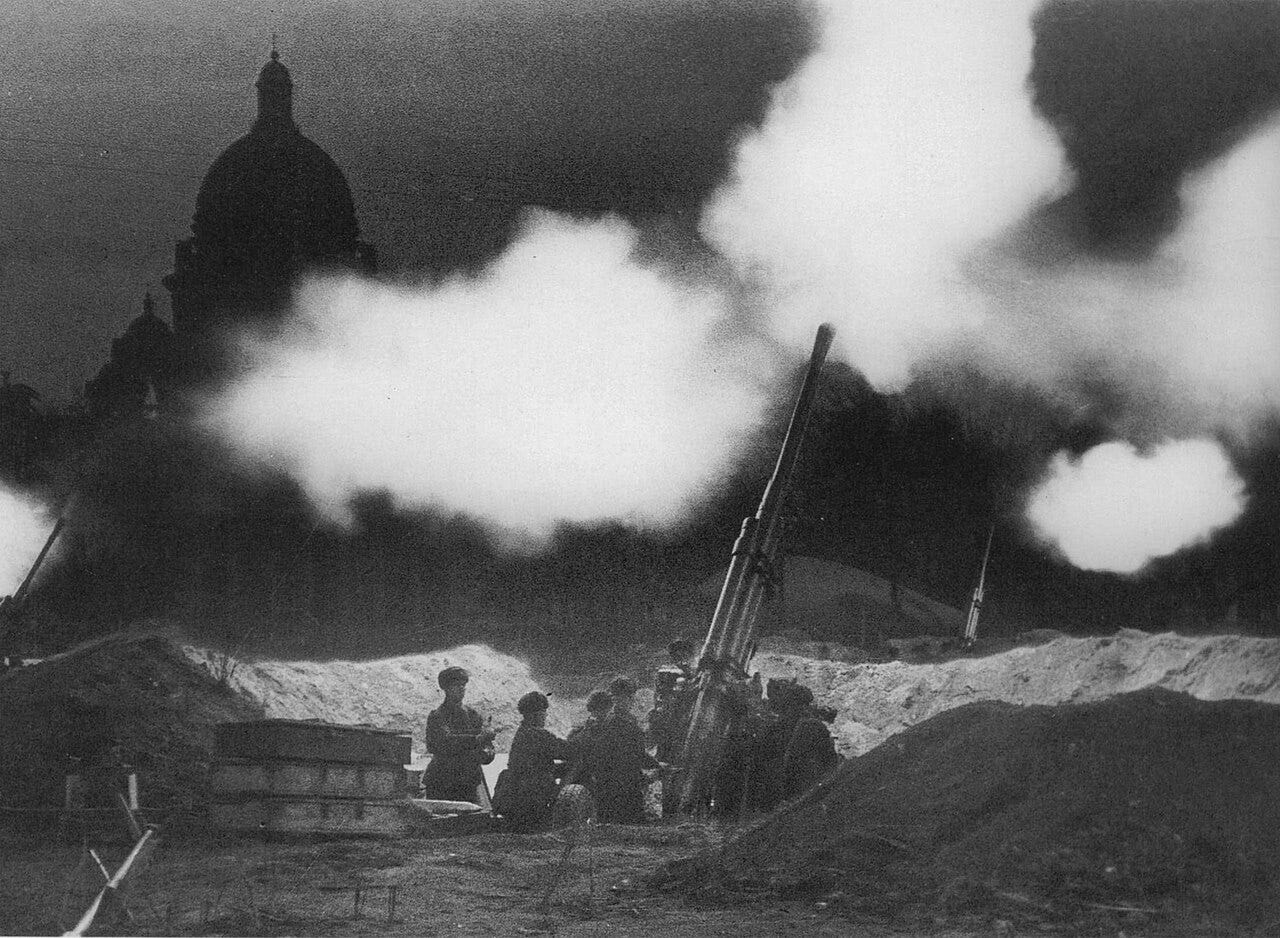
The plan was code-named Squall. Ahead of the concert, Soviet guns opened up on the German batteries ringing the city and hammered them into silence.
Soviet cannon fire was the overture, and then Eliasberg raised his baton.
For 80 minutes, the German guns never answered... and Shostakovich’s Leningrad Symphony played straight through.
I spent too long drowning in negative news online. My creativity spiked when I started giving myself quiet hours with no phone... and the ideas haven’t stopped flowing since.
Fight for your quiet 80 minutes.
Social media Inc. builds its feeds to keep us hooked and arguing. And 24/7 bad news warps how we see the world... a 2024 Flinders University study of 800 students tied doomscrolling to existential anxiety and distrust of other people.
Put your phone in another room tonight and shut the door. It's hard at first, and I had the same problem.
Play the Leningrad Symphony start to finish. Listen with your eyes closed, or pick up a pencil and draw or write while it plays. Odds are, your creativity will spike, as mine did. A UC Santa Barbara study found creative ideas show up when the mind is free to wander.
Govorov needed an artillery barrage to buy his city an hour of quiet. You only need a door.
They pointed the symphony at German trenches
For months, Leningrad’s street loudspeakers had ticked with a metronome between air-raid warnings, so people knew the city was still alive. Fighting.
On August 9, they played Eliasberg’s voice instead, telling the city it would hear “for the first time the Seventh Symphony.”
People who couldn’t get into the hall packed the streets outside to hear the symphony Shostakovich had dedicated “to my native city of Leningrad.”
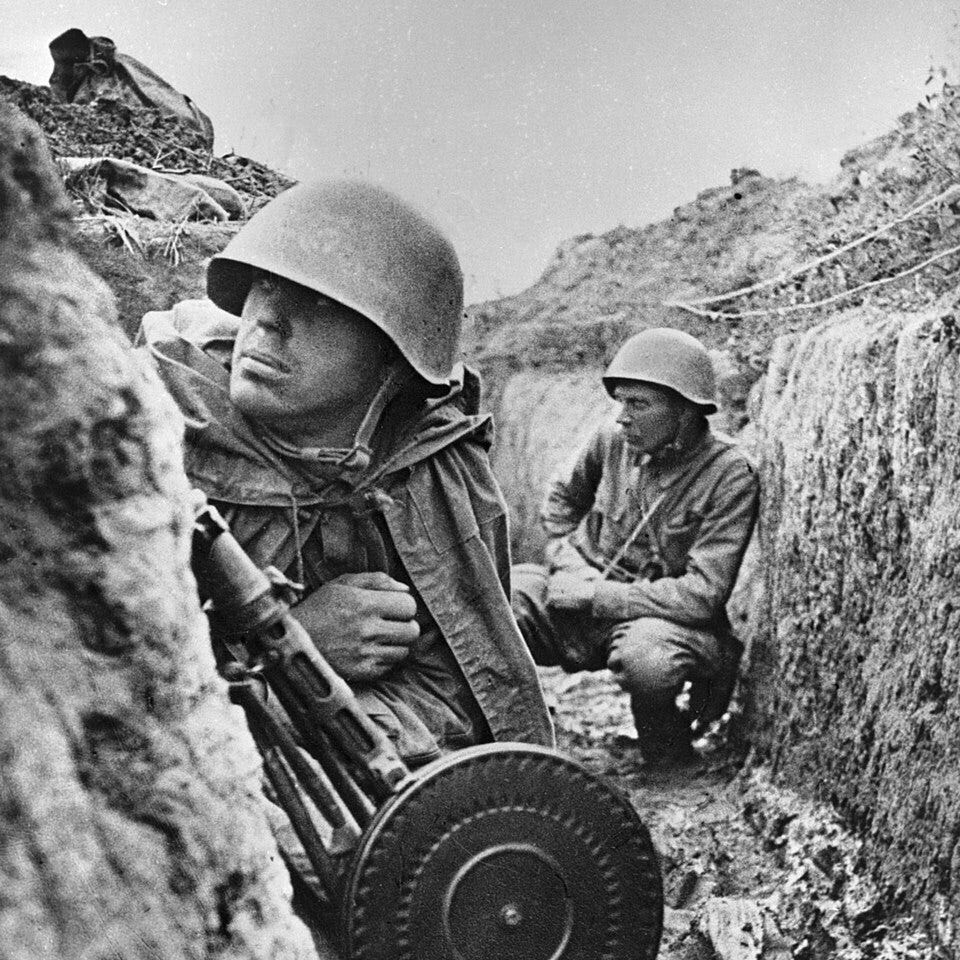
Some of the speakers faced no man’s land. In the German trenches, soldiers who had spent eleven months shelling Leningrad heard the city they were starving play Shostakovich... the snare drum and the brass, start to finish.
Years later, the story goes, a couple of former German officers visited the Soviet Union as tourists and went looking for the conductor. They told him the music crackling out of those loudspeakers was the moment they knew the war was lost. They held out their hands to shake his.
He refused.
Answer the doom with beauty.
Next time a doom post shows up in your feed, don’t argue.
Reply with the most beautiful thing you saw this week... a painting, or the sunset over your street. Leningrad answered eleven months of German shells with Shostakovich.
Leningrad forgot its conductor
After the war, the Leningrad Philharmonic came home from its evacuation in Siberia, and the spotlight went back to the big orchestra.
Between 1945 and 1975, Eliasberg headlined in Leningrad only three more times. All three were the Seventh, played with the reserve orchestra.
Back in the same seats 20 years later
Eliasberg’s musicians never pretended the siege wasn’t happening. They were starving, with German guns a few miles off... and they played anyway. “We have never played with such enthusiasm,” Eliasberg remembered.
I want the same for the Past Passport community. People who see the bad news for what it is and still make room for art and beauty. Folks who turn down the doom and negativity our society keeps selling us, and pick the symphony instead.
On January 27, 1964, twenty years after the siege lifted, Eliasberg raised his baton over the Seventh again. The surviving musicians of 1942 sat in the same seats they’d held that August night. Shostakovich was in the hall.
Embrace beauty, reject doom, my friends. 🌟
Thanks for reading Past Passport. Leningrad picked the symphony over the siege, and we pick art, beauty, and a bright future over the doomscroll. Join us: your first week is free, then $5 a month.
Thanks for reading. We can review history to find inspiration against the daily negative news on our phones.