

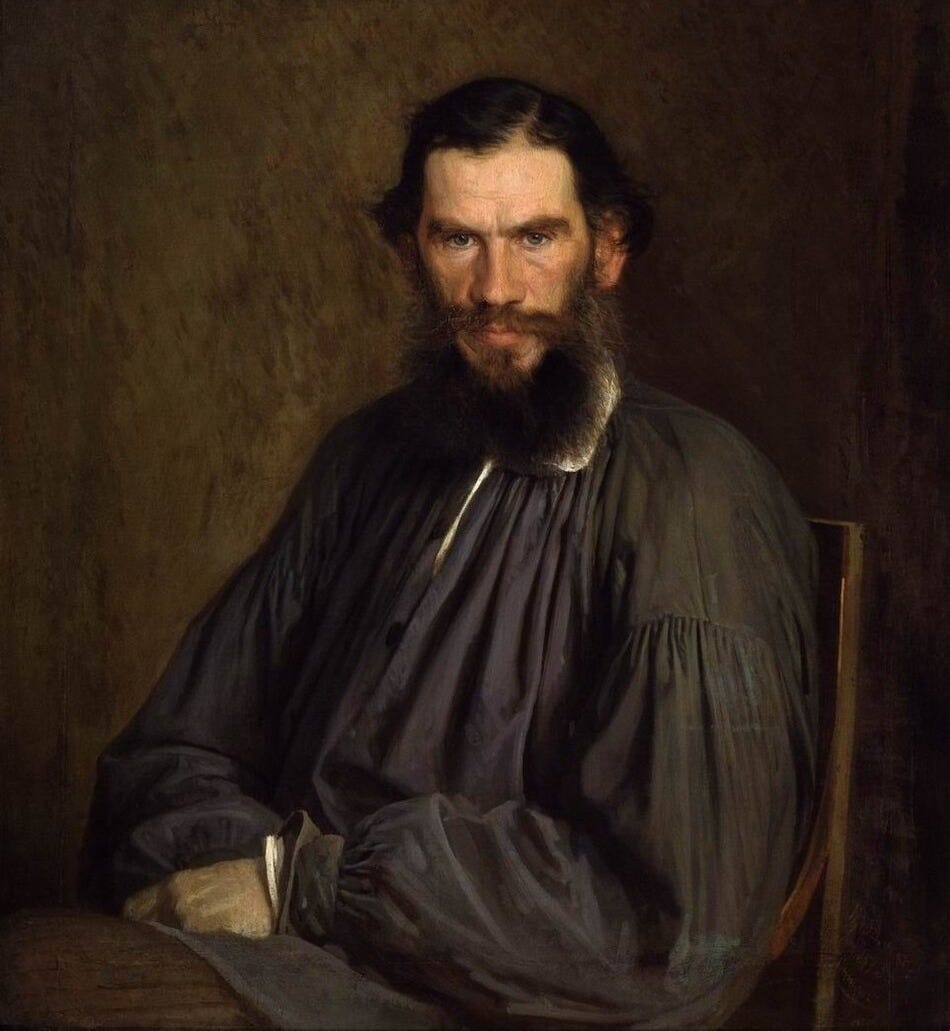
Leo Tolstoy wanted to kill himself.
He was not yet 50, and he was loaded and famous.
The huge estate, the loyal wife, the house full of children, and two of the greatest novels ever written.
Yet the great Tolstoy hid a rope from himself and stopped carrying a gun. Afraid he’s use them.
Money and fame bought him nothing. He wrote it all down in his book, A Confession.
I didn’t know Tolstoy’s story when I first read him at 21, in a rented cottage on an island in Canada. No electricity. Fishing by day, board games and a pile of books at night.
CBC radio down low. Gas lights hissed overhead, too dim to read by.
I knew only he was a Famous Writer when I pulled a yellowed copy of Anna Karenina off the mantel. It smelled of mildew and wood smoke.
Lay on a red leather sofa and read it by an Eveready lantern poised on my sternum. And read.
A 19th-century Russian love story had no business being a page-turner for a college kid from Ohio in 1991. Read all 239 chapters in a week.
The kid was no dummy. In 2007, 125 authors ranked the 10 greatest books of all time. Anna Karenina came first. War and Peace came third, and Hamlet finished sixth.
I left the island with a handful of fish pictures and a permanent love of Tolstoy.
Four lessons came with me in the boat. It took me 30 years to notice them. They'll take you 10 minutes.
Try Past Passport free for 7 days. Paid subscribers get:
3 weekly history essays. Easy reading. No dull dissertations.
3 weekly quick summaries of how we use AI to create every essay.
1 extra monthly newsletter, rotating between a full AI breakdown for writers and video and a Stoic philosophy article.
1-week free trial, then just $5 per month.
Getting it all isn’t enough
Just need to get that big promotion. I’ll be set when I’m making $250,000. I’ll be good for life in the massive house with the swimming pool.
You’ve said it. I’ve said it. Count Vronsky said it too, about a woman.
He’s the cavalry officer who chases Anna Karenina, another man’s wife, through the first half of the book. He gets the girl. He quits the army, and they run off to Italy.
It should be a happy ending. But the glow fades fast.
Tolstoy writes:
“He soon felt that the realization of his desires gave him no more than a grain of sand out of the mountain of happiness he had expected.”
Boredom sets in. With nothing left to chase, he starts wishing he had something to want. Tolstoy’s phrase for it: “a desire for desires.” The chase had been the best part.
The man has 16 hours a day to fill, so he tries politics and new books, then dabbles with painting.
You know this man. Today he buys a boat... then a bigger boat. Then a yacht.
Tolstoy knew him too. He saw him in the mirror every day.
While he wrote those chapters, he was busy with his estate in Samara. In A Confession, he describes the thought that kept interrupting: you’ll have 16,000 acres and 300 horses, “and what then?”
He looked at fame like that. Say he became more famous than Gogol, Pushkin, Shakespeare, and Molière. Then what?
He had no answer, and that’s where the rope comes in.
He lived another 30 years.
What kept him going was already in his own novel: a hayfield, and a tool most of us have never held, but should…
