Venus de Milo Was Never White
Painted skin, inlaid metal, colored eyes — and none of it survived.
Two corners past the Mona Lisa mob, the noise drops away. No crowd, no jostling for position. Just Venus de Milo, a security guard, and you.
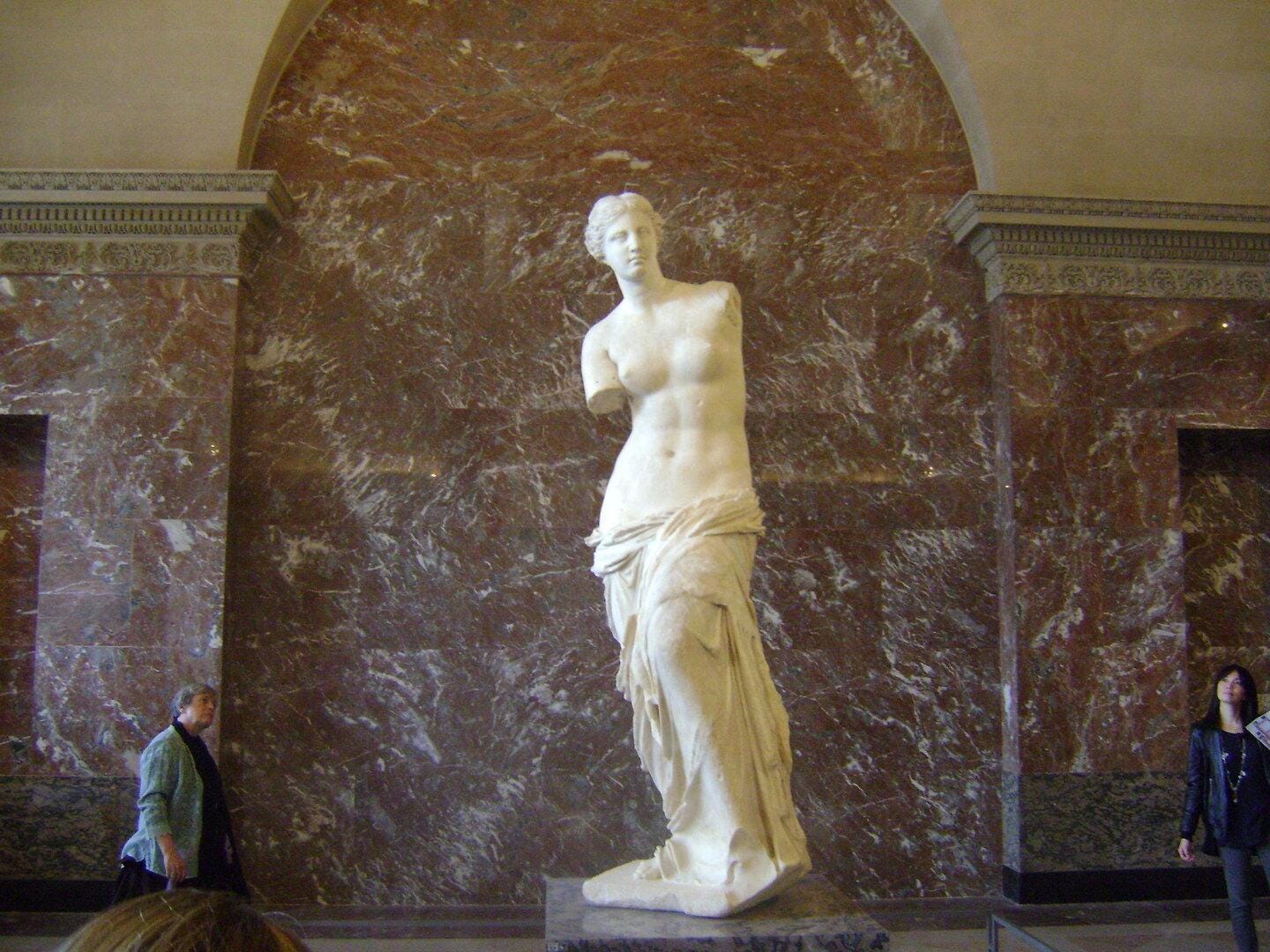
She’s taller than you expect. That’s the first thing you see as she towers over you. She fills the room in a way that makes the ceiling feel lower. You can walk right up to her — close enough to read the grain of the marble — which you cannot do with the Mona Lisa, where you’re penned behind a rope ten feet back, straining past strangers’ phones.
Standing that close, you stop thinking about the arms.
Look at her hips.
Her weight has dropped onto one leg, the opposite knee gone soft. Her torso answers by turning the other direction — a slight, almost lazy counter-twist. The drapery bunches where her hip pushes into it and falls loose where gravity takes over. Marble is doing what cloth does.
Her hips and torso don’t align. That disagreement is the whole thing. It’s what makes her feel like she’s mid-movement rather than mid-pose — like someone shifting their weight after standing too long, or about to take a step without thinking about it.
Earlier Greek sculpture didn’t do this. Figures stood straight, frontal, resolved. The Hellenistic period wanted tension instead.
She was found on the island of Melos in 1820, buried and broken, separated from her base.

The base had a signature on it — Alexandros of Antioch — which dated her to the Hellenistic period. Not the "pure" Classical Greece that 19th-century Europe had decided she represented. So the base disappeared. It was quietly removed from the record. The signature went with it. Someone made that call, and for about 130 years it worked.
The arms are a separate thing. They weren't lost to antiquity. We think the most likely explanation is that they were damaged in the scramble over who got to claim her, French naval officers against Ottoman authorities, the statue changing hands fast.
After that, every era took a turn guessing. Early accounts suggested one arm held an apple, a reference to the Judgment of Paris. A 19th-century French sculptor proposed a shield, which would have made her a symbol of national glory at a convenient moment.
Others put a mirror in her hand. Each version said more about what that decade needed her to be than about what she actually was. Nobody knows. The gap is still open.
Early accounts suggest one arm held an apple, a reference to the Judgment of Paris. Others say she was gathering her drapery. Nobody knows. And that gap pulls you in — you complete the gesture in your mind, which is its own kind of power.
Then there’s what she looked like when she was made.
She probably was not white. Almost certainly painted — skin tones, hair, lips, possibly metal jewelry fixed directly into the stone. The eyes were likely inlaid. Two thousand years of weather and handling stripped it all.
What you're standing in front of is the structure beneath the surface, the thing that was never meant to be seen on its own. Whether that's more beautiful or just different is hard to say.
But the white marble goddess — the one that shaped every museum facade and every art school ideal for two centuries — she was a construction. The one in the Louvre is real. They're not the same statue.
When she arrived at the Louvre in 1821, France had just lost its greatest looted works after Napoleon’s fall. The museum needed something to fill the absence. Venus was elevated — positioned alongside the greatest sculptures ever made, the inconvenient details of her origin softened and set aside. It worked. She became essential.
The arms are what everyone photographs. But you’re two corners past the crowd, close enough to see the twist in her torso and the marble going soft where the fabric falls. That’s the part most people miss.


