

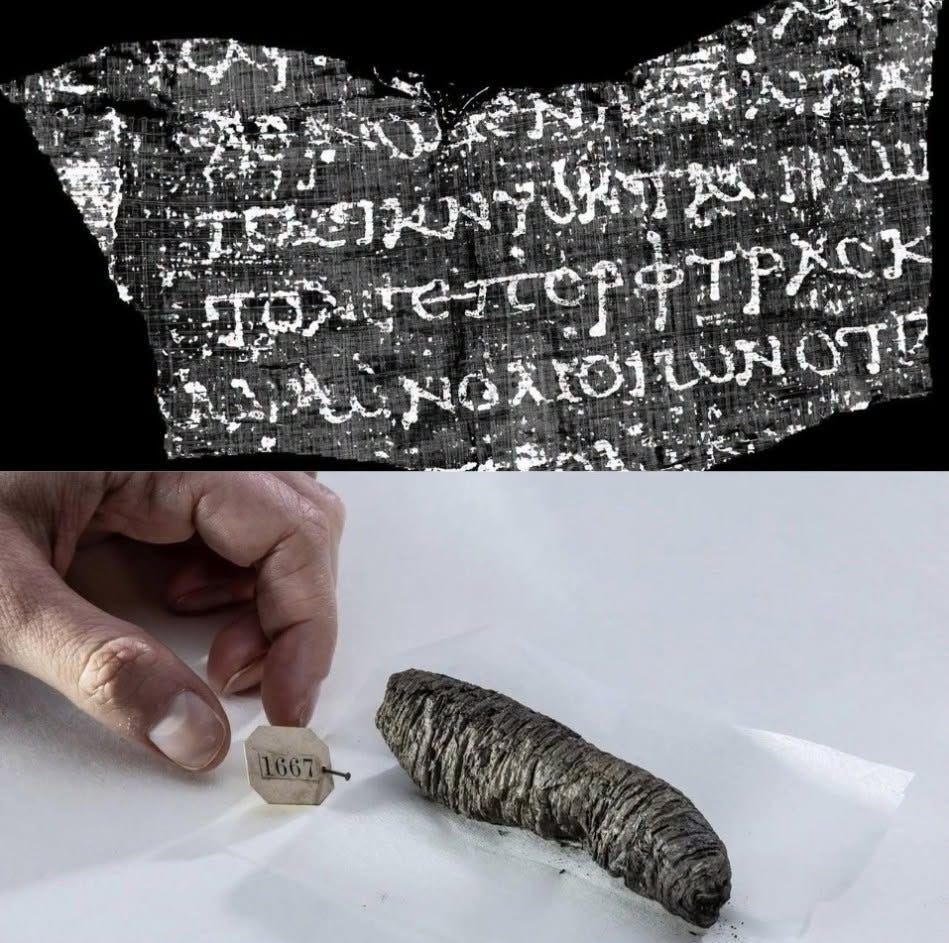
Workers tunneling under Herculaneum in 1752 struck dozens of black lumps. They looked like charred logs, so they tossed a few into the fire to warm the tunnel.
Those ‘logs’ were 2,000-year-old books.
You’d figure Vesuvius torched the place, burned every scroll to ash.
Wrong.
The volcano sealed the only library from the ancient world to survive instant….cooked its scrolls to charcoal, packed them under 60-plus feet of rock, and kept them there for 1,947 years.
Most ancient books are gone for good. We got the Odyssey, but Sophocles wrote more than 120 plays, and seven survive. Sappho filled nine books with poems, and about one complete poem made it out.
So a whole room of books from one Roman house? Jackpot.
Camillo Paderni, the man in charge of the finds, wrote to a London doctor a month later. His letter was read aloud to the Royal Society in February 1753: the rolls had “turn’d to a sort of charcoal, so brittle, that, being touched, it falls readily into ashes.”
They’ve been mostly unreadable ever since. Until now.
A crew of coders and Greek scholars is reading them without opening a single one.
The first word they pulled out was a color... and the first full book they read picked a fight that’s older than Christ.
This week’s free article. Support Past Passport for just $5 a month. First week free.
The volcano saved the books. People nearly wrecked them.
Vesuvius never poured lava into Herculaneum. The mountain sent a surge of superheated gas and ash that tore downhill faster than a horse could run... hot enough to kill on contact, and starved of the oxygen a fire needs.
So the scrolls didn’t burn. They baked.
Rome fell, and Michelangelo painted a ceiling, and those books stayed rolled up in the dark the whole time.
The shelves stood in the Villa of the Papyri, a seaside spread thought to belong to Lucius Calpurnius Piso, Julius Caesar’s father-in-law. His house philosopher was Philodemus, a Greek from Gadara who wrote about pleasure for a living. Nice gig.
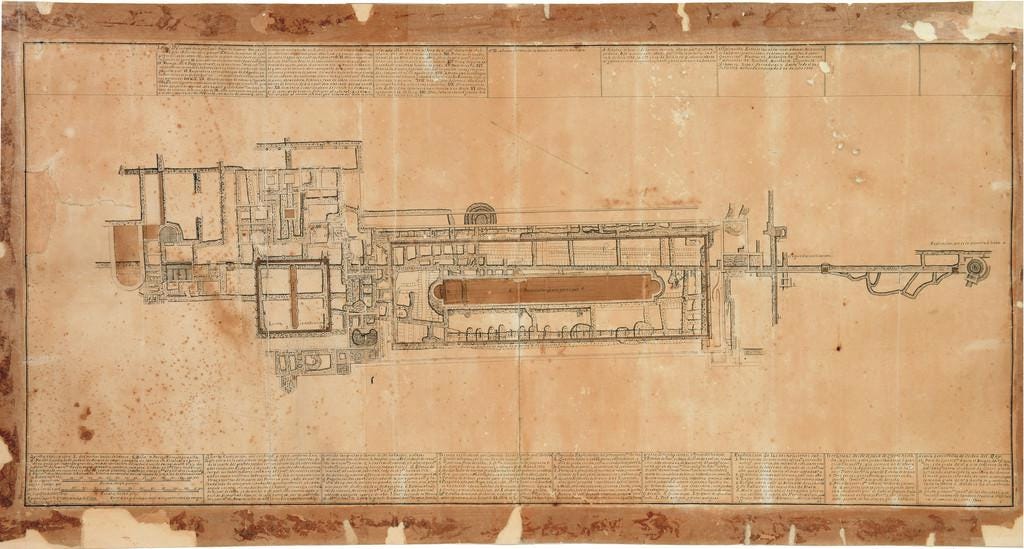
Fast-forward to 1750. Karl Weber, a Swiss engineer working for the Bourbon king of Naples, pushed tunnels through the rock by lamplight and hauled out anything that looked expensive. Bronzes. Marble busts.
And about 1,800 pieces of black cigars that flaked if you breathed on them.
Weber’s tunnel maps were so good the Getty Villa in Malibu was built from them. The scholars who came next were less careful. Paderni sliced scrolls down the middle to copy the text inside, and others soaked them in chemicals. Every reading cost a scroll.
A shame.
One man in a royal workshop outside Naples found a slower way...
A priest spent four years on one scroll
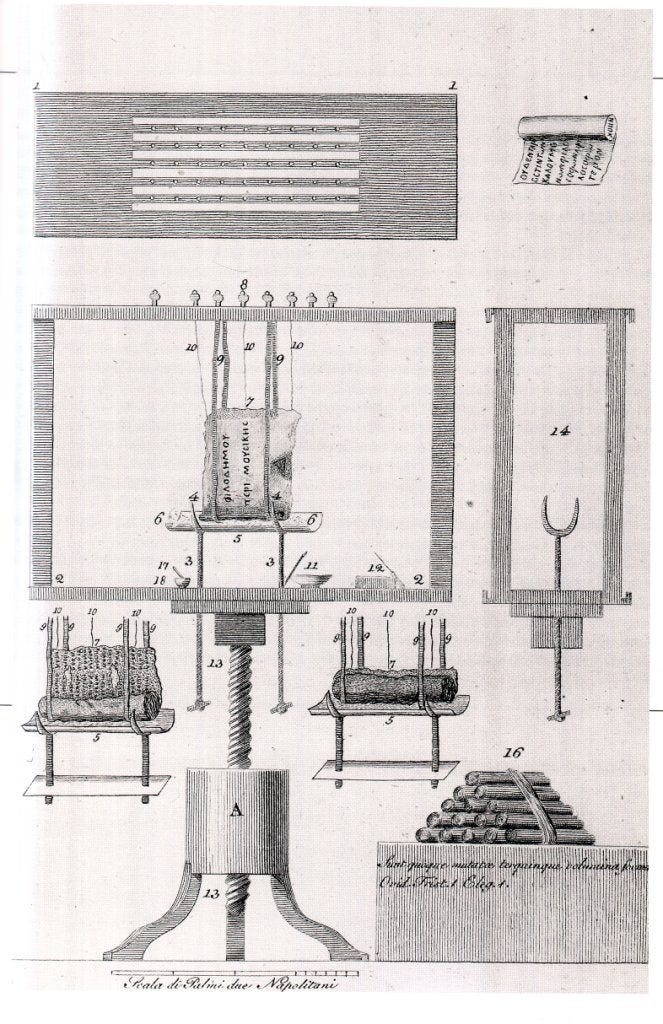
Father Antonio Piaggio was a Genoese priest who looked after manuscripts at the Vatican. Naples sent for him, and he showed up with a novel idea.
He built a wooden frame that looked like a bookbinder’s press. Thin strips of animal membrane got glued to the outside of a scroll, with silk threads running from the strips up to a row of pegs. Piaggio turned those pegs like a man tuning a violin... a hair at a time, lifting one charred layer off the next.
The first scroll took four years.
And the author? Philodemus, writing about music. Scholars were hoping for a lost Aristotle and got the house philosopher instead.
Piaggio kept cranking for some 40 years. In 1794, he sketched Vesuvius erupting from so close that his friends had to haul him out of a shower of cinders.
He died around 1796 with most of the library still rolled shut. By the mid-1900s, only about 585 scrolls had been fully opened.
Four years for one book sounds like a loss. But Piaggio’s machines were still running in the early 1900s, more than a century after he died. Slow work on something that matters outlives fast work on nothing.
Then it took about 270 more years and an online contest...
A college kid found purple
Brent Seales, a computer scientist at the University of Kentucky, spent about 20 years trying to read books nobody could open. The catch is that Herculaneum ink is made of carbon, like the charred papyrus... so on an X-ray scan, the words disappear.
In March 2023, Seales and two Silicon Valley backers posted the scans online and put up prize money. Anyone with a laptop could take a swing.
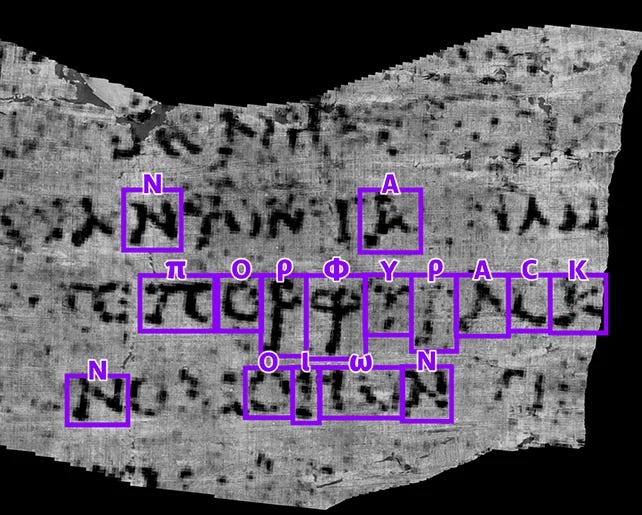
Luke Farritor, a 21-year-old college student from Nebraska, trained a program to spot the faint marks ink leaves behind. That October, his screen showed a full Greek word: πορφυρας.
Purple.
Two thousand years of silence, and the first word out is a paint color.
Four months later, Farritor, Youssef Nader and Julian Schilliger split $700,000 for reading 15 columns of Philodemus on pleasure. In May 2025, two German grad students pulled a title out of a sealed scroll: Philodemus, On Vices.
Then on June 25, 2026, PHerc. 1667 was read end to end, 20 columns on a scroll nearly five feet long that experts had written off in the 1980s.
By September, Berkeley scientists were burning their own fake scrolls to learn which real ones could still talk.
The software finds the ink, but papyrologists like Federica Nicolardi in Naples read the Greek. Seales put it plainly: “Now we need experts who can read, edit, and understand.” Coders and classicists at the same table. Piaggio would’ve loved it.
And that full book had a rival on the same shelf...
Two rival schools, one shelf
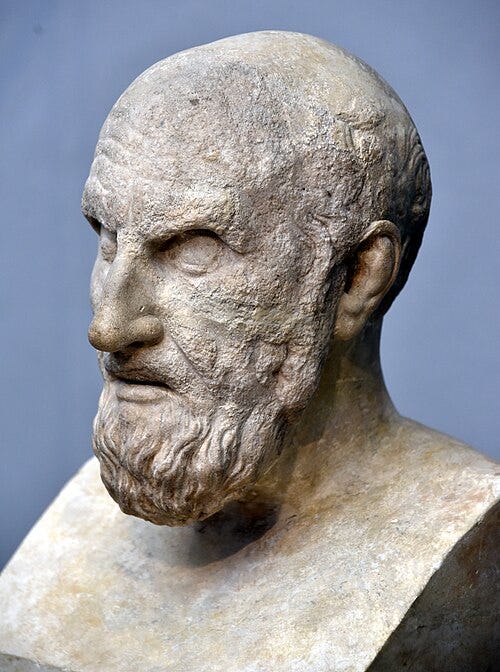
The June announcement brought a second scroll, PHerc. 139. Most of it is still rolled, but the end-title came through: “Philodemus, On Gods, Book 8.” Nobody knew his work on the gods ran that long.
PHerc. 1667 is a different animal. The author is unknown, the thinking is likely Stoic, and the scroll is a century or more older than Philodemus.
The last surviving column mentions Aristocreon, nephew of Chrysippus, the Stoics’ heavyweight. Uncle Chrysippus reportedly cranked out 500 lines a day, and the nephew put up a bronze statue of him on a pillar. Good nephew.
Stoics and Epicureans were the Ohio State and Michigan of ancient philosophy. Stoics said the gods ran the world down to the last detail. Epicureans said the gods couldn’t care less what we do.
Piso kept both teams on his shelves. His house philosopher wrote for one side, and the other side’s playbook stayed in the room.
The library may not be fully dug up yet
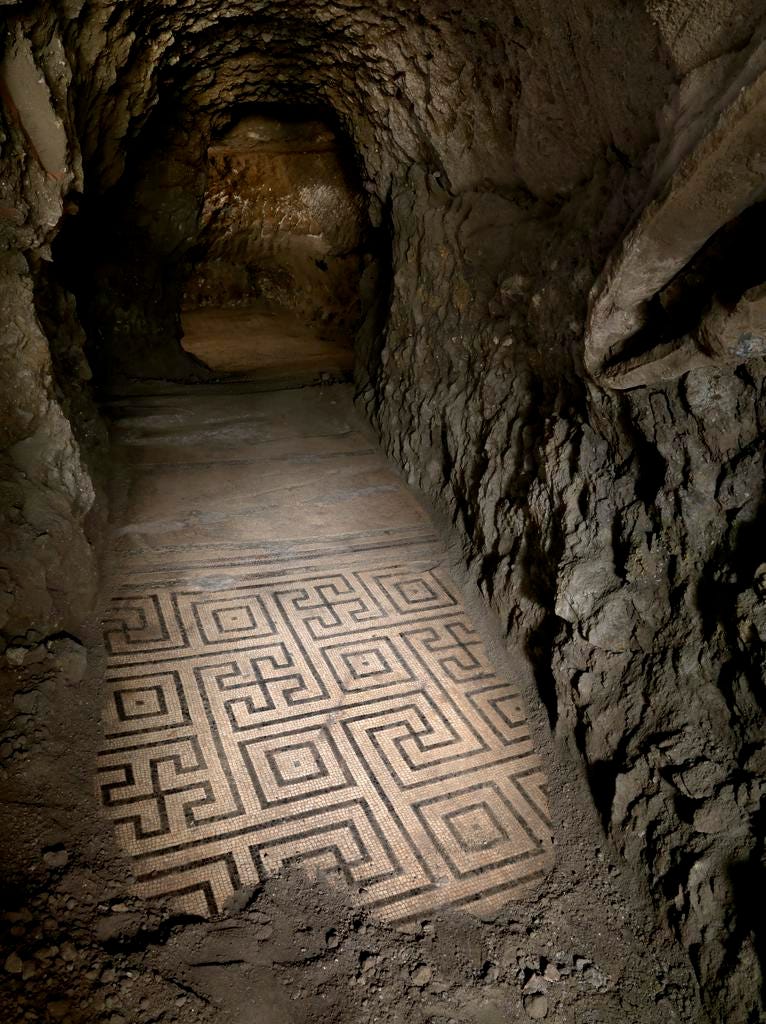
More than 600 unopened scrolls are waiting their turn. Deeper levels of the villa have never been dug, and scholars think more books may still be buried.
Academics asked Italy to consider new digging back in 2016. Still waiting on an answer.
We’ll be watching that hole in the ground.
Lost forever turned out to mean not yet.
Somewhere under Herculaneum, a book nobody alive has read is still rolled shut... and for the first time, somebody knows how to open it.
Under 65 feet of rock, a library waited 1,947 years for somebody to read it. Your phone gives you the opposite: a fresh stream of bad news every 10 minutes that’s gone by lunch.
Past Passport digs up the stories that last: a priest turning silk threads for four years, a college kid finding “purple” in a burnt scroll. Two paid articles per week.