

December 25, 1776
Pennsylvania, on the bank of the Delaware River
“It is fearfully cold and raw and a snow-storm setting in…and beats in the faces of the men. The storm….cuts like a knife.”
Continental Army staff officer diary entry
Washington’s password for the night said it all:
“Victory or Death.”
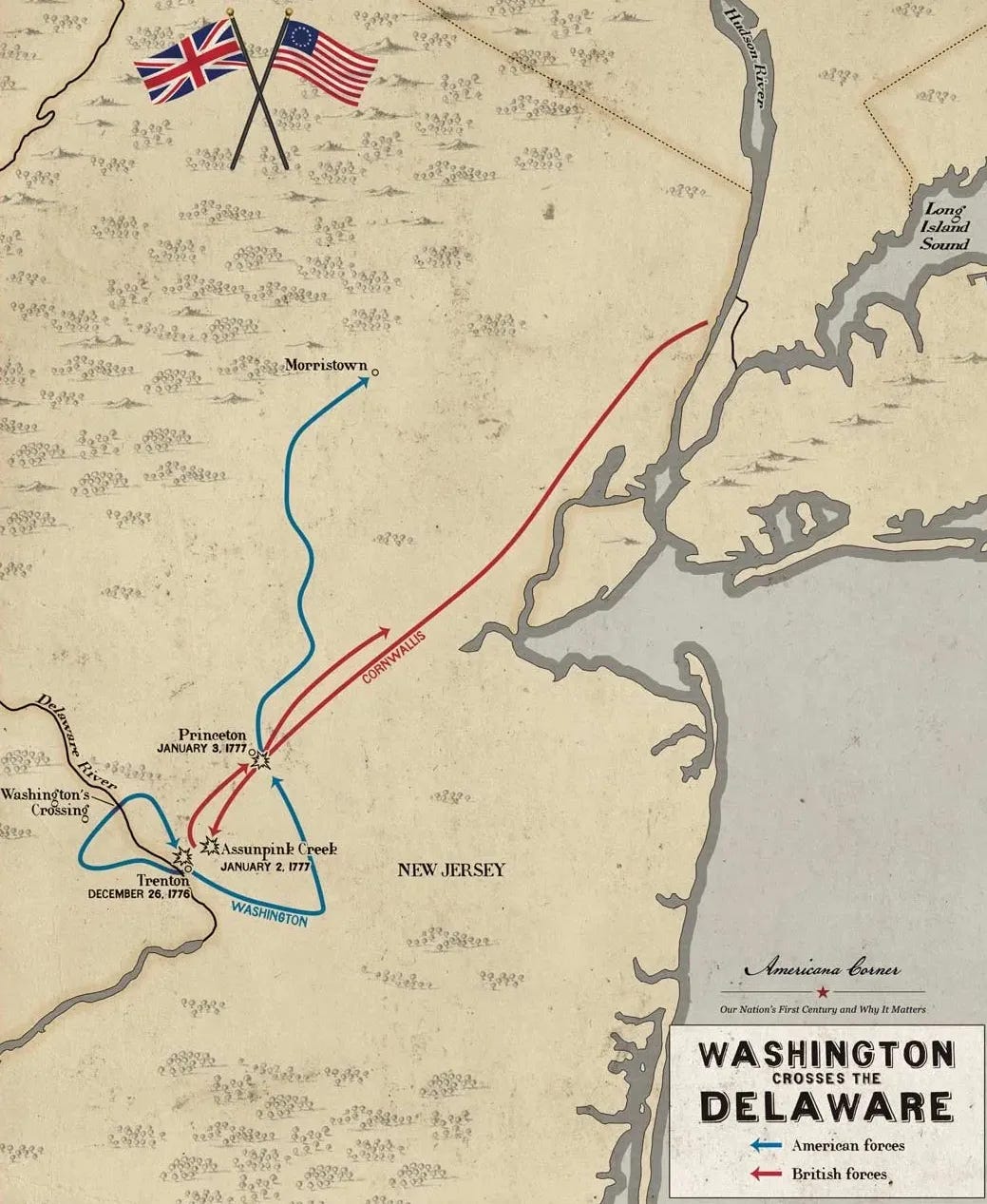
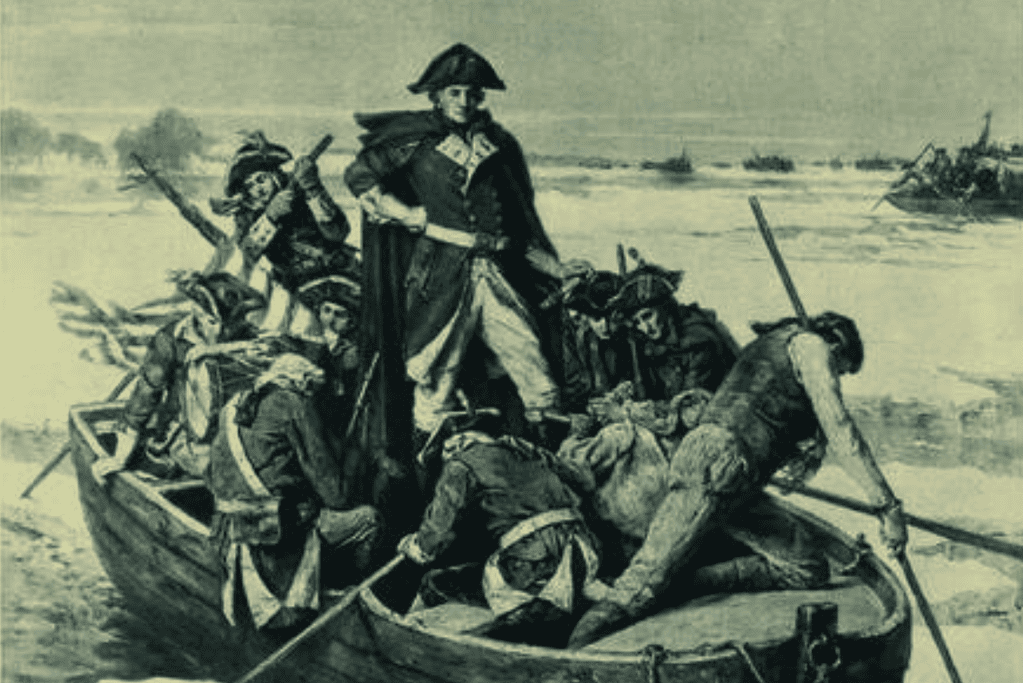
The revolution was gasping for air. Washington’s 3,000 tired men were hours from crossing the Delaware and marching nine miles through the storm to attack the most feared soldiers in the world, before dawn, before anyone knew they were coming.
You know the painting. Almost none of what happened that night looked like it.
Shivering, uniforms frozen stiff, the river filling with ice. Some had no shoes. Officers later wrote of bloodstain tracks in the snow where bare feet had passed.
The crossing took nine hours in the dark, on an ice-choked river. Ice ground against the hulls. Sleet hissed on the water. Woodsmoke drifted across from the bank fires as the boats pushed into the current.
Nobody turned back.
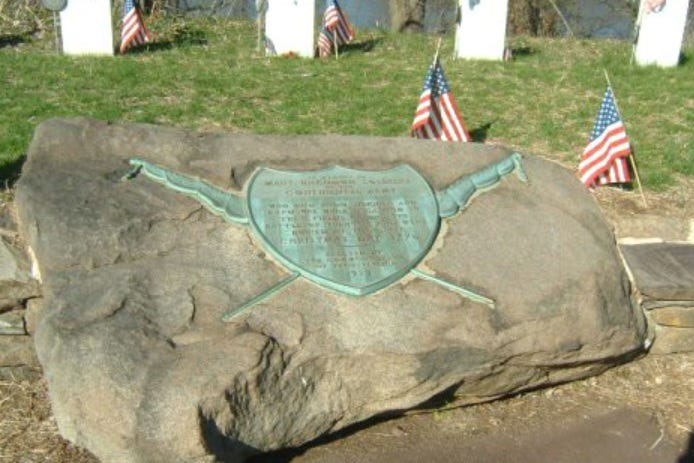
At least two soldiers died from exposure before the army ever reached Trenton. A cemetery near the crossing site still marks where they rest — unknown soldiers who died “from sickness and exposure” on Christmas Day 1776.
America’s first unknown soldier.
The Revolution Hung By a Thread
The Declaration of Independence was signed in July 1776. Britain’s answer was 400 warships dropping anchor in New York harbor, the largest expeditionary force the Crown had ever assembled. One American soldier wrote:
“I thought all London was afloat.”
Five months later, Washington’s army had shrunk from 16,000 men to under 3,000. Soldiers were deserting. Enlistments expired January 1st. Congress had fled Philadelphia.
On December 18th, Washington wrote to his brother:
“I think the game is pretty near up.”
Imagine your commander writing privately that the war you’re in is already lost.
Thomas Paine knew the stakes. The English immigrant had arrived in America two years earlier with almost nothing. His pamphlet Common Sense had helped ignite the Revolution.
Now he was retreating through New Jersey with Washington’s collapsing army, watching it fall apart from the inside. He wrote The American Crisis in the field and published it December 19th: “These are the times that try men’s souls.”
Washington ordered it read to every soldier in the army. Exhausted men standing in the cold, listening to someone read: “The harder the conflict, the more glorious the triumph.”
Six days later, against brutal odds, they were on the boats to attack.
The Most Feared Soldiers in the World Surrendered in 45 Minutes
The Hessians weren’t just any hired soldiers. They were 30,000 professional German troops, battle-tested. So feared that Jefferson named them specifically in the Declaration of Independence as evidence of King George’s tyranny. Disciplined men whose home state of Hesse-Cassel had built its entire economy around renting out its army to the highest bidder.
The attack on Trenton began just after dawn on December 26th.
Washington’s frostbitten farmers hammered them into submission in 45 minutes.
Nearly 900 soldiers captured. Two Americans died, both from exposure during the march, not from combat.
It was the first significant American victory of the Revolution. The Battle of Trenton kept enlistments from collapsing.
The Revolution had a pulse again. It would take five more years and another winter at Valley Forge to finish the job.
And then there was a country.
This is a reader-supported publication.
Three articles a week.
Subscribe for $5 a month.
History changes. People don’t. Neither did the men on that river.
The Painting Everyone Knows Got Almost Everything Wrong
You know Washington Crossing the Delaware.
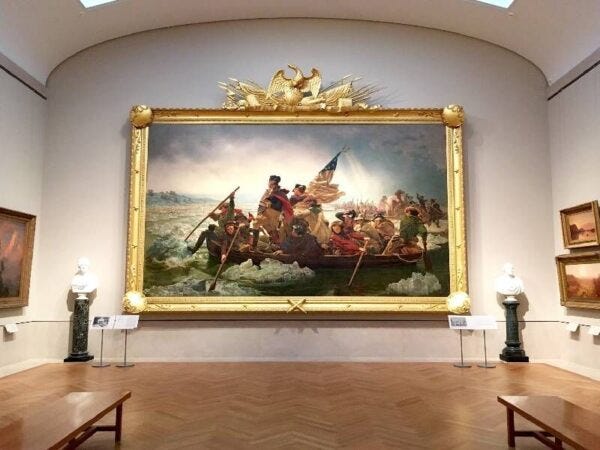
Washington in the bow, dawn breaking gold, flag flying, ice parting around the hull. It’s on coffee mugs. It hangs in the Met.
What you probably don’t know: why a German-American immigrant painted it.
Emanuel Leutze was living in Düsseldorf in 1849, watching European democratic movements get crushed one by one. He painted Washington crossing the Delaware to show German democrats an outgunned force could still beat a superior power.
Washington in a boat was propaganda for a failing German revolution.
Leutze used American tourists as his models. He made the river wider and more dramatic than the real Delaware. The flag was wrong; the Stars and Stripes didn’t exist yet. He set it at dawn, not midnight in a nor’easter, and made it golden because that’s what a losing cause needed to see.
The painting was made for Germany. It became America’s most iconic image of its own Revolution.
One Was Bombed. One Was Defaced. One Sold for $45 Million.
The painting’s own story is almost as strange as the crossing.
Leutze painted three versions.
The first was damaged in a studio fire in 1850, shipped to Germany for safekeeping, and destroyed in an Allied bombing raid over Bremen in 1942. The second reached New York in 1851. Fifty thousand people lined up to see it. It landed at the Met in 1897, where it still hangs. In 2002 a former Met security guard glued a photo of the September 11 attacks to it.
A third copy sold at auction in 2022 for $45 million.
Germany made America’s myth. America kept it and forgot where it came from. The men who actually crossed that river never made it into the painting: the ones who left bloodstains in the snow, who died before the boats were ready.
They made it into that cemetery plaque. And into the republic that’s still here on America 250.
America turns 250 this year. The country nearly didn’t make it past year one.
Subscribe for the real stories behind the myths, the people history left unnamed, and the proof that every generation before us thought the same thing you might be thinking now: that this one might not make it.
It always has.
Great read. The real story is even better than the painting.
Good history lesson. Thanks.